I am getting Married.


Yes it is true I am getting married 🙂 Most people I know asked me why. Who with? And so I felt like telling it in this one message. How it is that it happened.

We all know I almost died. Not so many people know that I felt hatred, and anger, betrayal, abandonment. Some might even know that I had simply given up completely. I did not even want to live anymore. And definitely did not believe I could ever love again.
And so I joined Tinder. For all kinds of reasons. And one day I met Andre. He was at the beach like me. He had quit his Masters, his job and was there taking his time resting. I was there recovering my mind and my body. And we met to drink coconut. He told me he would like to climb Pico do Corcovado. I immediately considered that that meant we should be friends forever but not lovers.
I went home. We woke up and it rained and we did the track under the rain. I wanted to go to that beach no one wanted to do it, he agreed to go like that. And that day I already liked him and decided I could never kiss him because the mountain was way more important than one more kiss. I prefered the climber than one more kiss that I would forget hours later.

And then I got my period that same day and I could not do anything. No climbing, nor difficult tracks. I had period cramps. I told him about it. He did a massage to eliminate my pain. Then in hours we kissed. And then he never left my house.
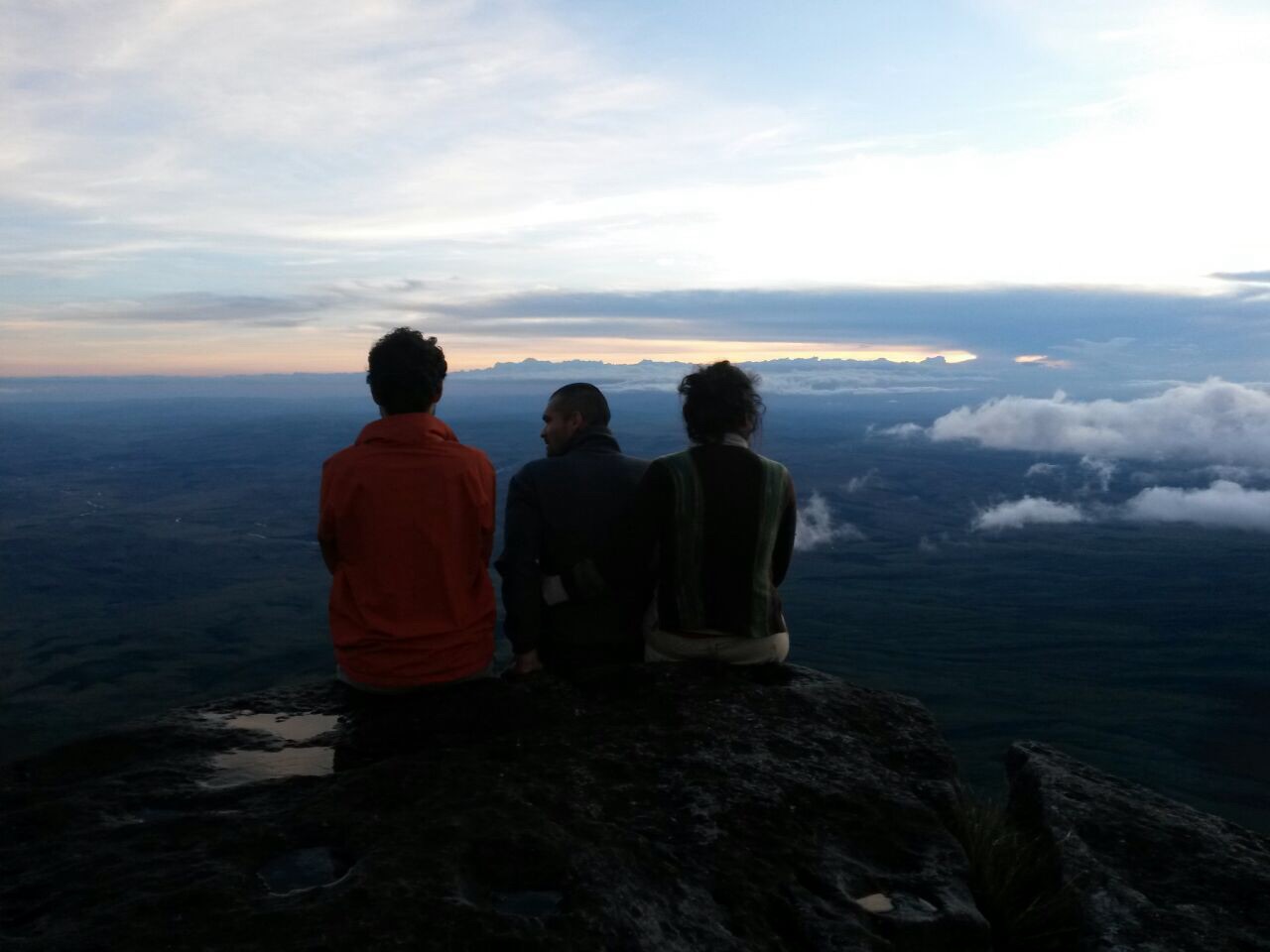
Carnival was about to come and we decided to go to Venezuela to climb Roraima. He met my parents, my grandma, I met his family. We went to the north and then crossed to Venezuela. We spent 7 days in Mount Roraima and then spent more than 40 days in the rest of Venezuela. We crossed the country learning all there was to be learned from all sides.

We came back and we took my grandmother and her 89 year old friend to the beach. We walked every single day with them. We went to the sea. And suddenly I was happy beyond belief.
“Let’s go to India?!””

He was apprehensive. The tickets were expensive. He realised how important it was for me to go back to Asia. He agreed to that. And then he was called for an interview and two days laters we are in Sao Paulo and he is hired.

“Are you sure Andre? Do you want to live in Sao Paulo? We can’t even go to India anymore! You are not even from here.”

“We can go later.”

“Let’s get married than ; ? but it has to be secretely?! ;)”

“Why do you want to hide it? ”

“No, I am apprehensive. I already got married before. Parties of marriages are so complicated. I will ask my grandmother what does she think about a secret marriage.”

“Julieta what a silly idea. We will celebrate it. ! ”
And then my parents were totally into the idea. So were his parents.
So, we are getting married.

It will be on the 91st birthday of my grandmother. It will be on the beach. It will be spring. I will be barefoot. I have a dear friend who will do a Tibetan Brazilian ceremony for me. I met her in front of Dalai Lama. She took me to meet Karmapa, Lama Lobsang, Rinpoche. She is my friend. The Judge will also come.

There will be music played by amazing musicians who I know, and who I have seen playing so many times in Cidao.

The photographs will be done by someone who became my friend this year. I met her in the beach. I also met Andre this year.

I did not invite many people. I simply invited close friends, and people I deeply respect.
My invitation is done by a great friend. It carries a tibetan eternal knot on it.
The gift is the presence of these people who can come to our party. It will be also a donation to Nepal.

I am not getting married because I am pregnant. I am getting married because the past 7 months I have spent 24 hours a day with Andre. Those were wonderful days. There is nothing exceptional about it. Simple joy to be alive, to love and to be loved.

And now we plan to go next year to Iran, to Burma or India for our honeymoon.
With love,

Jules.

A letter from a Brazilian Palestinian to a Brazilian Jew

One of these days, I read the letter that was written by Mohamad Jehad Ali Tayeh, a Brazilian Palestinian. It was written to Michel Gherman who is Jewish and had asked his Palestinian friends to write what they thought about anti-semitism. He said that he had many answers and posted this letter on Facebook. It is in Portuguese, so after I read it, I decided to write to Mohamad to ask whether I could translate it to English, so that I could send it to my Israeli and Palestinian friends. He told me I could. So, here is my attempt to translate what it is there.

“I studied in the middle of the 80’s in a public school in Sao Leopoldo. Though it was a public school, because it was located in the centre of town, the school was attended by traditional families that were mainly from German origin. I believe that at the time there was not such a gap in standards between the quality of public and private schools, as exists today in Brazil. In a certain year, the Federal Government gave us the usual books but also a notebook, with the following slogan: “Education for all”. I remember that one day, when I came back to my desk I found all my notebooks completely scratched in red. On the top of that slogan, someone had written: “Not for Turks!”. I was about twelve or thirteen and I did not have the maturity to raise my hands and voice to protest against it. At the time, I believed I was condemned to be forever simply the son of the Turq, who owned a shop in the centre of the town. That was simply what I would be. This and some other unpleasant experiences happened. Some were not cruel while others were more profound and serious. These experiences became part of my daily life and have shaped who I have become. Most of the time I remained silent, and the price of this silence was high.

My Palestinian father raised me with the belief that on top of being persecuted in our homeland we were not accepted in many other places and even when they seemed to accept us, we were at best, simply tolerated.

There were subliminal messages like hanging a catholic rosary in the doorknob of our house, which my naive Syrian catholic mother believed it to be a gift. There were even rules against us attending the clubs of the countryside of the state. Because of all of these experiences, I have developed a profound repulsion for racism. This degrading feeling that flagellates humanity persists even while it is always fought against it.

As a result of these experiences, I see myself in the obligation, as a Palestinian, to show my repulsion in relationship to how some political sectors have been treating the Israeli/Palestinian conflict. Beyond everything, I want to make it clear that I am a harsh critic of the Israeli colonial expansionism. I have seen closely the ills that this politics had and have created among the Palestinian people. But I have used my profound knowledge as a Palestinian to become more knowledgeable of the real situation in order to be able to have a more humanistic reading of this conflict.

It does not matter who oppresses the Palestinian people. What matters is that we cannot fall in the trap of judging a whole population because of the political decisions of a State. If Israel is an oppressive state against the Palestinian people, Israeli citizens have the obligation to change that, but they cannot be blamed for it.

I say this because I am very concerned about the rise of anti-semitism as I am concerned about the growth of Islamophobia. There are today inside of Israel several organisations that fight for Palestinian human rights. These organisations are without a question, fundamental for the search of a peaceful resolution to this secular conflict.

In Brazil, specifically in the Rio Grande do Sul, there are large Brazilian Jewish and Palestinian communities. These communities have worked honestly and hardly for decades to develop a harmonious and civilised relationship between these two communities. We cannot allow the harming of this relationship because of inflamed, incoherent, irresponsible and many times criminal discourses. We cannot be silenced in the face of injustice. We cannot omit ourselves when we see people being stolen from their basic human rights. We cannot ignore when violence intends to give answers to just demands. We cannot in any way endorse the judging of a whole people. There should be Education, peace, freedom and justice to all.

For that reason I affirm and scream from the top of my lungs that we should fight against all the forms of discrimination. Therefore simplistic perspectives that use anti-semitic and anti-judaism colours should be denounced just like Orientalist and Islamophobic discourses that are used to refer to Arabs and Muslims as common and similar groups.

As a Palestinian, I affirm that the anti semitic is my enemy like it is the enemy of the Jew. Anti Semitism should not be used, in no way, in my name. It demoralises and brings shame to my cause. It cannot happen under my name.

Divali, and the secret pains one carries within.

  
Drawing by Thomaz Bondioli

She can’t really tell what comes first, the air pushing her suddenly aside or the explosion that makes her heart skip a beat. She is almost certain that everything suspends and stops in a vacuum inside and outside for a millisecond. She looks at the petrified tourists around her. They are Israelis, and for them everything stops in a different place. Everything stops because they feel a millisecond of terror, until their mind reminds their bodies that those are bombs of joy. It is Diwali, the Festival of Light in India. Tourists do not understand that these firecrackers not only fight evil, but that they also celebrate the return of Krishna. And both the tourists and her do not understand that behind Diwali there is an awareness of one’s inner light. She might have once known it, but now she doesn’t anymore. How could she, if inside of her she feels less lit.

She wants the bombs to keep exploding to get again and again a millisecond of suspension of pain. Not even looking at the children laughing while throwing firecrackers at the legs of Western tourists does it anymore. Western tourists never understand that they are children, who do not understand it is dangerous. She used to feel amused looking at the tourists jump and look for an adult to complain to in total anger. “They are crazy! Don’t they know it is really dangerous?” Adults always agreed, and explained that children were amused by the scared faces tourists made. They did not understand. The truth is that also adults were amused, so they never truly reprimanded the children. They did of course not tell the tourists that. But they felt resentment towards their shallow hellos and goodbyes. They felt resentment to the bargaining foreigners who could not tell the difference between the good and bad silver. And yet they still bargained the same way. They felt contempt for these people who came and sat the whole day smoking jars, eating, laughing and making lots of noise till much later than acceptable. What she hated the most was when these young rich kids bargained by saying they had no money because they were students! When she knew that being a student was the dream of so many around her. No that is not what she hated most. What she hated most was that her own brother, a Brahmin, a pure person, now defended them. He even learned their language. He now lied to their parents and smoked, and drank and had accepted the invitation of an Israeli to participate in a barbecue. A barbecue! She thought many times before about telling her father. She should have done when it first happened. When her brother first had the idea to transform the guesthouse into one that catered for Israelis.

“Why Israelis?” Her father had asked. And her brother explained that they came in groups, and they told each other about it. It would not take more than satisfying one of them and all of their friends, and friends of their friends, and friends of their friends’ friends would come. “It is good business papa”. Her father was suspicious at first. Mixing so closely with foreigners could not possibly be good. But his son had mentioned something that put ideologies and fears aside: money.

And so it was that her father allowed him to take care of it all alone. It went little by little. He had to first learn to do the food that they eat in their country. And then they had to just find a way to allow them to make as much noise as they wished, and to smoke anything they wanted. It seemed so far away now. How was it that her old house had become what it was now. She should have said something then, but she was also curious about these girls who sat with boys smoking and laughing. They touched each other in public. She could only see them sometimes when she came to deliver something. She should have told her father then, but she did not know it would go so fast and now it was too late. She could not even recognize her brother anymore. He was now so distant. He never spoke to her that much but he was still part of the family. Not now, now he sat with them and laughed their crazy laughter. She knew it was not real laughter. It was laughter to distract. Laughter that worked for him as the bombs now worked for her.

She suddenly realized it had happened again. She had repeated the whole circle in her mind of how it was that her life was destroyed and this time she did not even hear any firecrackers. She wanted to cry, to scream, to run away. To swirl time backwards and run into her father’s office and scream, “Do not let Pratheek do this Papa! Lets just cater for Indians!”

And every time she swirled time backwards she could see one more detail of how it was that now she stood where she stood.

One more possible exit that she did not take because she was always afraid. On the first exit out her brother would have been disappointed, on the next possible gate out he would have been upset and now she regretted not having taken the first exit out. Then the next one would make him angry, and then the next furious. And then it did not matter anymore because her brother was trapped, he was gone. Now any exit she took would just cause pain to her father. If he ever were to find out his own older son now ate meat! MEAT? He would feel the same pain she did now. He had no health for this. So she helped her brother out taking the road to his own entrapment.

The wind dislocated her violently. It exploded so close to her that she was pushed aside. Was it the explosion or her own weakness that made her fall to the ground? She did not know. A friendly blond girl dressed in colourful dirty clothes, with dreads in her hair shouted at the children.

“Are you crazy, you almost hit her!”

The girl looked at her preoccupied. Enquiring whether she was ok.

She hated the girl she had never seen.

“Let them explode their firecrackers. Let them hit my leg. I am like them. I understand them, you don’t. Maybe then I can forget that look. That one look”.

She said nothing. She looked down. She would not thank her, she would not smile. She hated her, and all that she represented. She did not need her help. She did not need to be saved from the firecrackers the children threw around by a foreigner! She wanted to tell her that. She wanted to shout at her all the trapped anger she had inside. But she did not. Her greatest subversive act was to look down and remain silent.

Maybe it would have been better if she had not known. Maybe if she had not gone that day to deliver an unimportant message she would not have understood so well why he was so distant. Maybe if she did not know she could have had imagined that that was how it was supposed to be. But she had seen it, and the knowledge of it did not allow her to be able to change anything.

She wanted to scream at him. She wanted to run away from her own self. To vomit herself out and let the body lay there on the floor. Even if she could not understand what would be left. Was the pain in her body or in her soul? How could it be that it was both, and even vomiting herself out would not solve it. That is what it was, she was trapped, and she trapped him too.

She remembered how lucky she felt on the day when her parents announced that her arranged marriage was to Mohan the boy she had secretly loved her whole life. She imagined from that day onwards every single ceremony of the wedding. She imagined how she would walk around the fire, every circle making a promise that was more and more profound. She daydreamed about the saris, and the Henna and the exchange of gifts and where she would put her hand in the wall. How it would be marked that his family home was now hers. She knew she was probably the luckiest girl in the whole of India. For the whole time she was away helping her grandmother in the farm she thanked the gods every single day.

She was so happy that she had even forgotten how distant her brother had become. So happy that she thought it was a good idea for Mohan to work in the guesthouse too. Retrospectively she realized that it had in fact not been that clear to her all that she saw now. Those gates out there were not clear then. In fact they were not even visible. She might have been even happy that her brother was becoming more open, and so learned. How could she have been so stupid? How could it be that things become only so clear when you look back at them? Maybe it was a punishment for being so distracted with her own luck.

It did not matter she was too tired now to even scream. Too tired to tell the blond girl anything. She felt no strength to even stand up. She secretly wished those were real bombs. She just wanted her mind to stop. But it did not, her mind did not abandon her, and within herself she had to once again, in spite of her own desire, walk back the streets to deliver that unnecessary message in the guesthouse.

She walked again through the streets inside of her. She remembers the joy that now seemed so stupid. She remembers the thankfulness to the wind for cooling off her skin a bit on that beautiful day. She is walking as paused and peacefully as she could possibly walk, when her own body wants to run there. Her posture is flawless. Her hair has just been oiled, her sari is perfectly in place. She climbs the stairs gently, and walks towards the restaurant of the guesthouse. She can hear Mohan’s voice. Her heart beats stronger. She gently slides into the room.

She feels beautiful as she has never felt before. She cannot see anything else but him. Nothing else exists. He does not see her. How long does it take? She looks at him, and feeling invisible things start to materialize around her. Little by little she starts to hear other voices, and see other bodies. She can see now he is sitting with them. He is laughing with them. Why can’t he see her? He looks so happy.  She admires his joy. She observes when he suddenly becomes quiet. Why is he not seeing her yet? He is looking in her direction but yet he does not see her. His look changes, it communicates something in silence to someone. It is a secret look, she has never seen it before. It is a knowing look. It is an intimate look. It is in her direction yet it is not for her. His gaze flies through her and behind. She suddenly becomes petrified. Her whole body knows it but she still does not believe it. She gently and fearfully follows his gaze. What is he seeing? She follows it meticulously inch by inch, and as in an already announced tragedy she slightly turns her head to suddenly find a foreign woman. The foreign woman does <b>not</b> look down, as she comes from another world living by different rules the foreigner looks inside of him. She knows in every cell of her body that <b>that woman</b> had taken him away from her. He will still walk around the fire with her, but he will never really be there.

Still in Venezuela

image

After being in Venezuela for more than a month I guess we can say a lot of different things.

We have seen a country that is divided. People who absolutely despise Chavez’s Plan and those who will always defend him and whoever follows his project.

Santa Elena is by the Brazilian border, so the common things with borders happen. Smuggling ( here specially fuel), tourism and all kinds illegal or bordering illegal activities. Because it is so close to Brazil everything is more expensive than in the rest of the places we have been to.

When I first came to Puerto Ordaz I did not particularly like it. It is true I barely spent anytime there. Then I crossed the country for about 16 hours to be able to reach Choroni, and more specifically Puerto Colombia.

Puerto Colombia is by the sea. We have spent about three weeks there. And as expected from a small place by the sea, life was calm and most of the people liked their lives and the government.

From there we saw the U.S declaring that Venezuela was a threat to them, Maduro starting to rule by decree and even children being asked in school to write to Obama saying “Yankees go home!”. We saw people despise the act and also some who defended Maduro’s request.

We heard about all missions implemented by Chavez ranging from a literacy project first to teach the elderly and then the children. The project of pocket constitutions. Private computers to all children attending school and free internet in all schools. Projects to rent money for micro-projects. Legislation to protect small fishermen and many other things. We verified there were many channels, and internet did not look censored. We felt people spoke freely in the streets since many people screamed out loud about their hatred towards the government, the lack of food, the destruction of the economy, the longs cues to buy food etc.

We were impressed to learn that while the minimum wage was 5,500 bolivares ( about 21 dollars) monthly, there were hotels charging 4,500 a night in an average weekend and charging more than 10 thousand a day for the “semana santa” (easter holidays). We were amazed to see they were filled up by Venezuelans who came for weekends and had made reservations for that week.

In Brazil easter is celebrated from next friday to sunday. But here it started yesterday and will last till the following Sunday. Considering Choroni is small, would be full, and there would probably have lots of traffic jams we decided to leave on Thursday.

It was rather miraculous that we were able to reach Maracay and get a bus to Puerto Ordaz that same day. After 16 hours travelling we were hoping to take a bus on friday to reach Santa Elena today. However, we were told all buses were sold out for that night and that we should come the next day at 5 in the morning to check for buses for that day, considering no one can buy tickets in advance now in Venezuela .

Being unable to find a ticket, we reserved a cab for the following day. The driver’s car broke down and so we went to the station at 10, only to find out that the buses were not running today. Being advised to check again every single day. It is holidays they explained “they might not be running”.

Staying longer made us learn many things. We visited the 200 hectares beautiful park la llovizna where there are huge waterfalls. In fact, we were told, that the river Caroni, one of the rivers in Puerto Ordaz, provides electricity to the majority of the country and even to some parts of Brazil and Colombia.

There is nothing like staying in a big city to realise how much this country has lost. While in little towns people might not see it so clearly here it is screaming at your face. There are some sentences we hear here which are priceless. Our cab driver told us yesterday.

“It is all falling into pieces. We are floating. Do you think I am really a taxi driver? I put a sticker in my car and I drive. That man there is selling what he does not need. There are no jobs. The new laws make it impossible for anyone to hire anyone, one could never fire them even if they did not come to work. So we do anything to float.”

Yet there are malls where the prices are completely un-payble for the average Venezuelan. There are McDonalds, Tommy, Adidas, Burger King, Tinberland, Guess, Victoria Secret etc.

There are hotels that can cost up to 15 thousand bolivares and Venezuelans that stay there.

Ad of course there are “colas” (lines) to buy food. Since the government stipulates prices for some specific items. Those are immediately bought and sold in the black market. So when they are in the supermarket people run there to buy them.

Doctors are free to all, but medicine is not there.

Those who are pro Chavez accuse the market and the US for creating this situation. They consider all that is happening to be part of an economic warfare.

Those who hate Chavez’s project blame the destruction of the industry, the total dependency of oil and the fact that this government has replaced most of the skilled people. While before in the state ran company there were experts on oil now the government has substituted those workers with people who are more aligned with the party but who are not necessarily knowledgeable about the industry.

“We have more oil than saudi Arabia. It is heavy oil and perhaps more expensive to extract, but still these are the greatest reserves in the world. Yet this incompetent and corrupt government has fired those who know how to get it.”

These debates will always be answered by Chavistas saying that “lowering oil that much is part of the economic war.”

People are divided. Venezuela imports 70 %of its food from abroad. They are rich in minerals and oil and the reason why the economy is collapsed is always debated by the different sides. I guess they might all agree in one thing: the situation is dire. The reason for that however varies according to who you ask. It has nothing to do with lack of information but rather with people’s different political views.

I am always amazed when I see these who float to survive. I am amazed because whatever side they belong to every single person I have met here was helpful.

Though they might know very clearly that we are privileged to be able to be travelling for so long, they help the best way they can.

Despejado- Going up Monte Roraima


image

.
The first day we walked about ten km. We woke up early but took a long time to leave since Josué decided to make us pancakes. By that time we convinced him to get someone to carry some of the food. Who could possibly carry all those glass bottles of marmalade, plus tents, food etc 🙂

And so we started to walk. We were amazed because around us all was burnt. There were no plantations, nor cattle just burnt ground and fires burning what was left. I asked Josué why was everything burnt.

“It is our tradition.”

“Why, Josué.?”

“To plant Yuka (some kind of manioc)”

“I don, t think you have to cut trees to plant”

“It our indigenous tradition.”

“But Josue, one day there will be nothing left. The ground is becoming petrified and there will be no more rain. What will you do then?”

“Move to another site.”

We all realised there was no way of going further on that topic.

It took us days to understand Josue. He was a boy that was trapped in traditions of the past, lived and wished for a life of the modern world. Above all he also had huge mood swings. He would go from singing Hakuna Matata to total silence.

Maria and I were real therapists trying to always bring him back to a good mood. It usually did not take more than saying Hakuna Matata.

I miss Josue. He tried as much as he could to help us. I guess he was lonely. Trapped in a divided existence. So any concern we showed for his private life would change it all. Like most of us he had huge dreams, no total vision of the whole picture and a form of loneliness.

The second day we walked about 10 km. The ground was always changing. We crossed rivers and went up and down hills.

It was only on the third day that we reached the real Monte Roraima. As we were arriving we passed trees, rivers, and then suddenly we were right in front of that huge Monte. I looked the wall of rocks in front of us and just wondered how could we possibly go up without climbing gear.

Josué who had walked way faster with all this load on his back waited for us.

“You must touch the rock and ask for permission to climb Monte Roraima.”

And so we did. I laid my hands and head on the rock and asked permission and protection for the very few o us who were going up that mountain that day.

Till I reached the third day I thought most people who are healthy and like walking could do it. On the third day however it became clear I knew very few people who would want or would be able to do it.

We started our way up. There was fog, rain, and the water from “la lagrima” (the teardrop fall) falling above us.

The ground changed. We could see granite, crystals and so many other kinds of rocks I don’t know the names of. There were red and blue berries. The blue, Josue warned us should never be eaten.

Our Argentinian friends might have climbed it in less than 3 hours. We took about four. And then we were there. We could barely see anything. The fog was covering it all.

We found our “hotel”. A cave where we sat camp. And then we heard the word, that has been most used the whole time there.

“Despejado”

Which meant we should wait for the brief moments when the clouds had gone and the sky would be clear.

Maybe that is what we always wait in life… Clarity to see how things really are.

Monte Roraima, Venezuela e Josué- The first day

.image

We are back from Monte Roraima. It took us 7 days and I could not even say we had the privilege to rest on the seventh day 🙂

Where should I start? Obviously by the fact that it was totally worth it, beautiful and surprisingly different than what we anticipated.

We had thousands of recommendations before arriving here in Venezuela. I had however always wanted to talk to Meru. Meru was the guide of my Argentinean friends Gonzalo e Carolina. It was hard to reach Meru. As we waited a couple of days we saw dozens of people coming back from Monte Roraima that looked and said were falling apart. They had loved it but they were exhausted. These dozens of people coming down Roraima had gone up during Carnival.

We were also approached by many agents with packages way more expensive than what Gonzalo and Carolina had paid. You have to bear in mind that the economy is collapsing so the inflations is high. So I imagined that was also why prices were so high. So I wanted to talk to Meru. When we finally did she was in Caracas and sent to us her brother, Josue.

Josue is a character on his own and that is why I will write this post in pieces.

We did not have an agent. We spoke to Josue who is part of one of the indigenous tribes of this area. We did not have sleeping bags nor a tent. It would all be provided by him. So since it was soooo much cheaper we decided to go the two of us with him. He would be our guide, and he would be in charge of it all. Food, tent, sleeping bag, and guiding us. We agreed since we knew little about it bur still wanted to go shopping for food with him.

That was a wise thing to do since we eliminated loads of non necessary and heavy things from our food.

And then came the day for our departure. He told us he would be here in our hotel at 7. Well, I guess this did not happen. Considering he insisted we should pay him the full amount before, by 10 we were worried.

Josue however sent whatsapp messages many times and eventually arrived here by two pm.

We were actually happy about it because all this waiting was not wasted. We had a lecture about Venezuelan history and politics. It was taught to us by someone I cannot mention the name but was an economist from Caracas.

One of the best, and most unforgetable sentences he said and I wrote it down was:

“Cuba is a dictatorship. Venezuela is an authoritarian fascist military regime. And the worse part is that is has a social discourse.”

Maybe the most amazing thing of it all is that this very knowledgeable man who knew all about Brazilian politics, the history of Venezuela and Colombia and had never failed in giving dates for revolutions explained that in the beggining he had liked Chavez. As for Maduro he asserted he guesses not even his family might like him.

We were so entertained that the time flew and as Josue arrived we barely noticed what he said. Our driver was from Colombia and hated Chavez. He knew profoundly the ilegal practices around here. Going from mining, tourism and petrol smuggling.

An so we arrived to Josue’s community in Sao Francisco. It was a small village filled by indigenous modern houses.

And then we understood he had managed to reach two other people to come with us.

They were also Argentinians and I was amazed because I decided to ask by chance if they knew Gonzalo and Carolina. They did. They immediately became our friends.

Maria and Mauricio had been travelling in a motorhome for the past 2 years. They worked doing art-crafts and were surviving like that. They explained to us that it was way cheaper and more pleasant than living in Buenos Aires.

Immediately we all realised Josue could not possibly carry all this food plus tent alone. He believed he could. I said I would not carry anything but my bag. Josue always agreed to it all, what would happen after was always a mystery.

Maria and Mauricio were real mountaineers. And were also very skeptic about it all.

And we drove to our first camp site and to out enormous surprise though he added two people he still refused to getting a “porteador”. During the night, the four of us convinced him it was impossible. He needed to get someone else to carry food!

As we sat to sleep in our common space we realised that he might not exactly be that prepared at all.

He told us his dream was to become a singer and travel the world with his songs. That day he did not sing to us but told us that his artistic name was Eddy Frank, which is available on Facebook.

We still had no idea how it would be. All we knew was that we were in a great group. People were peaceful. Friendly and the mountain was empty. Carnival was over.

The first song we heard Josue sing was Hakuna Matata, una forma de ser. Our indigenous guide might have not known much about guiding but he loved the Lion King, Shrek and The simpsons.

We came back alive, happy, well, and laughing a lot.

So if you are as prepared as Maria and Mauricio you can go up alone. If you are like me, better to have Andre, Maria and Mauricio together with you. Otherwise take an agency.

From Manaus to Venezuela

And so we made it. We are in Venezuela!

First we stopped in Manaus and we visited the botanic gardens. It is amazing. There is a tower with more than 40 meters. From it you can see loads of enormous trees around.

The clouds were there and a storm broke out. I was amazed being reminded that the Yanomami say “how is that the white men do not know that if they cut trees there is no rain left.”

So in the middle of the amazon a storm broke out. We could see so well that places where there was no rain there were no trees, and also how much rain was condensed in places where trees had not been cut. I was moved and amazed to be entirely wet by the storm in the middle of the jungle.

But it was time to bid farewell to the lovely family of Dona Lu. We met them in Manaus and they took care of us. I am always amazed by the goodness and warmth of people.

We then took a 12 hours bus ride through the rain forest of the Amazon in order to reach Boa Vista. There we were met by Janio our host in the state of Roraima. He picked us up in the bus stop and took us home.

Today we woke up early and his lovely family prepared us breakfast. They are exceptional people. They are adventists. Janio’s has done amazing things in his life, one of these things is that he rode from Boa Vista all the way to Chile with 50 reais… Which is about 17 dollars! His trip took 11 months. He told us he stayed mainly with people from his church, though he was also helped by non religious.

His father who is a carpenter is 72 and started to run when he was 70. His mother hosted us so carefully. Showed us pictures from the adventist camp where she and her husband had spent this carnival. But once again it was time to bid farewell.

So we took a cab to the border of Brazil and Venezuela. The landscape changed enormously. It became dried flat and eventually enrolled by hills. Eventually we reached the last town in Brazil which is called Pacaraima. There we exchanged all the money we had with us in the black market since once we would have crossed the border the exchange rate would be much less favourable.

With the collapse of the Venezuelan economy and the devaluation of money we were given begs of money. We were told to bring even toilet paper since the country is said by the mass media to be close to a civil
War. Petrol is worth little, and all is missing.

We spent hours to pass the Brazilian border. There was one person working to check people in and out. People who were crossing by car and walking. As usual in a border you see it all. Maybe the most appalling thing was the young lady who wanted to cut the line because she just had had a surgery. Since all of us had patiently waited for a long time we decided to ask her what she needed and what had had happened to her.

She was Brazilian. She looked at us looking for sympathy and very proudly said she had had a complete plastic surgery in her whole body in Venezuela. No. She did not have an accident. It was simply a cosmetic surgery. She wanted for her and her friend/daughter to have the same treatment as the elderly and pregnant women. Namely they wanted to go first. It was somehow hilarious. Especially because everybody was appalled by it. Maybe the most funny is that while she stood there pretending to need help and then she decided to ask us what we were doing in Venezuela.

“We want to climb Monte Roraima.”

She took some time to process the information and then said.

“Why?”

I wished I had said: “for the same reason that you decided to change your whole body. It is because we think it is beautiful.” But I didn’t say that. It was all so out of place that we all did not say anything.

Passing into Venezuela was very easy. We did not see cabs on the other side. Therefore we decided to ask for a ride. Immediately a truck stopped and gave us a lift. This very friendly man brought us to the main square of Santa Elena. There we talked to students and decided to walk to a hotel we had heard of before. It was so far and we walked a lot to find that hotel. It was ok, thought more expensive than we anticipated.

Later we finally met our Venezuelan friends. We met them in the centre. And we found a hostel for half of the price of what we were paying there. We will move there tomorrow.

We met more people and concluded that most people we saw were very nice. We were never asked money for rides. We saw a couple of tanks in the street but the police also did not approach us.

Now we are planning to see La gran Savanna before we climb monte Roraima. If we do not write often it is simply because there is no wifi everywhere.

With love,

Julieta

IMG_1430

On The Road- Evading Carnival on the way to Monte Roraima

I am in Sao Paulo with Andre and we are driving to get some gear to get ready for our next trip. It is pretty empty now since lots of people have left yesterday and today to go celebrate carnival somewhere else.

There is carnival here too. I don,t particularly care for carnival. And every single attempt I have had to spend it in Rio made me feel like running away from there in a couple of days. I love Rio, but not during Carnival.

There are loads of people who like Carnival here in Brazil. To me it always feels that the discrimination and difference between social classes which is always part of Brazilian life becomes more latent. Therefore now I try to evade it!

Where should I go I ask Andre considering he cares as little as I do for carnival.

So we come to Sao paulo since we have a plan, we are flying from here. We want to go back to Manaus, which is in the Amazonas state, and from there we want to go from Manaus to Boa Vista. From there we will take the “in”famous BR-174 road. From Boa Vista we should cross to Venezuela in order to climb Monte Roraima.

Monte Roraima also known as Tepuy Roraima and Cerro Roraima is the highest of the Pakaraima chain of tepui plateau in South America.

Most of the people who have been there say it is beautiful beyond belief. It is also tiring to get there and it gets cold during the night, and it is enormously hot during the day. It rains and never anything gets dry there. Does that look like an invitation to come?

On top of that the Brazilian TV shows daily how dangerous is life in Venezuela. I usually dismiss the news from TV. Had I not, I would have never made amazing friends in Palestine, been alone to Kashmir and would have not seen and done so many things in the world. So I usually prefer to talk to those who have been there, or even better to those who are there now.

I ask Gonzalo, who is Argentinian and had come from his country through the south of Brazil in a trailer. He came all the way from the south to the north. He drove to belem, took a fairy and went to Venezuela with his trailer. I asked him whether it was dangerous there now.

“Well, no. I think there is not that much difference between Venezuela and Brazil. You should always use caution. But it is beautiful, and the people are very friendly. I have been here for the past 3 months . You should definitely come.”

After getting information from people all over the place, we decided to go to decathlon, which is a sports/adventure shop in order to get some last items.

As we were driving with open windows, which many people are afraid of doing here in sao paulo because of robberies, we stopped in a red light. Suddenly a man came running towards Andre’s window.

He looks at Andre and says:

” Brother, I am not going to lie. I am an alcoholic. I am missing 25 cents to be able to buy my cachaca (a hard liquor made of sugar cane). Can you please give me? I don’t need more than that. Just my cachaca.””

I am amazed by his honesty. I rush to get the money before the light changes and we have to go. He thanks us enormously.

As he goes we start laughing. So much honesty. I find it is truly admirable. I have seen so many times, new evangelics and “super” religious who drink too much, use drugs, cheat and bit their wives. And still preach how to lead a good life talk so much about honesty and lie, that this guy amazes me.

I remember one more time that my grandmother had once gave money to a woman who lives in the street. She said it was to eat. I was fifteen at the time and told my grandmother “this lady is going to drink”. And so my grandmother said “She said that to make me happy. Once you give something to someone you should learn to really let it go. It is no longer yours. Who am I to decide what is better for that lady. It is a cold day, maybe alcohol might be what she needs.”

I am still amazed by that awareness. Having the position to give is already lots of power you do not need to decide anything for the other too.

I have several times attempted to make people be more conscious. And many times there has been people telling me I should be more conscious. I also have several times heard from wise men and women that we should allow for the others to make their own decisions.

As I told all of this to Andre I realised that that was probably the most honest encounter I had ever had in a carnival period. I remembered being in Rio’s street carnivals singing about the freedom of oppression while poor children were collecting cans to sell. The poor serving once again the privileged singing the equality of all. The blatant discrimination of white rich Brazilians towards the poor.

My sequence of thoughts
are broken because it was time to arrive. We are in Decathlon I should buy almost nothing. I should spare money and should remember I could not possibly carry a heavy bag on my back.

It is hot here, but I do look forward to go back to Manaus. There it is “winter”just as hot as here, or even worse, but it is winter because it rains. I look forward to cross the famous BR 174 for about 13 hours inside of some kind of bus through the Amazon. I am apprehensive about the climb with rain, with nothing that dries, the heat and the cold, the sky, and I am definitely looking forward to it all but specially to meet the Venezuelans of whom so much has been spoken of of TV lately.

Insh’allah nothing will stop my path this time. Whenever I do have internet I will let you know about it.

IMG_1293-0.JPG

A “serra”, the mind and the slow steps to recovery

I felt slightly apprehensive yesterday. Could I drive all the way to the beach alone? When I woke up from being sick in september 2013 I did not speak, read, I hallucinated. It seemed to me that two worlds existed.

I returned to Brazil and was in hospital again. I remember so well my first meeting with Dr. Getulio once I was back from Asia. Though he worked so hard on being gentle. I understood him but I could not focus to explain anything.

I am never tired to explain that I will be forever thankful to Dr. Getulio Dare Rabello. And I know I usually shock him 🙂 It is not even because we agree in our visions of life or medicine. But because that day that I could not speak he tried as he could to give me hope. That day I knew why he was considered the greatest neurologist in Brazil by so many. It is not because of all he has done and is doing. Some people call him Dr. House. He is not Dr. House. Having seen every single episode now I can say that. I like Dr. House. But I adore Dr. Getulio. They are very different people. Dr. House is a work of fiction and Dr. Getulio is real. But if he was real, Dr. House is very lost. Dr. Getulio is in place. Getulio cares profoundly about the well being of the mind and “soul” of his patients. That is why I admire him. It is not just one more case to solve.

Why do I speak about this again is what my father would say now 🙂 It is because recovery comes in stages. And sometimes there are set backs to it.

Once I could verbalise enough I wanted to go back to my old life. I wanted to climb, to drive, to travel on my own and go back to Asia. Every single battle with my dear friend, who is my doctor taught me new things. The process taught me new things.

And so I went alone climbing, went to the Amazon without plan. I came to the beach alone, I swam in open water. Every single decision of this left me apprehensive. Could I die there? Till I did the action.

I remembered that Annette Karmiloff-Smith in the baby lab in London once said she felt concerned about how parents treated their children once they discovered they had a condition. Sometimes their extra protection created new problems. I thought about that a lot. So in spite of the general concern I did those things.

My mom met Dr. Getulio in the hospital this week. I missed him because I was with my grandmother. I lamented missing him because we always debate the basis of our very different beliefs.

I was not in hospital it was my grandmother who was. She did not want to go. And seeing her for days made me realise she was definitely not well. I bought lots of coconut water to see if she would improve and then realised she was not well. So I asked her whether she wanted to go to hospital. She said she was OK. I said something that shocked my cousin.

“Grandma, the indigenous say life does not stop because the heart beats weekly or strongly. It stops when the air stops being there. I know you are 90 and maybe you are tired of life, but if you are not tired of life and you want to live I believe we have to go to the hospital. If you are tired, just let me know so that awarengly we stay here and wait.”

So we went to the hospital and I discovered that one of the things that most kills the elderly is dehydration. My grandmother had Dehydration. So if you realise someone is not breathing, is loosing balance, has head-aches, etc it might all have been associated to dehydration.

The heat in sao paulo is enormous. So is the loss of rain. It is very frightening. There is no rain in winter in Brazil. The rainy season is in summer. It will be the second year without rain. We were never concerned about long showers. Now there is almost no water to wash one’s hands. As usual poor people are more affected by it. Good neighbourhoods don’t feel it so much. Yet everybody is concerned about it.

The air feels dry. Sao paulo is a huge concrete jungle. So as soon as my grandmother was better I decided to go back to the beach. There it must rain, or at least there will be more wind.

And then I took my yet to be braver decision after being sick. I decided to drive alone to my beach house.

Dr. getulio told me once I could not loose more neurones and that I should spare my guardian angel. He does not believe in the existence of a guardian. The sentence meant I should use more caution. I explained to him there was no possible thing that he would say that would make me miss less Asia. All doctors I know consider my recovery miraculous. Yet I am not prepared to abandon the life that I enjoy living. Set backs should teach you things, not stop you.

I confess I was concerned. I barely told anyone about my plan. I simply packed and went. I even thought maybe I would no longer know the way. After all I did loose neurones. My concern lasted till I reached the road. Then I drove.

So many thoughts came to my mind. Body perception and analysis come from different parts of the brain. We should not follow just dopamine nor just and idea. We should just choose the middle path in that too. The observation of all.

And as I drove I went through the path without thinking. I remembered my Phd. Once I realised without thinking I remembered it was embodied. I did not need to think about it consciously. Just like i don’t need to think about how to drive, or play, or do yoga or ride a bike. The process of embodying knowledge is amazing.

As I rode I was shocked by the fact that the path I naturally took seemed unfamiliar. It felt like that for seconds. I decided to not feel nervous, but to observe why was that the case. I realised. There was no water in the rivers nor lagoons and some changes in the road. I felt happy it made sense.

The coast between Rio and Sao paulo is called the green coast. We call the road that leads the top of the state of Sao Paulo to the sea Serra. The city of São Paulo is located on a small plateau, over the mountains from the Atlantic Ocean. It is above 750 meters above the sea level. We call it Serra because it means Saw. The green coast has mountains that look like a carped saw. So we have to go down one of the mountains to reach the beach.

It literally means to go around a mountain.

As I entered the Serra I was amazed. Every single time I am amazed by the beauty of it. When you drive you really have to pay more attention. You go trough a rain forest that has many trees and sometimes bamboos and sometimes you are just next to the sea. From the mountain you see it.

The sky was blue. The rainforest beautiful. I was once again amazed by it. My concern had long time ago disappeared.

As I arrived here I was met by the same heat but there was more wind. I sat to drink loads of coconut water in the Kiosque where I know everyone. They told me that here it does not rain here either.

It was too hot do do yoga. I waited for the sunset. I did yoga while the sun was leaving the sky painting the sky in soft coulours.

It was the best practice ever. I could do so much that I couldn’t do before. I had heard a dog barking far away. I meditated. I practiced hearing the sea and with closed eyes. For such a long time I did it. And suddenly as I was doing a rather hard variation of an Asana that dog came and licked me. I decided that that meant I should stop. I sat holding the dogs beating heart and meditating. He stood there with me.

For a long time we stood there calmly seeing the waves. His owner called him nervously. He peed in front of my house and went after him.

I was brought back to thinking. I thought of tibetans and neuro-science. As he barked close to his owner I thought he had embodied that behaviour. The man was hyper. Buddhist say it is all about practice.

Close to the sea I was brought back to the rhythm of nature. I slept deeply. As I woke up knowing I had reached deep sleep I felt joy.

I decided to write because we must share what we have learned. Recovery comes in stages. Treating the other as a sick person slows there recovery enormously. Lack of patience with one’s own time too.The greatest exercise is to calm one’s mind.

If you can try to be close to the nature it always helps.

Ps: I fully recommend the book the monk and the philosopher by mathieu ricard and revel.
IMG_0464.JPG

Inbetweeners in the world of Islam and humour.

Sometimes I wonder whether those of us who have run all over the world can ever feel really in place. My abandoned book was supposed to be called “Inbetweeners” and then as the time passed it became “Mosaic, the path in between.”

There was a reason for that. I felt that as broke and scattered we all become through life we should attempt to make a work of art of that of whom we had become. Maybe in that title though I spoke of a path as in an homage to Tao and Buddhism I always also searched for home.

HH Dalai Lama has a famous quote that goes something like ” Give to those you love wings to fly, roots to come back and reasons to stay.” In Betweenners might have no roots or maybe they have too many. I am not sure.

Some people tell me one should feel at home wherever they are. I find this beautiful but to me this idea is possible simply for higher beings like HH Dalai Lama. As the average human being I find home in others. And what can you do when those are so spread all over the world. I realise attributing roots to people will always lead you to profound experience of the impermanence of life.

I have a profound relationship to very specific people. Mark, my dear friend from my Phd, in his brilliancy and deep knowledge of it all and of my own sorrows feels like home to me. Sabrina and Laura searching different paths in different places and fields all over are home to me. Andrey with the absolute goodness of his soul is what I take to be one of the most admirable human beings I know. He makes me feel at home. Adriana and Mariana in their cruel laughter feel like home. Leila should arrive here soon to expose photographs that she has collected of those who are like us…. in Betweeners. Leila is home to me. Mustapha who has taught us to really see people feels like home. So are some specific indigenous, and tibetans I know. They taught me it was fundamental to learn how to differentiate things, to not say yes to it all, to observe what you import in. They seem to propose that compassion might be sometimes cruel.

How could that be? It is because they attempt to bring consciousness to one. Being aware is way far from a pleasant thing. Yet it is the path to responsability.

There is no pride in being an inbetweener. There is no field. There is no country. There is no language. There are encounters. Values. Respect. And when we encounter one, we simply know it. I actually know many. They recognise it in me. I recognise it in them.

Should life be movement? I am not sure. How do we accept the impermanence of things in life?

Sometimes I feel we have become entirely indifferent to it all. What we call freedom seems like indifference to me. I guess it is easier this way.

I arrived in NY a few days before 911. I saw two wars being fought. I decided to learn about the middle east. Then I became friends with Palestinians and Israelis and so many other middle easterners. And then I started to go there. And then to Asia. Even if you feel the Middle East is Asia it is not. And suddenly the west seemed to import itself there. In its worse version.

I honestly never know why I write till I sit and write. And as i stopped to think of the simultaneous feelings I feel now I realise this post comes from two places.

A message of love from someone I met years ago and who like me misses Asia. Someone who feels also out of place.

And from Charlie. I am not Charlie. I suffer for his death, but I suffer even more by imagining how much harm it will be done to muslims because of that horrible act.

I once sat in a talk by an Iraqi. The war against iraq had just started. He was a student at Harvard and he spoke of laughter. I still remember it. “Humour is the last refuge of pain.”

That man had done Medicine in Syria. Then he was in Harvard while libraries were being flooded, museums robbed, the country destroyed. Could I even speak of the population?

I sit here and think what would he say now? When Damascus, Allepo and all that he has touched no longer exists?

I think of Edward Said. The great palestinian author who has written many books, but I think of the book “Covering Islam”. He asserted in that book that this is exactly what people do. They cover as in they put something over it, so that it makes it impossible for the outsider to understand that Islam goes through a huge area. There is no way of speaking of Muslims in an unity.

So, I think of my dear Muslim friends who come from all over the world. Some of which embody literally the word Islam. Islam means peace.

And because I respect peace I cannot support the murdering of anyone. Nor can I endorse discrimination. I cannot do it in any form.

That is why sometimes I wonder whether those of us who have run all over the world can ever feel really in place. Can we even feel in place when those arounds us abide by a distant past that has not been experienced by anyone living?

I breathe in and try to remember it is all impermanent. I breathe out and hope for peace. Internal and external. Then, I realise my book should be re-written. It should be called Mosaic of Inbetweeners.

—

IMG_0261.JPG