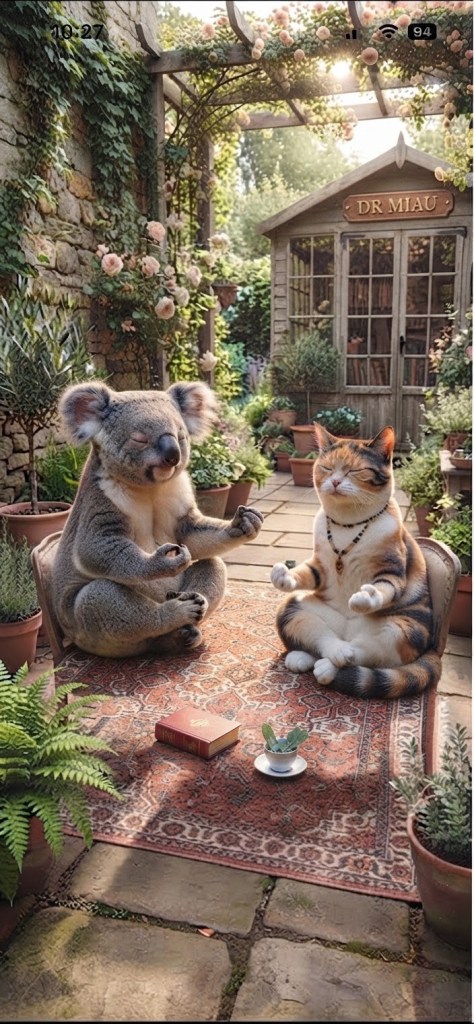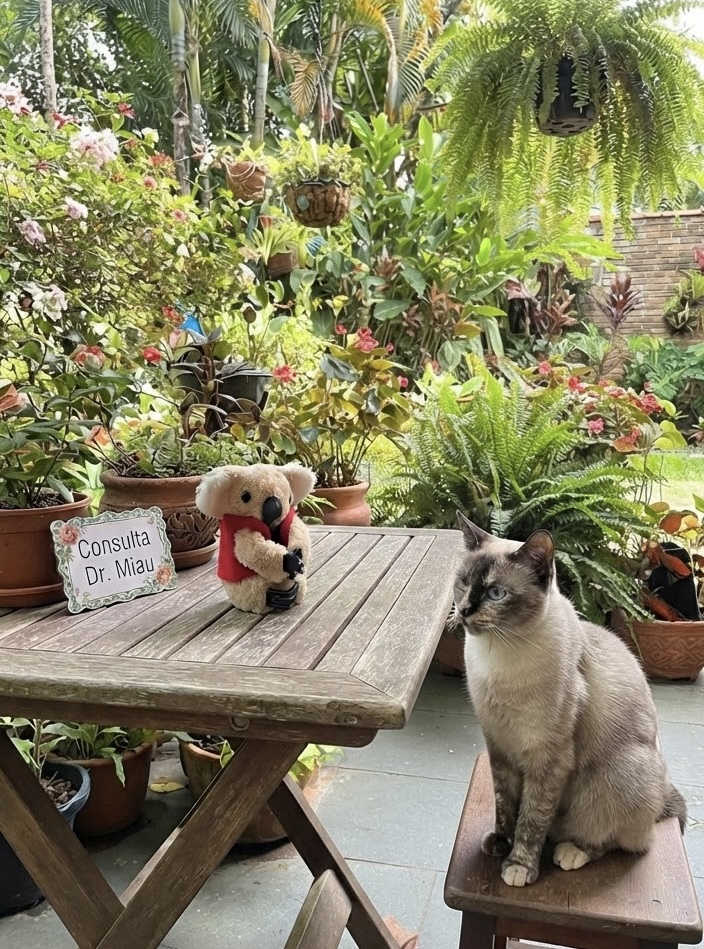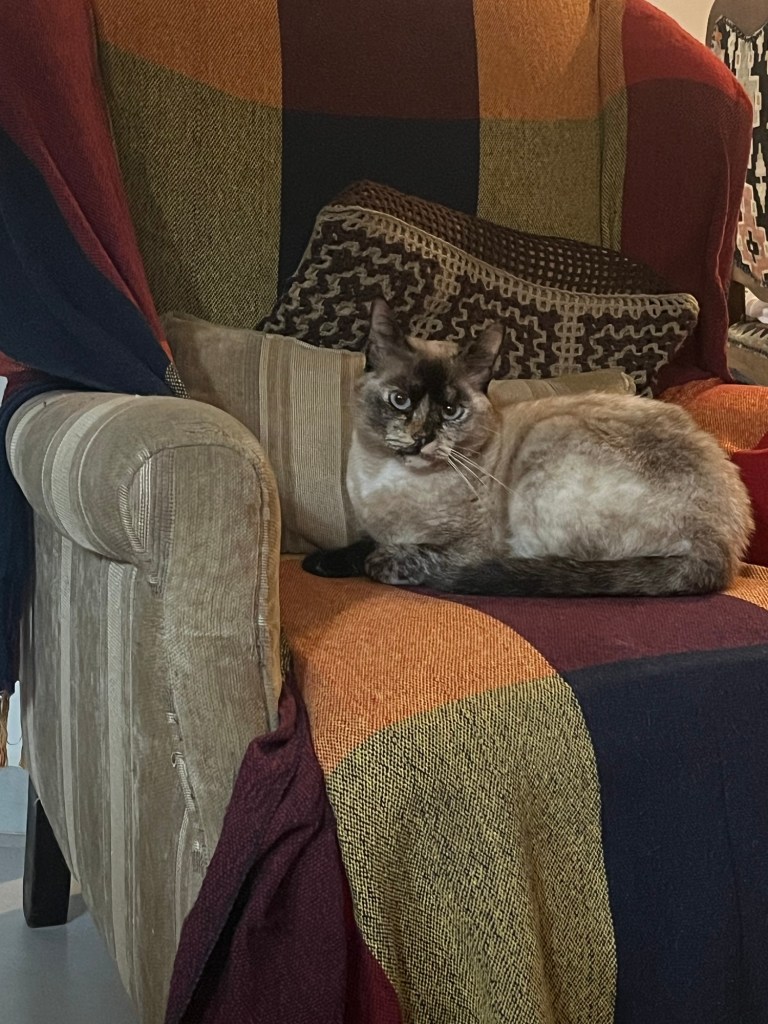
Dr. Meow, could I schedule an appointment with you? I confess I’m so distressed… or rather, I can’t even explain it. But I discovered that Dr. Meow exists—an animal who helps the minds of so many cats.
— Of course, it’s a pleasure to have you visit. What’s your name?
— My name is Mitaka, but you can call me Mita. You know, I have such an empty feeling… or rather, a hard one. I can’t even tell if I’m unwell or sick. It’s more like the weight of being where I am.
— I understand that feeling, especially with a name as incredibly beautiful as yours. Do you know the origin of your name?
— No. When I arrived and found such a beautiful house, close to nature, where I could hide from everything… but they saw me and called me Mitaka—which sometimes turned into Mita. I felt that deep inside.
— What a beautiful name you have. It means impermanence. The most direct translation is ‘impermanence’ or ‘non-eternity.
— Wow, Dr. Meow! That’s why you’re so famous. I’ve traveled the world, and people have always told me about you—almost as someone who can see right into a person’s inner self.’
— Mita, can you see how perceiving the other person in their own moment acts as a mirror of what they, too, have gone through? Amidst our impermanence, the beauty lies precisely in understanding that this flow of feelings needs not to be reinforced or nurtured in our minds. But what, in fact, is this feeling you are experiencing?
— I don’t know… Maybe I have a doubt about my existence, or about why I’m living in this place and not the other one I liked.
— But if I went back to live there, wouldn’t it be the same feeling? You know, Mita, I, too, have lived in so many houses, streets, and countries, seeking to help my patients, and I always relate to that. Perhaps I realize I long to return to the last place I sought out—a place that was no longer the same as before. Almost as if I wouldn’t even appreciate it. That is why your name is so beautiful.
❤️
— Wow, Dr. Meow, that makes perfect sense. Just when I was feeling really good, they’d decide to take me to another house, another country… and when I went back there, I felt it wasn’t the same as before. Then I’d miss where I had been and want to leave again and go back to that other house.
— Yes, Mita. The term is also defined as ‘momentariness,’ indicating that everything changes from moment to moment, in a continuous flow of transformation. It is one of the ‘four seals’ of Buddhism (‘all conditioned phenomena are impermanent’) and a fundamental theme for spiritual reflection.
— That’s so interesting, Dr. Meow! You know, I used to stay at home, and suddenly I had to leave and stay for a while at another house. Then, just when I was doing well, they’d grab me, stuff me in a box, and put me in a car. They’d leave me at another house and I’d feel huge dissatisfaction, even though they gave me good food. Then, just as I was settling in, they’d haul me off again—right when I was getting used to that new house. Days would pass, and they’d cart me back to the house I liked. It makes me so mad! I feel trapped as they haul me back to the house where I used to live… but when I get there, nothing is the same; I don’t like it like I used to, and I don’t even get the food I liked anymore. Ugh, it’s so frustrating!
— What I feel is deep; it reminds me of the sea that comes and goes. And I used to like staying put, going back and forth. But today I find myself thinking: why am I here? It’s almost like that sea that came with the Sun… that has nothing to do with material things; it doesn’t exist. Even if my name is impermanent, I always used to go back and forth.
— I understand, Mita. Nature is the most beautiful thing I see, and that impermanence also ebbs and flows, much like a river. I understand that feeling. I think it’s the best way to meditate and observe our own emptiness.
— That’s true, Dr. Miau. It reminds me of what I heard about not following thoughts during meditation. Is that right?
❤️
— Exactly, Mita. When you inhale, hold, and exhale… and thoughts come up.
— Exactly, Dr. Miau. But what do I do to stop those thoughts?
— Great question, Mita. At first, we focus on our breathing and don’t notice the thoughts. But when you realize a thought is there, that’s when you try to stop it. I try to create a separation between the mind and consciousness.
— Dr. Miau, to be honest… that’s easy to say. But how do you do it?
— You’re right, Mita. It’s difficult and easy at the same time.
— But what do you find easy?
— Oh, Mita… I think it started when I was stuck on a boat. They took me away from Australia and away from nature, and there was nothing I could do. I was practically trapped—both on the boat and inside my own mind. At first, I even wanted to jump overboard, but I couldn’t even do that. That’s when I remembered the lessons I’d heard from a Sloth.
— Wow, Dr. Miau! Were there other animals on the boat?
— Yes, but he came from Africa and taught me how to stay still. Perhaps when he feels threatened, he prefers not to fight against himself. That taught me to try not to fight a battle within myself.
— Can you teach me in a way that I can actually do it?
— Of course. Let’s start by simply observing our breathing, without expecting anything. Usually, a thought will come up, and we just choose not to follow it. If you like, give it a name; this helps identify the thought so it doesn’t overpower us. If boredom arises, accept it. If worry arises, accept it. Just try to recognize it.