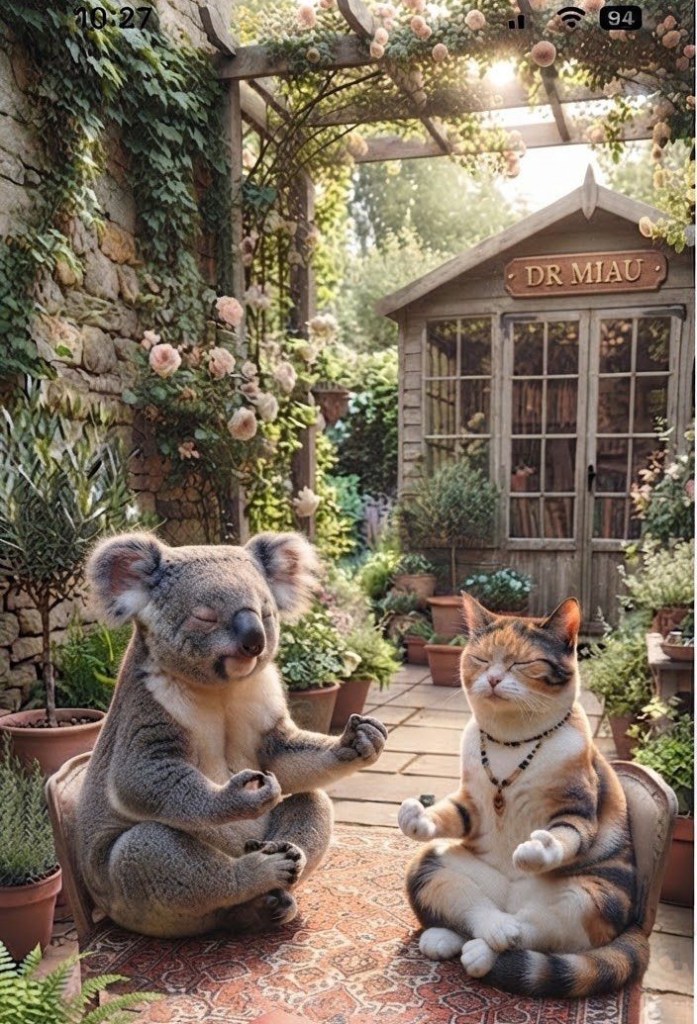
“Ah, Dr. Meow… Sometimes I feel a profound sense of discouragement. I wonder, will it ever pass? After all, I was doing so well here… But when everything shifts into something else, this anguish takes hold of me.”
“Mita, are you sure you didn’t feel this way before, too?” Dr. Meow asked. “You know, that same search that led you to discover peace? Yet, right at the moment you finally felt at peace, seeing everything around you begin to shift brings on this anguish.”
“I understand, Mita. Do you remember that time on the boat, when I told you about Zangmo? She traveled so much along her path, amidst so many trees and animals… And just when she felt she had found the way, she realized that the path itself didn’t exist. She taught me that, instead of looking only at the boat or the land, one should look beyond.”
“But, Dr. Meow, what did she mean by that?”
“Mita, she taught me that rather than remaining trapped, staring at the boat, the land, or the river, we can learn to see from a perspective outside of where we happen to be.”
“I see, Dr. Meow… Is it like observing life? Creating a bit of space within one’s own being? The ability to view ourselves from the outside?”
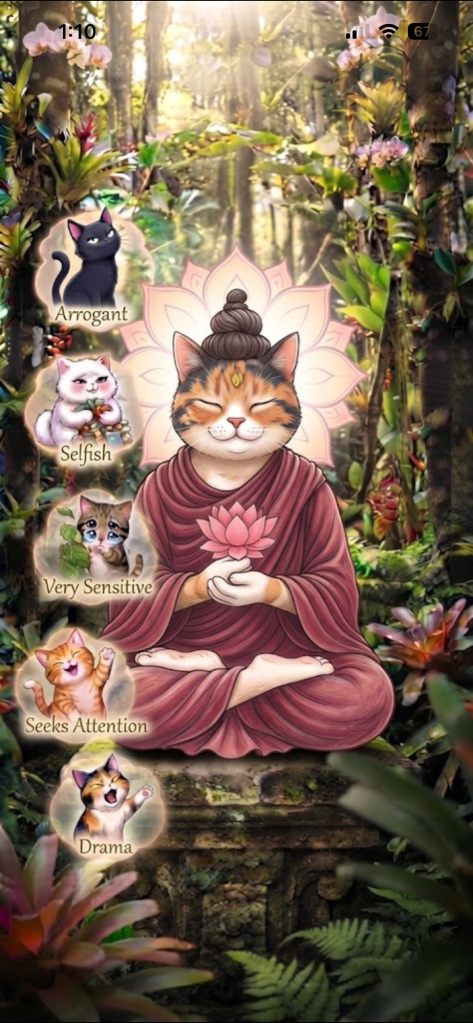
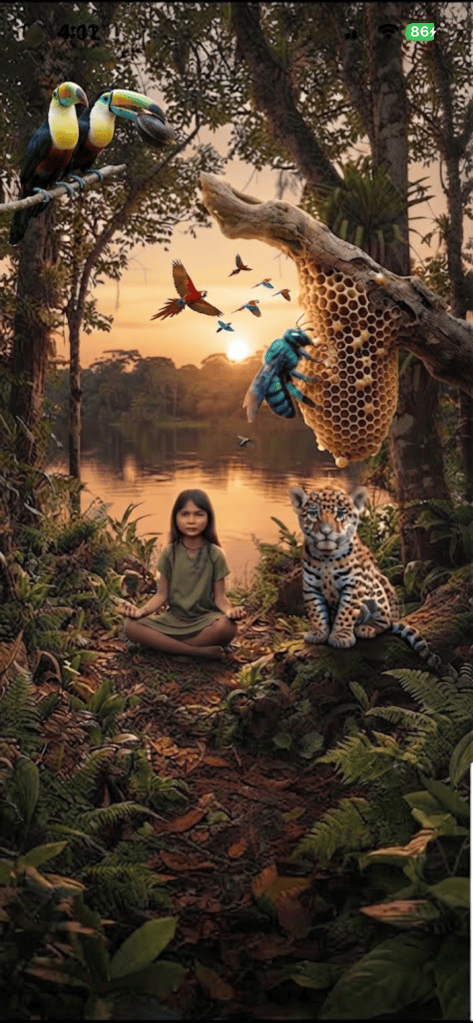
“Exactly, Mita. Zangmo taught me that we are not our thoughts. Look at this image, Mita: at the center, there is the serenity of someone meditating in silence. But all around it, notice the many fleeting states that arise… There are moments when an arrogant voice emerges, or a self-centeredness that closes us off, or a deep sensitivity that weeps, or a hungry craving for attention—or even the kind of drama that magnifies everything.”
“And are we all of those things, Dr. Meow?”
“No, Mita. We are the One who sits at the center, eyes gently closed, holding a lotus flower in our hands.” These small aspects appear like soap bubbles across the landscape of the mind. When you learn to simply observe them—without becoming the drama, without identifying with the arrogance or the pain—you discover a sense of separation. You realize that you are the essence that observes, while the emotions merely pass by.
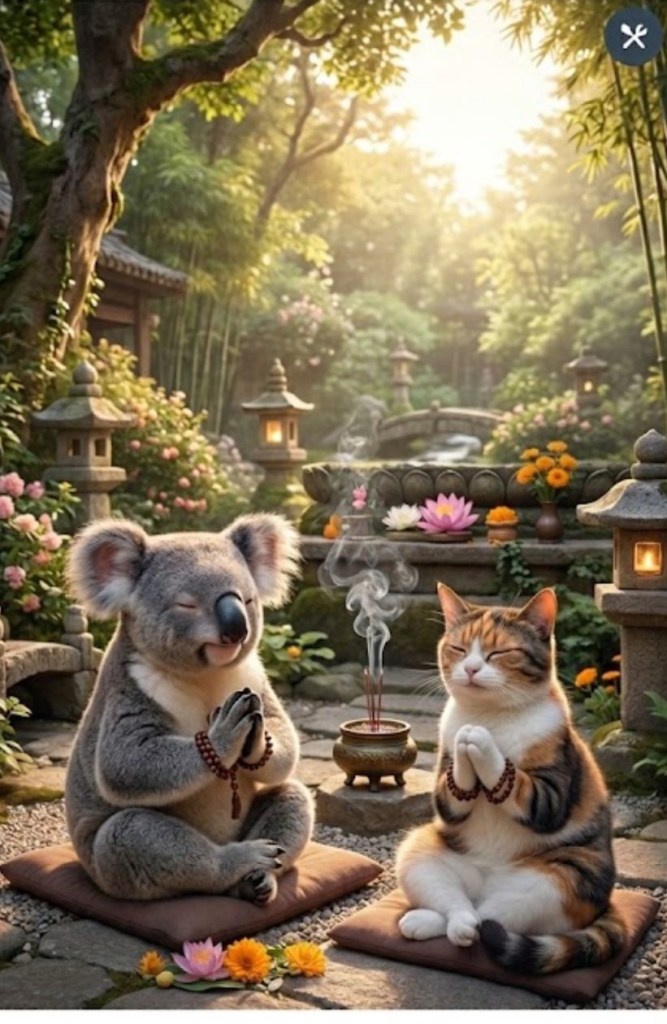
— Ah, Dr. Meow… Indeed, it is time for us to meditate and watch the mind flow.
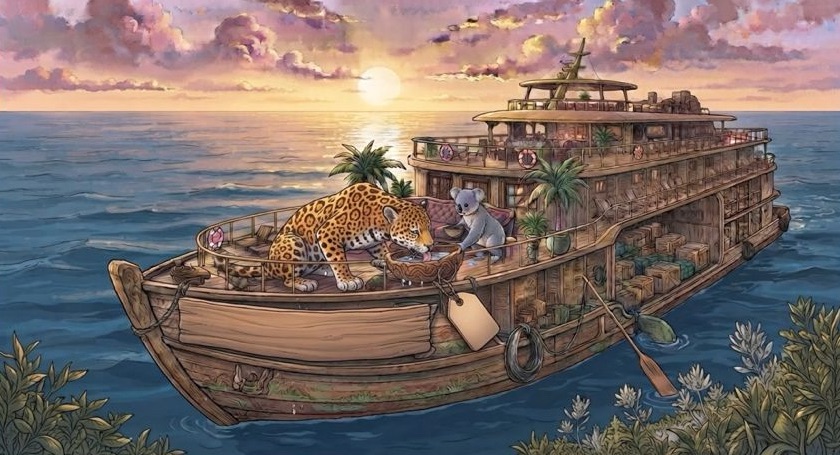
“Dr. Meow, in my dream, I saw the jaguar lost on the boat, feeling anxious, happy, and sad all at once… but what is her name?”
“Ah, Mita, I hadn’t even told you yet how she ended up on the boat. The jaguar came with names that kept changing until she met Zangmo, who is from the Harakbut lineage.”
“Wow, Dr. Meow, I’m confused — is Zangmo a Harakbut? And I don’t even know what a Harakbut is… what kind of animal is that?”
“Ah, Mita, the Harakbut are indigenous people from Peru who had a deep connection with spirituality, nature, and animals.”
“Dr. Meow, who on earth was that person? Did she bring the jaguar to the boat? Now I’m even more confused. A human being bringing a jaguar to the boat — that’s even more unusual.”
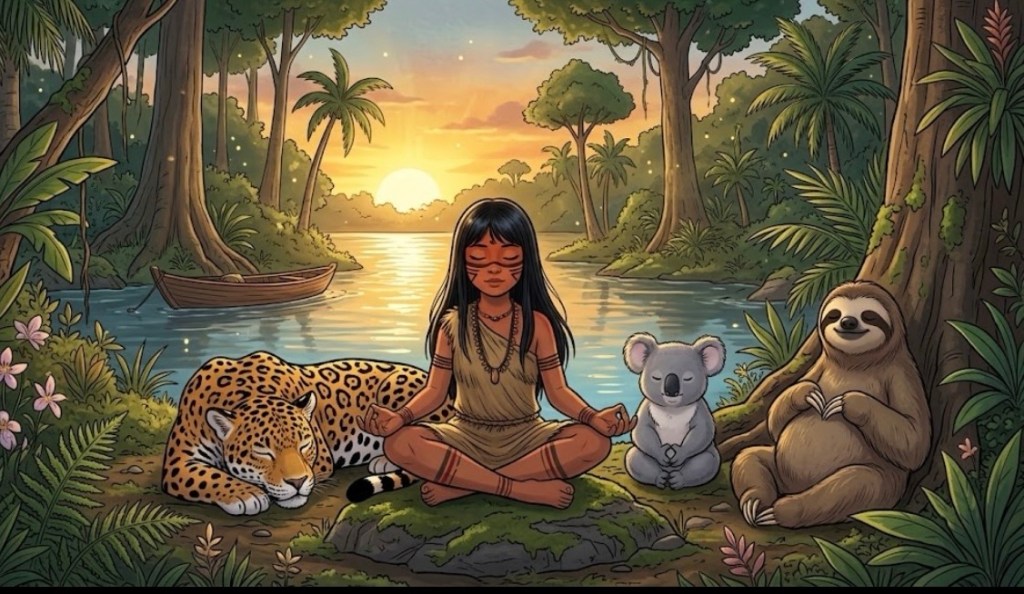
“Mita, she is a young Harakbut girl who, one day, became Zangmo — a figure who wished to help all beings on Earth. Besides her Harakbut identity, she received that name as she walked a path close to the Tibetans.”
“And what does the name Zangmo mean?”
“You know, Mita, one day I also heard that there are several interpretations of the name Zangmo, but one of them is ‘virtuous woman.’”
“Dr. Meow, have you ever met her?”
“You know, Mita, along my journey I learned that Zangmo is a young indigenous woman who wants to protect the Earth. On her path, she witnessed how the indigenous population and the animals of the Amazon were facing disappearance.”
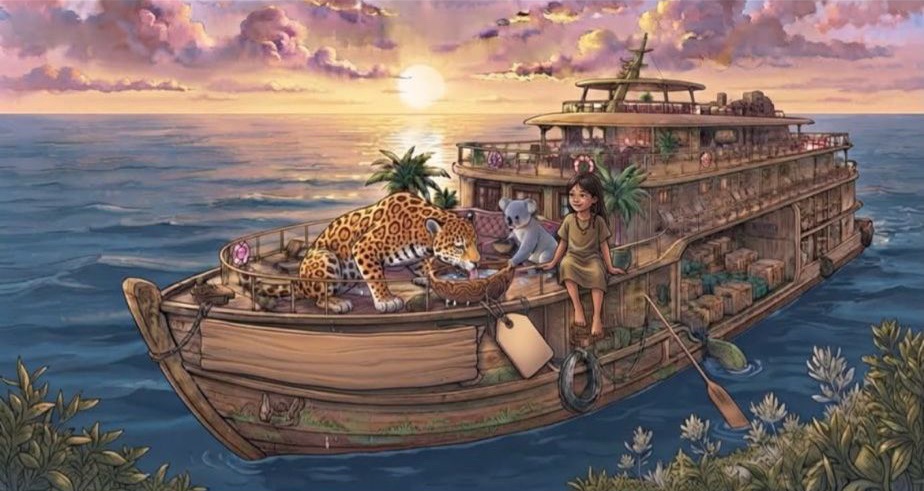
“One day, she saw an abandoned, half-broken boat. She decided to try to fix it, even though she didn’t know how. She remembered that one day she had seen bees building their hives, so she asked the wise bee to help her with the boat. She began by sharing her idea to create a haven for those who respect the Earth. She even wanted to reforest.”
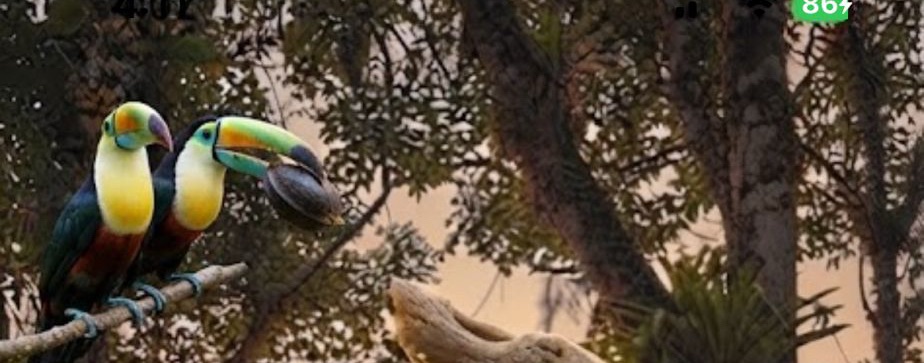
“Dr. Meow, I want to meet Zangmo. She must know that birds can bring seeds to help reforest.”
“You know, Mita, Zangmo told me that she received her name from the Tibetans in the middle of the Amazon. She was surrounded by nature while they were creating a mandala.”
“Dr. Meow, wow, I understand. I’ve been to so many Tibetan places, and I felt in a way that it was just like Tibet losing its land — just like the indigenous people, and just like mine.”
“Ah, Mita, that’s why you have that name; you’ve been close to the Tibetans. That is the impermanence of life. Just like Zangmo received her name: even without fully understanding it at first, she listened and resonated with it. The Tibetans gave her that name recognizing the young girl’s kindness. And that practice of the Mandala is to cultivate detachment. I imagine they gave her that name upon seeing the compassion she holds for everything on our Earth.”
“Wow, Dr. Meow, and so it was there that she met the jaguar and was able to bring her onto the boat. Wow, I almost forgot my curiosity about the jaguar’s name!”
“True, Mita, I almost forgot to tell you the jaguar’s name, too. Zangmo saw her and walked close to the jaguar, and she started calling the jaguar Apetpet.”
“Wow, the jaguar? She didn’t try to attack because she sensed Zangmo’s goodness. She felt that kindness which doesn’t come from who we are on this Earth, but from our actions and reactions.”
“True, Mita. Apetpet told me that when she met Zangmo there in the Amazon, Zangmo looked at her with a compassion she had never seen before.”
“Dr. Meow, I understand. Neither Zangmo nor Apetpet wanted to leave the Amazon, but this time, they had to depart.”
“Mita, it is truly heartbreaking for living beings to watch humans destroying trees without appreciating the value of nature. Right there, Zangmo spoke her name and declared that they would board the boat to help all living creatures and nourish them with their seeds.”
“Ah, Dr. Meow, you know, I was also once close to humans — they say they are superior, yet they kill and abandon. That’s why it seems these humans like to observe, only to abandon our nature afterwards.”
“Ah, Mita, your dream makes me reflect… sometimes we have to leave a place to search for something good. And right when we were doing so well, why did we end up moving to a worse place, or expecting everything to turn out for the worst?”
“Exactly, Dr. Meow. Every day, just as before, I used to think the other place would be better, but then I turn around and see it’s even worse than where we are.”
“Ah, Mita, just like your name Mitaka — whoever gave you that name wanted you to understand that everything in life is impermanent. But I understand… yet perhaps the most beautiful thing is for us to meditate and see the beauty of everything within our mind, right where we are. Right there, and never look at the negative side. I learned not to keep dwelling on past places as if they were better. That traps our mind, preventing us from realizing that those places also had negative aspects. Now I only see the beauty of the past, forgetting that there were hardships there too. We must see the beauty of where we are right now.”
“Dr. Meow, that’s true, but how can you not see the destruction of our Earth? What beauty do you see right now?”
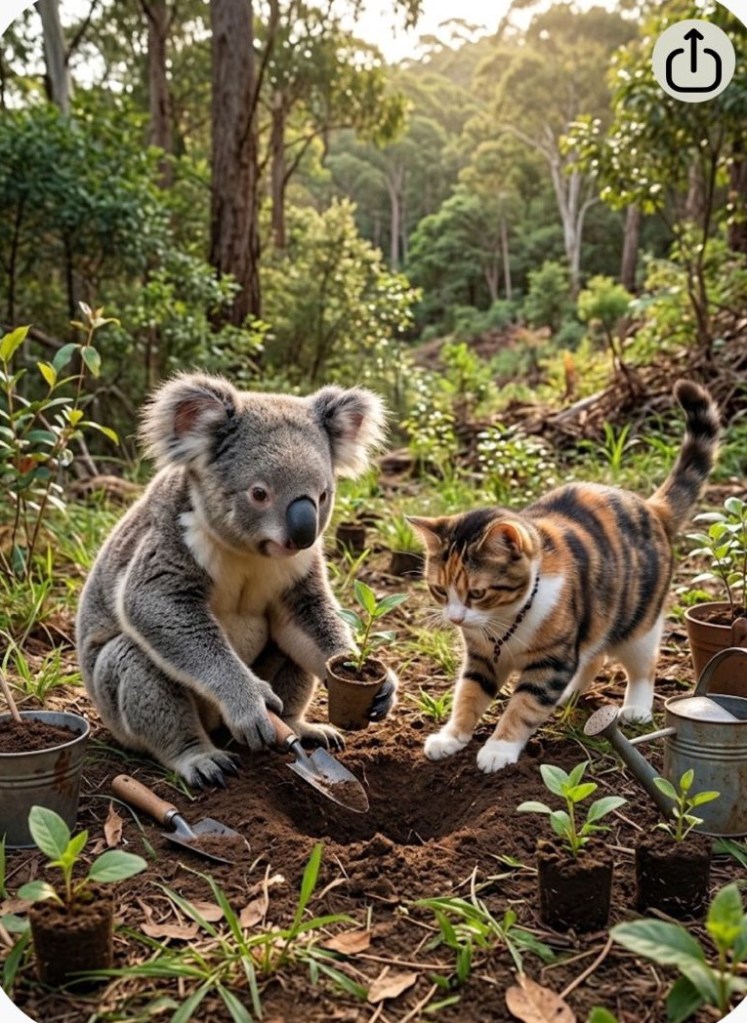
“True, Mita, but I see that throughout our journey, as you crossed paths with us, we have actions and reactions. And right here on this boat, Zangmo brought us the seeds so that we can reforest.”
“Dr. Meow, you’re right. Let’s meditate… but let’s reforest.”
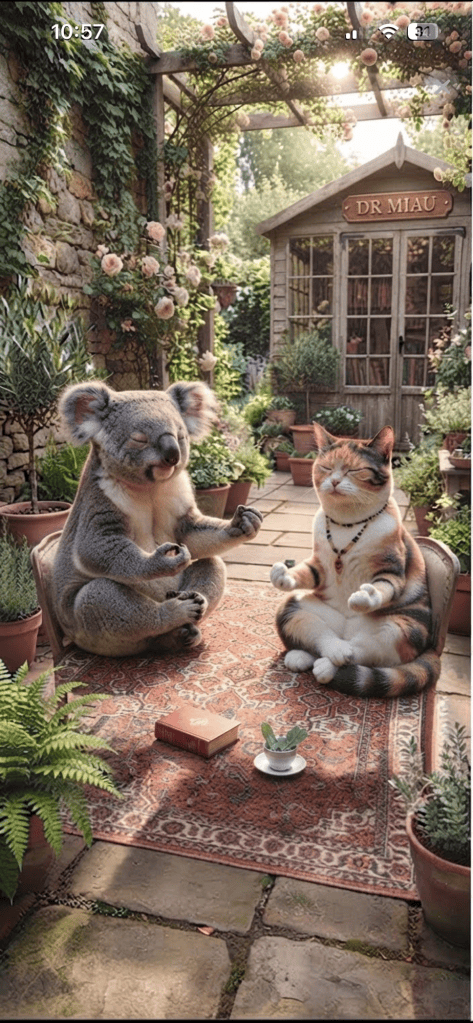
“Good morning, Dr. Mewu. I enjoyed meditating yesterday so much that I came to ask if I can join you and meditate together today, or would I be bothering you?”
“Good morning, Mita. Oh, it brings me deep gratitude; it is a pleasure for us to meditate together.”
“Dr. Miau, that day while I was meditating and had even forgotten my own discomfort, you advised me to name my thoughts and become aware of their similarities. This even led me to reflect on the word you used: ‘gratitude,’ rather than ‘thank you.’ You encourage me to understand how you guide us in our reflection, allowing our thoughts to flow freely.”
“Mita, what a beautiful conversation. It even reminds me of the boat I told you about yesterday—how I saved rainwater on the boat because I imagined that one day we might run out. One day, I went to give it back to the animals trapped on the boat. When we ran out of water, I even thought of the Jaguar, whom I was terrified of, but I felt it was better not to leave her thirsty.”
“Wow, Dr. Miau, you even wanted to be close to the Jaguar?”
“Exactly, Mita. As I meditated, calming my fear, my hunger, and being trapped on the boat, I thought how sad it was that the Jaguar stayed so far away, without water, and didn’t even know how to meditate.”
“Dr. Miau, I think you are famous because you can help so many animals meditate, and I would even say you know how to think of others.”
“Mita, you are very generous. Truthfully, meditation helped me meditate; it helped me so much. And when so many animals showed such generosity, I always wanted to share it with everyone. After all, we all learn along the path.”
“Dr. Miau: Yes. With peace in your mind, is that when you went to give water to the jaguar?”
“That’s how it went. She took the water and said ‘grateful’ to me. She explained that she doesn’t say ‘thank you,’ teaching me that ‘thank you’ (obrigada) comes from ‘obligation’—it’s when you feel trapped, in debt, bound to the person who helped you. But ‘grateful’ (grata) comes from ‘gratitude’—it’s when you acknowledge the good without becoming a slave to it. Better yet, she sat down with compassion…”
“Wow, Dr. Miau, I know so many cats. Sometimes we fight, but we are friends even with the opossum, even with human beings.”
“Dr. Miau: She drank it. But before that, she looked deep into my eyes. Do you know what she said when she said ‘grateful’?”
“Yes, Mita: did she say ‘grateful’ and explain why not ‘thank you’?”
“What do you mean, Dr. Miau?”
“That’s the exact same question I asked her, and she explained it to me. She taught me that ‘thank you’ comes from ‘obligation’—it’s when you feel trapped, in debt, tied to the one who helped you. But ‘grateful’ comes from ‘gratitude’—when you recognize the good without becoming a slave to it. The Jaguar said she had spent her whole life trapped on the boat, afraid, hungry, and that no one had ever shared water with her. When I shared mine, she felt gratitude. But she didn’t want to owe me anything. She just wanted to… show appreciation. That’s how we even became friends on that boat, as everything unfolded.”
“Wow, Dr. Miau. So the Jaguar even taught you to learn from everyone.”
“She taught me several things. She made me understand how words can trap us, opening my mind to realize we often don’t even know how the other person is feeling. Perhaps that’s why today I feel grateful that you came to meditate and talk, even about our difficult moments.”
“Dr. Miau, I am so grateful to you for helping me meditate and for teaching me. It is a good time for us to meditate now. And next time, I will tell you about a cat who shared a story with me so I could learn about the word compassion.”