Full Circle :)

I leave Istanbul in a few hours, and even harder to make it here, is to go away. I arrived almost 2 weeks ago, and exhausted as I was I ended up in Nesli’s b-day party in a little cafe nearby Nese’s house. Last night we went back there, so that I could meet my new friends and say goodbye. It felt like a full circle, there I had my first turkish coffeee read to me, and there I had my last. Lonely Planet would probably not agree that I have been to Istanbul as I have not gone to a Turksih Bath, or to the Grand Bazar, or even to the Souleimane Mosque (it was closed), or many of the other Turkish experience “essentials”. I did do some touristic things, I visited the Hagia Sophia, the Blue Mosque, the Sistern, Sulthanmet. But what I enjoyed most however was walking the random streets and learning about the life of the people I encountered here.

Not the life as we sometimes imagine abroad. Not the veiled and conservative life. I met the activistists, the gay community, the artists, the architects, the painters, the yogis, the musicians. I participated in a body awareness and dance workshop and not understanding the language made me so much more aware of it all. All the while listening to the traditional turkish music and observing how diferently bodies from other cultures move than mine.

I was in numerous cafes and bars. The coziest places I have ever been to. Places like those that you only find if you know someone who knows the secrets of the city. As they are always hidden in little streets, behind staircases, taking an elevator. These places are magical, as behind mysterious doors they exist just a few steps from your awareness. So making it to these places, following those who know them is an adventure in itself. It’s like being given the chance to see other worlds that exist without you knowing about them. And there seem to be so many different worlds co-existing here.

I will write more later. Now i would just like to say that Istanbul for me are the people I encountered. And in this crazy interaction of people making the place, and the place making the people, I found out a lot about me. As when far from what is known looking inside is easier. So amidst a lot of smoke, an enornous human warmth, a contradictory tolerance to difference lies Istanbul. Like that, divided between eurpe and the Middle East. Between the liberal and modern, and the conservative and religious. And by crossing from one side to the other, observing, enchanting, keeping to itself so much of those that pass by here this crazy city creates itself. And I feel that in this incoherent, dichotomous place and space I exist.

Henrique’s Farewell

Last night I went to the farewell party of a dear friend. One of those people who modify the world around. Someone who causes conflicts, intrigues, conversation, controversy, and for that reason will not go unnoticed. I didn’t even meet him that many times while he was in London. Our conversations were most of the time political. The two of us fighting for an ideal of justice.

Yesterday, at his farewell party, I cried. Not a sobbing cry of despair, but just tears that overflowed at seeing time passing by. A light crying, touched by seeing the world change. And the world, of course, changes all the time. Some events, however, make it more evident. Looking at our discussion forum, and not having seen Henrique’s well-written opinions lately, already anticipated what London would be without Henrique, an emptier London. Even if Henrique was not part of my daily life.

And last night, as I looked at the dozens of people that went to say goodbye to him, I couldn’t help but think about the life of all of us travellers, immigrants, and wanderers of the world. I could not help but think about how difficult this process of saying goodbye is. How difficult it is to restart in every single place, of becoming someone in relation to the other, and then having to leave, or see him/her leave. It made me remember when my flatmates, Leila and Joss, left the house and I was left alone in an empty apartment in New York. It was the same feeling, the feeling of the end of an era. Life as we lived did not exist anymore.

I always run away from these feelings, from these rituals. I didn’t go to graduation parties. I did not care about weddings. Moved countries when my friends were graduating. Not that I was not able to understand the functions of a ritual. But maybe I thought that because I thought I understood, I was beyond them. Yesterday, however, looking at Henrique leave, watching him moved saying goodbye to the people who were his life here, I knew how important these rituals were. Important for all of us. And I allowed myself to cry, because to say goodbye is not easy. Not for the ones who stay, nor for the ones that go. And the beauty might even lie in there: that it is not easy. If we were to leave countries where we lived for years untouched, without a drop of suffering, that would be quite strange. On the other hand, the end of an era always marks the beginning of new times. Resisting this is an enormous waste of time. But to pretend that we do not suffer is also silly. The importance of the ritual is exactly that: of marking. Marking this transition that is not easy, not insignificant, to mark it symbolically.

Last night it was marked. In a bowling lane full of Henrique’s friends it became evident how many people he touched while he was here. How many people transformed him with their ideas, their presence, and their behaviour. And I confess, I thought about not going. I dislike farewell parties. It is much easier when a person leaves without us noticing it , at least it seems easier. But I did go. And today, when I woke up, I thought about Leila and Joss. We should have made a party, a farewell party. Because a farewell party does not celebrate leaving, but our encounter with the other.

Published in Portuguese January the 17th 2009.

Europe or Middle East ?

Last week was really fascinating. I did so many things that I don’t know where to start. My only English friend Andrew (the one who took me to yoga) is the son of a Lord. And so I ended up going to see the Parliament with him last week. We had the privelege to see the House of Lords in session, learned about a million rituals, histories and stories, and even had a drink in the ‘Peer’s room’. The following day, following up with the ‘fabuleux destin de Julieta Falavina’ (as a friend of mine would say), I went to do something completely different. I posed for a Russian painter. This was an experience that should be told in more detail, as for someone who has taken a million classes in (post-)feminism, orientalism, to be suddenly on the other side of the coin, was quite revealing… As I said before, this is worthy of another post.

In this post I would like to talk about my dear friend Nese. My Turkish friend, who studied with me in Holland, appeared unexpectedly in London last week. It had been years since I last saw her. And encountering her was without a doubt the nicest thing that happened to me lately. Her visit was brief, as she had to go somewhere else as well. But it was just amazing to have someone over who had actual informed opinions about all the texts and books that were lying around in my house. It made me remember how I met her.

On my first day in Amsterdam I went to register for the university, and as I queued up the first person that caught my attention was Nese. She was radiating and beautiful, and she seemed like a little bee flying around all over the place. She laughed, speaking French to one, English to another, and in a language I didn’t recognize to a third person. I watched her for a long time, because Nese is like that, captivating. I remember thinking that I wanted to meet her, as she seemed a very nice person.

So when a couple of days later she appeared in my civil war class, I was very happy. I even became more enthusiastic when I heard her speak. She had very well constructed and original ideas. I heard then that she was not officially in my class. She was just joining it out of her own interest. But even so, she was the person who read the most, participated the most, and had the most interesting questions. One day we were told we had to do a presentation, and even though she was not officially part of the class, she decided to do it. And she chose to do it about the same organisation as me. I was ecstatic, as I would finally get to meet her. We set up a meeting, and when she arrived and started to talk, I felt she knew more about the organisation than the president of the organisation himself. And I who already thought I knew too much for the 15 minute presentation was dazzled by how much she knew about the organisation, its projects, and even the countries where the projects were. In sum, she knew all there was to know. When she told me she didn’t feel quite prepared, I could not hold my laughter, and we became friends immediately. I told her that I had wanted to meet her since the first day of school. And she told me that the only reason she chose that organisation was so that she could meet me. We laughed!

We did a million things together, while we were in Amsterdam. Well, in fact, she did billions of things, and I followed her in a few. I tried to calm her down every time she was delirious not feeling prepared for something. I got amazed at seeing how many activities she was involved in, and I learned a lot about Turkey. Since then I have been trying to go to Istanbul, but for some odd reason there was always something that kept me from going. So when I got a call from Nese this Thursday at the painter’s studio saying she was at the airport, I couldn’t contain my joy.

We met close to my house, and she was the same. Thinner, but with the same joyous face. We hugged, just as if we had met the day before. It was all the same, even if everything in my life had changed since we last saw each other. All the same, even if she had been through depressions, diseases, difficult relationships, desperate thesis, annoying jobs, it was all the same, even if she lost her enthusiasm about her PhD, about academic life, about art. As we hugged nothing mattered, and all of this didn’t make a difference.

She enters my house and sees Abu-Lughod on the couch, and starts talking about the ethnography of the Bedouins. She looks at my Bourdieu book and tells me I should read it in French: the English translation makes almost no sense… I become hyper, just like that; I, who don’t even care reading about Bourdieu, I who have not even read about the Bedouins. I do know however, that when Abu-Lughod sets out to study the Bedouins and finds them living a ‘slum-like life’ she becomes disappointed, feeling that they are not real Bedouins anymore. She then realises that for them what makes them Bedouin is their blood. That everything around them can change, if only they are able to preserve their ‘essence’, all that is external does not matter. It touches me enormously to think about that. It is the metaphorical ‘internal’ that matters.

Nese invites me to come to Istanbul. I tell her I am afraid, as every time I have a ticket something goes wrong. Haiko tells me to go, at least to end the superstition. I agree. After all, it is not difficult to convince me to go on a trip. I agree. After all, I have never been to the Middle East. I say that out loud, already anticipating Nese’s response:

“But Jules, you know we are Europeans, right?”

We laugh. We laugh a lot! Let it all change. Let all concepts change. All the frontiers, all the continents, all the countries, all the categories. Let me visit the Lords one day, and pose for a Russian painter the other. Let me study social science, do yoga, meditate, or wander around South-East Asia. Let me travel the Middle East in some people minds, while being in Europe to others. Let’s change it all, but let’s keep the essence, let’s find the essence, and when we do, let’s celebrate it.

A piece of Cake

I know it has been ages since I last wrote, and I do have a million things to tell. However, a million things to tell easily turn into none at all 🙂 I spent a month in Romania, and I am flying tomorrow to India.

In this post however, I want to talk about a simple and beautiful encounter I had, as I was volunteering at Amrita, a shop that belongs to the Yoga school I go to. I was there trying to learn playing the Tibetan singing bowl, when an old lady came in. I helped her settle down, and left her on her own so that she could look at the books in the shop. After about 1 hour, she chose a couple of books, and brought them over to me. She told me in quite a strong accent that they seemed wonderful. I explained her I had not read them yet, and not containing my curiosity asked her where she was from.

She inhaled deeply, looked straight into my eyes and said “I feel like a citizen of the world. I was born in Poland, but because of the war we became refugees. I asked her whether she was Jewish, and she explained me that she was not (which reminded me once again that many other people also suffered). She explained her father was a doctor that opposed what was happening so they had to run away. The lady was very old, she spoke with difficulty and sweetness at the same time, and once again I felt as if I was entering someone else’s memory, visiting another time, another life.

They went to Russia, they had no money, everything was difficult, and the war was everywhere. Then they made it to Palestine and then to Iran. And I who am fascinated by Iranian culture did not miss the chance to ask her about it.
Her eyes inhaled, went far away, looked inward, as if she had decided to travel there, to that time in history, to visit a place that she had left a long, long time ago. And little by little she started to speak.

“I like Iranians very much! I remember that I was young, we had no money, but my mom decided to take me to Teheran to a cafe. There were many cakes in the window, but we could only afford a glass of milk. The cafe was empty. Apart from us, there was only a gentleman sitting on the far side of the room. We sat at the table so that I could drink my glass of milk and I noticed that the gentleman suddenly stood up and left. As he disappeared the waiter came to our table carrying a tray with a piece of cake on it. It had been offered by the gentleman that had just left. The gentleman had seen me, a little girl secretly desiring a piece of cake, and guessing my wish he had bought it for me. In order to avoid any misunderstanding, or make us feel uncomfortable, he left before the cake reached us.”

Quite moved she smiled, and I knew she was carefully visiting that moment, looking at the cafe, her childhood, her mom, the kind gentleman. I felt quite honoured to share that moment to be there looking at the table, seeing the cake, staring at the girl in her little dress, her joy. In anticipation, and before she took me there I imagined the sweetness in her little mouth, I imagined her tasting very slowly and carefully each little piece of the cake, savouring it carefully, sharing it with her mother. I could see the happiness in her childish eyes… but then she continued.

“My mother was very touched by his kindness, but she could not accept it. She said no thank you, I am sorry but I cannot take it. And as I am telling you this, I feel a lump in my throat. It was one of the most beautiful moments in my childhood. To think that that Iranian man saw me, a little girl sitting with her mom, with no money and he just wanted to make me happy touches me. And that is how I remember Iran, and Iranians. They have the face of that gentleman who wanted to bring me happiness.”

And as I heard her speak I was touched beyond words. First, because I could imagine how much this little girl probably wanted that cake. But suddenly I realized something deeper, that what remains in her mind are far more important memories than that piece of cake. She remembers the dignity of her mother, and the kindness of a man who wanted to bring her joy. And it became clear that the cake did not matter so much. The dignity of her mother, and the kindness and compassion of a stranger are much sweeter, more profound and lasting memories.

Symptons of a sick society

I want to talk about two stories in this post. The relation between them is not so obvious, but for some reason my brain linked them as soon as i heard the second story. One happened in the US, in relationship to Holland, and the other in Holland, in counterpoint to India. The common point is not really Holland, but lets talk about that later.

I spent a year studying in Amsterdam, and on the day I was supposed to fly back to NY, to finally graduate, my flight was cancelled. With an extra day Haiko and I decided to do something different. We decided to go to a swimming park. We took the whole day to get there, and when we finally did, the place was full of kids. Small children were running on the wet floor, climbing small concrete ‘mushrooms’, jumping from one to the other. Some kids fell down, cried, but soon enough stood up and started playing again. There were a few lifeguards, but I did not see any of them interfering. I told Haiko that this would have been impossible in the US. There would have been numerous signs forbidding this kind of behaviour.

The following day I flew to NY, and as soon as I got there I went for a swim in the university pool. I noticed a new sign, spread all over the wall. In gigantic letters it said: “IT IS FORBIDDEN TO PLAY BREATHING GAMES”. A bit shocked and very curious, I decided to ask what this sign was sypposed to mean. The young lifeguard told me, with a serious face, that it was very dangerous to cross the pool underwater without breathing. And that it was forbidden to do it in that pool. Wow, i really was back in the US! At first i found it quite funny, but thinking about it later, i realised it was in fact quite sad.

My second story is about a Dutch couple in their fifties, who spent six months traveling in India. They visited many regions, participated in rituals, and took uncountable pictures. Once back in Holland, they showed those pictures in a night of slides and stories. The man said that since his return he had been quite depressed. Naturally, the differences in reality between the two countries were enough for a cultural shock, but his shock was strengthened by a particular event. The man, a university professor, told that once he went back to work, he found an absurd sign on one of the university toilet doors. The sign read: “Because of possible bad smell and annoying sounds, it is forbidden to poo on this toilet”.

When i heard this story, the sign in the pool immediately entered my mind. These signs are not the problem per se. Isolated they are even quite funny. The real problem lies in this trend! How is it that we allow a whole generation of kids to grow up without the right to fall?? How do we allow a whole new generation to grow without being able to learn to stand up, without being able to take any decision without calling their parents’ mobile, without scratching themselves, without calculating risks, without planning? What happens in a society when we displace our responsibilities to others, to the government? Suing everything and all? How is it that we got to the point that a toilet is no longer a place to poo? As if we had to “perfect” ourselves so much, that we would have to set ourselves apart from our vital functions. As if we have to set ourselves apart from our humanity…

Happy New Year!

The year is about to end and I am here writing my blog. I am with Haiko in Amsterdam after having spent x-mas with his family in Maastricht. I talked to my parents who are in Ubatuba, Brazil, with blue skies and 36 degrees at 5 pm. It is really amazing, I have never spent a new years eve there without at least some rain. Here it is 5 degrees, but it is not raining.

I tried to call my grandma the whole day. I was finally able to reach her now. She was very happy, traveling with 5 friends. As she put it herself, a group of girls ranging form 70 to 80.

My grandma, 83 years old, goes to the gym everyday, takes modern art classes, uses the net, and travels with her friends. She told me they had reserved a table in a hotel restaurant for 10pm. They will take two cabs, so that they can enjoy the night and have champagne.

Then I hung up, quite moved by her youth. And sitting here in the apartment of my brother in law, with not much desire to go out, i got moved thinking of the joviality of my grandmother. I had watched a program about Benazir (the other side of the story), read about the crisis in Kenya, and at the nicest moment of the day I did some yoga, and watched le cirque de soleil on tv.

The year before last year I spent New Year in a buddhist temple in NY. It was different. I had never been there. I did not want to be at a party. Haiko was in Holland, my family in Brazil,and my friends spread around the world. And I went to a buddhist temple. It was nice, I heard legends from Bhutan, and we meditated for peace.

We will go out soon… walk around the Jordaan quarter. We will watch the fireworks. And I wish I could meditate for peace. But with so many explosions this is a bit hard. Apparently they are to scare the evil spirits; to me, a bit ironic.

I find our new years, that do not follow the moon or seasons, a bit arbitrary… but I like the atmosphere of peoples’ new resolutions, and hopes.

I finish this year thinking of my grandma’s joviality. I finish this year thinking of the monk in that buddhist temple two years ago.

To each sound of the gong he said: positive thoughts for those we love…bong… positive thougths for those we dont know..bong… positive thougths for those we dislike….bong… and positive thoughts for all there is….

Happy New Year!

Through The South of Morocco

While we were planning our trip to Morocco, I stumbled on some information about a tour that went through the south of the country reaching the Sahara desert. I wanted to go, and Haiko agreed to it immediately; after all, he had already been on a desert safari (in the Thar desert between India and Pakistan) and had loved it. I was a bit apprehensive about it, because it was the end of the summer, the heat was certain, and the desert is a place from which most people run away. To spend numerous hours on a camel didn’t sound very comfortable either, and if we were to regret it, once in the middle of the desert there would be no way back.

So, in the first 3 days in Marrakech, we went around asking everyone we encountered about the trip. We heard everything, from ‘the desert is too hot now, around 48 degrees Celcius…’, and ‘it is really worth it’, to ‘it is tiring’ and ‘‘don’t waste your time”… As you can imagine, these comments did not make it any easier to decide. So when Brahim (Mounia’s husband) finally called from the desert saying it had rained and that it wasn’t so hot anymore, we decided to go.

With everything organized by Brahim, we left on a Monday morning and headed to the south. We, that is Adriana, Haiko, our driver Abdul and I, travelled by 4×4. Once I showed Abdul some interest in his views, he told us basically everything he knew about all places we went. The landscape, the colour of the earth, the wind, the houses, and people all changed along the route. The only thing that always remained the same was our meal options: tagine and/or couscous.

We travelled the whole day, passing numerous little villages. We journeyed through the hardest kinds of lives. Lives that seemed arid, difficult and poetic at the same time. And this, to me, was the greatest dichotomy of all; that so much hardship could be so astonishingly moving, in a beautiful and lyrical sense. A bit like a Salgado

exposition, where one never feels too good for feeling so touched.

The apex of this surrealism happened when we arrived at our riad in Zagora. It was a magnificent place, full of astonishing details, a feeling of Mali in the south of Morocco. It was beauty all around, from the mud coloured walls, the details in every pot, every window, door and corner. We strolled, completely mesmerized, a bit lost, and confused. We walked towards our rooms, but found a pool in the middle of a garden. There, in the middle of sooo much dryness, there was a pool for tourists… And there, in a mix of relief and guilt, we swam. We swam with the moon and stars in the sky at the mouth of the Sahara Desert.

The world

I can´t really remember when my passion for maps started, but it is definitely a long time ago. I am not talking about Mercator´s distortions and eurocentrism, nor about the arbitrary carving of the colonizers, but rather of that curiosity that emerges from seeing the name of an unknown city, river or mountain.

My mother always loved maps. She had different kinds and they were hanging on walls all over the house. Just as she would never let an unknown French or English word in a book pass without looking them up in a dictionary, she would not let the name of a city, region or river she did not know go by without finding out its exact location, latitude etc…

Still quite young , in the French school where I studied, I remember hearing my classmate Jerome say that he knew all capitals in the world. I found that to be absolutely impossible. That he would know all European and South American Capitals was fine, we all learned them, but all capitals in the world was unheard of. I still remember searching for the hardest place I knew and only being able to come up with Sri Lanka. To what he responded with ease: Colombo. It is true that at that time it was much easier with most of the ~istans~ still being part of the Soviet Union.

Later at university, Joss, my ex-flatmate, enrolled in a geography of Africa class, and she had to learn all kinds of information about the African countries. Since I was in charge of asking her questions I ended up learning a lot about it myself. Then I decided I should at least be able to place all countries in the map, and know their capitals, and for some time I even knew all Pacific Islands.

Then Joss and I decided that knowing capitals and countries was not enough, but that every week we should learn about a different place, about the governments, about the cultures, about the food etc… And in fact, while we lived together we learned a tremendous amount about different countries, not so much in the formal way we expected, but by reading novels, taking classes, and especially by meeting friends from abroad. And it still amazes me how some people get happy realizing you know something from where they come from. In the beginning, you expects a lot, and have grandiose dreams about what people should know about where you come from. They should know more than Rio de Janeiro, carnival and football; but when someone from Bishkek or Bandar Seri Begawan, knows three things about your country while you do not know where his country is (or that it even exists!), ytou become more humble.

I have a friend who says that you only actually learn about places by travelling. And I do agree that travelling helps, but i do not feel it is fundamental, nor that it guarantees you will learn about that place. After all, there are many who travel without wanting anything to change, and without learning anything at all.

Last night, I accidentily stumbled upon a site called Amores Expressos ( Express Love). It was a project by one of the most important Brazilian publishers to send writers to different cities in the world to spend a month, and later write a short story about love. I was outraged by one of the writers who was sent to India. She was discriminating, generalizing, and offensive; so ironic for someone who is supposed to write about love.

Later on I read about a 5 year old boy in Paraisópolis ( a slum in sao paulo), whose father taught him about numerous countries and its capitals. And the only thing the father had to teach his son was an atlas, a little blackboard and his good will.

And by reading that article I suddenly realized that my passion for maps comes from willing to learn about the other. My fascination for maps took me to study anthropology, to travel as often as I can, and to learn about different cultures. The maps, just as novels, and languages awake us for different lives in different places. And traveling, it is true, emphasizes that learning, but I do not think it creates the interest, or the desire.

I do not know where the interest for the world, for the other comes from. But I see it in the father, who shows the map to his 5 year old son. He shows his 5 year old the atlas of different ways of life, of different opportunities. This interest for the other is what seems to me the writer that got sent to India is missing.

And I do understand it, since not all trips are all that easy. Some take us to our limits. When I was in Hong Kong, for instance, I came back mentally exhausted, the synapses only started to happen when I was on the plane. Morocco took my body to rebel, but I soon realized that it was not against me, but in my favour. It was in name of a better integration between my body and mind, versus the old way of mind over body. And it is a pity that we so often close ourselves to the different, to the other, without ever realizing that we are in fact afraid of ourselves. Scared of letting go of concepts, habits, and ideas that we are used to, but that, in the end, are not even that much truly ours.

Dreams


When I went to Slovenia last year to visit my friend Vesna, she took me to Croatia to visit her aunt. I have written already about Jelka´s kindness in my Brazilian blog, but I never got to write about an old lady she made us visit in the small village of Stankovic.

Stankovic is a small, one street village. Actually, the only road crosses the village in two. A village of approximately 20 houses, being Jelka´s almost self suficient. A bit after we arrived Darko, Vesna´s uncle, called. Vesna told him she was visiting and that she had brought a Brazilian friend. We woke up the following day with Darko arriving in his small red car, dressed in a Brazilian shirt, and eager to tell me Brazilian football players’ names, and the few words in English he knew. We went out with him the whole day. He took us to beautiful Dalmatian towns, and we took uncountable pictures of his car. Pictures he did not stop planning, or ever got tired of admiring in my camera. At the end of the day we went back home.

As soon as we arrived, Jelka asked us to visit an old lady who lived alone in one of the houses of the village. Jelka told us that the woman was a bit sad, and that our visit would bring her some joy. Jelka, one of the kindest persons I have ever met, visited the lady often, bringing her food, and cleaning her place.

We walked up to the house, and went through the front yard, while Jelka clapped and called the lady’s name. She called, and called, but there was no answer. Jelka went in, while Vesna and I checked outside. After 5 minutes with no answer I started to panic a bit, imagining us finding the lady dead. But I was wrong, a couple of minutes later she appeared. She approached, very old, walking slowly, hunched, and explained she had been to the neighbour’s house.

We went in, and the room, kitchen and living room were actually one and the same. While Jelka turned the oven on to warm up the house, the woman mumbled. I felt I was transported to another world. As if time had stopped, and went back walking really slowly like one of those monks who ring a bell to every step. There was not much light, the colours were yellowish, and the woman moaned. Jelka said kind things while Vesna translated everything to me. The old lady told her to tell me about her second husband whom she had been married to for 40 years, and had died now.

Eventually, Darko appeared. He explained he had new plans and that Vesna should translate them to me. Since he could not travel the world as Vesna and I could, he would do the same amount of km around Croatia. He would do that, he explained, even if he had to cross the country a thousand times. As his plans changed to an intercontinental trip that would take us to Russia, the woman attempted to remember in which countries of South America she had a lost son. Then the trip would reach China, and the woman tried to remember the name of yet another forgotten kid. Vesna did not know what to translate and I felt in a film.

And there, in the middle of a talk in another language, in another world, I could understand the tones, in fact I could relate to the humanity of it all. There in the middle of a remote village, no internet or tv, or good social welfare, these people were treated as people. In other places they would maybe be in homes, or professionally treated. But there they could live, more than that they were part of a society, they mattered to someone, and they had dreams

About Emotion and Criticism

We According to her, it did not matter how different the classes she chose for the semester were, at some point they always met at a point that united them all. I never knew if things were really all connected, or as Joao Carlos, an arts and communication professor, always said it was because of our repertoire that we are able to connect and appreciate things more or less. I later on married to a neuroscientist, and started to think of Joao Carlos’ repertoire as bases for neurological networks that connect the way they can according to the information we hold. There are days that my atheism and scepticism is strong and the neurological and evolutionary explanations are more than enough to explain those connections. Other days, however, I use these neuro-networks to connect Jung´s notion of synchronicity, with the mystic´s idea of connectivity, with the wanderings (that I have no way of judging) of quantum physicists. In the end, I still do not know the reason for those meeting points, but I could never deny that Joss was right, they always happen.

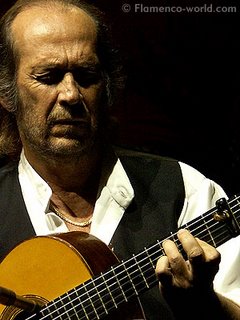
This point happened to me one of these days as I attended a concert by Paco de Lucia here in London. In fact, it happened afterwards, when I said goodbye to the friends I watched the concert with and carefully considered our conversation.

In the beginning of the concert, the guitar strings vacillated, teetered and some notes did not come out. I paid attention, a lot of attention to those faults. I paid attention in the emotion the man next to me felt to see his idol. I paid attention to the group of Spaniards who kept screaming ‘Maestro’ during the concert, to the people who filmed, those who took pictures, those who whistled… Enfin, I paid attention to everything but that moment. In the second part of the concert, I stopped looking around, and I finally felt the music. And as usual I was overcome by emotion.

On my way out, I ran into my friends. One, like me, had paid enormous attention to the mistakes. The other, a flamenco player himself and huge Paco de Lucia fan, did notice those notes as well, but to him it meant little. Paco had been great, his timing always perfect, his hand unexplainably fast. The emotion he had felt came from being in front of this man, who is the greatest flamenco guitarist alive.

And only when I came home I could finally understand that moment: the dichotomy between emotion and criticism. I realized that every time I let myself be taken by the emotion of being in front of someone or something I admire, I insist on minimizing my critical sense. I guess out of fear perhaps of finding a fault and not being able to admire it any longer. On the other hand, when I let my criticism go unchecked, I inevitably miss the moment. The problem I realize does not lie in criticism itself, or in the emotion, but in the idea that something must be perfect as a whole all the time. My friend was right, who cares if some notes did not come out? Paco is fenomenal!