Unknown's avatar

About julietafalavina

Eu escrevo da minha vida, e agora sobre a minha recuperação da saúde .

Srinagar, Kashmir

As I left the Internet last night I ran into friends I had met in Leh. With them I walked the streets of Srinagar looking for non spicy food for a french girl. To encounter non spicy food in India is probably just as hard as winning the lotery. We walked and walked and the people greeted us.. They always want to know where is it that we come from. In a huge group of french, italians, Algerian, Russian and Brazilian it is always surprising for them. They always greet me saying shalom, always imagining i am Israeli. After long walk invited by every shop owner to come in, by ever passer by where we are from we found a restaurant where the cook understood no spice for our friend really meant no spice. She was happy. The rest feasted on the orgy of flavours that is India. Being looked at by every single person becomes normality and so it is easier to keep going.

We walked the streets of Srinagar and as Ramadan, the fasting Muslim month is about to end, we hear prayers everywhere. We followed the chant to arrive in an alley that led us to a Mosque. There were lights hanging from the trees. It was late so only men were there. They were intrigued. Where had we come from? What were we doing there. We stood outside while lots of boys came to our rescue. An older man dressed in traditional Muslim style, with an white beard and kind eyes explained we could not go in, but the Italian boys could. First they had to do the ablutions/ We followed them, and watched the gentle old men gently squat and pedagocially teach how is it that one washes himself before entering the sacred realm of a mosque.

It was dark, and as our strange group tried to execute the choreography more and more little sweet boys came our way. were we muslims? Were had we come from? They explained us the women that at that time we could not go in. Maybe we could, maybe they could talk to someone. We explained we had time, we could come any other day, any other time. The Italians went in, we stood outside listening to the chanting. It sounded so beautiful.

At 4:30 am this morning we woke up to visit the vegetable market. It was still night and the shikara ( little wooden boat) came to pick us up. We entered it still half asleep. And as the Kashmere man paddled our little boat through the lake, through the house boats, through the plants, green lotus, and algae that covered the lake we could hear prayers from all over. Al Hamdulillah, Allah Allah. It was not a decision, it was simply natural that we remained all silent floating in the lake. It was dark and it felt so magical and sacred music came from everywhere. We could only hear male voices but they all chanted their faith for hours and hours. It is not a matter of religiosity, it does not matter whether you have any metaphysical beliefs or not, listening a whole town singing their faith while you float through the secret paths of the river touches you within. We watched the lights change, the reflection of the light painting the water every second in a new shade. Once again I felt thankfulness. When the sun rose little boats came from everywhere. They exchanged goods, they prepared for the great celebrations of the end of Ramadan. Simple boats containing flowers, saffron, spices, vegetables, bread, sweet. I bought cinammon to eat like candies. In reality I bought cinammon to see the muslim man weigh it in a middle aged scale, I bought it so that I could talk to him. He explained to me the meaning of Ramandan. The meaning of Id. The man who I bought water from yesterday came to bring today my favorite chocolate. In the streets people recognize and greet me. As I walked the streets on my own my Kashmere friends, and my Canadian travelling companion came to find out where I was. ”You were gone for 3 whole hours, we were concerned”. Incredible, I thought, I am not alone… never alone. in the thought to be one of the most chaotic places of the worlds, I already feel protected. I already have found a little space of my own.

Leh to Srinagar

No matter how much you believe you remember a long local bus ride in India, you just simply dont. It is completely impossible to translate into words what it is like to take a bus that leaves Leh to arrive about 20 hours later in Srinagar. The roads are no longer scary, you get kind of used to the continuous abyss next to you, the incredible confrontations with colorful buses and trucks who come the other side never really deciding before the last second which way they are going to go to. It is also hard to convey how it is that the Indians look at you. You western, you woman. It is somehow this dead fish look, the complete awe. it is impossible to describe how noisy it is the roads, the phones, the conversations, the phones playing music. But in the end of 20 hours even the most annoying person shows up to be somehow naive, and friendly. They smoke inside the bus, heat your chair, touch your hair, but if you seem to be sick, as the sweet Brazilian girl Louisa happen to be they will all come to help. They lend their blankets, change seats, teach ways of avoiding sickness. I slept most of the trip. I ate all that was local, and had enormous pleasure, and absolutely no fear. I start to actually love unknown spicy vegetarian food. Whatever it is i Just take it.

20 hours of ride made me little by little appreciate the vegetation that seemed to reappear. I was thankful for the gompas, the desert like mountains, for the Buddhist temples. But how happy made me the misty weather, the pine trees, the green fields, the rivers. With all of this comes also life. A total abundance of it. Arriving in Srinagar was nothing short of epic. I had already reserved my place in a boat house in the famous lake which has been quite abandoned by foregin tourist because of the continuous conflict in the region. As I met some people in the bus I tried to bring them with me so that they would not have to go with unknow possible touts. The kashmeres who wait in the station to get tourist were furious. It was nothing short of a fight. I knew where I was coming. I had met Mustaq in Leh, and he had reserved for me one of his family boats. I knew Rafiq his cousin would pick me up, so I told him I was bringing three more people with me. The men outside went insane they did not want to let us go. I who am normally patient lost it, and while one of the men tried to fight Rafiq I got out of my Tuk tuk and went there and said we would not leave without our friends. I stood there, feeling the power of a giant. No they are not taking them I said decisively. The men were unhappy but could do nothing and so we came the six of us. My new Brazilian friend Louisa, Francis her Canadias friend, and three Italians.

Arriving at the boat House was nothing short of magical either. The greatest happiness was to reencounter my German friends. I was supposed to come with them a few days earlier but because Liron, the Israeli, could not decided whether she came or not I stayed behind. The boat floats in the Lake, and Mustaq family took care of us. They cooked, told us the history of the place. Their desire for total independence from India and Pakistan, about the 50 thousand people who were killed here in the last 20 years. They told me how they were 5 th generation of houseboat owners. I looked the guestbook that went as back as 1912. They told me family histories of the British here and suddenly as I sat outside in the boat with my German friends, looking at the calmness of it all I thought once again that it was all worth it.

It feels like being in a film. As we seat little boats come by to sells us things. they have food, ice cream, jewelery, handicraft made wonden boxes, lamps, statues, clothes. It is quite magical. We seat and have tea, chai, we play with little Ibraham, hear Kashmere stories. Srinagar is predominantly Muslim and as it is Ramadan during the nights we hear prayers for the entire night. It is nice. In a couple of days it iwll be over. Id will be celebrated. From here when and where I am going I am still not sure.

lots of love,

Julieta

Nubra Valley

The stars are all in the sky. I have only seen the sky like this twice in my life. I saw it once in Australia, and the other time sleeping in the Sahara. There are absolutely no lights around so while I look up I am almost convinced that the sky is actually white and here in this remote traditional Muslim village 5 km from Pakistan the black cloth that covers the sky is too worn out to hide the light that emanates from it. It was not easy to arrive here. We road through a treacherous road around the himalayas, crossing occasionally bridges that danced as much as they sang. We had to require a permit to be here, to discover the valley that has been disputed so long by the giant India, and Pakistan. We had to show permissions and passports to kasmirian, nepali, Tibetan, indian, Pakistani , mongolian faces in several check points along the way and ponder how much mixture has happened here too. We had to drive across the highest road pass in the world, pray every single time a truck or a bus came the other side for the road to magically enlarge for a second , it did. And we had to agree to be totally disconnected from the world.

After about 8 hours of driving crossing villages that have been already open to tourism for some years we reached our little village which had not. This muslim village lies between mountains and to reach it we had to go beyond it all, and in the end as the road did not make it there we had to climb the last part. Every single child and adult that passed greeted us. We were the main attractions of the village. I had a mix feeling of joy for being able to see this almost first hand, and the concern that in a couple more years this traditional life style would also seize to exist. We climbed the mountain with our heavy back packs in our backs. The path was so steep that i often thought i would fall backwards. There is something however empowering of arriving so far, and so i denied all offers of people to carry my stuff. Someone once told me we should all carry our own load.

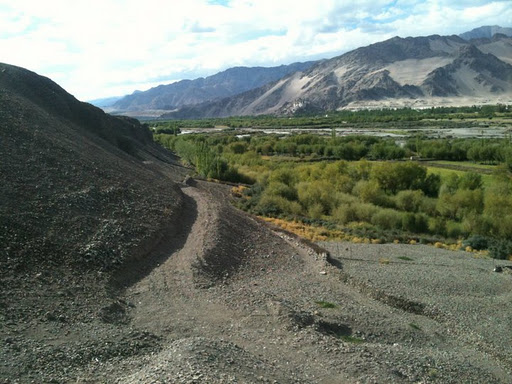
When we made it to the village itself i could not believe my eyes. Could really soooo much beauty be contained like this in a corner of the world? In the middle of the rocky and sandy mountains laid plots and plots of green fields, apricot trees, channels of water and colourfully dressed children and women. They veiled in their own traditional way.

I talked to every child who crossed my path, they greeted me in english i worked on finding out basics of their own language, they were surprised by it. They wanted to sing the hebrew songs israelis had taught them. They wanted to be photographed and then look at themselves on the camera.

As i arrived at our guesthouse I thought of our shampoo, toilet paper and all the junk we tourists bring with us. I decided i d minimise my impact to the bare minimum. None of these items would be used. I walked and walked mesmerised by the natural beauty, by the friendliness of the people and by this strange feeling that we were part of the process that would destroy it all.

It surprised me to realise that lack of option of what to eat made me happy. I never cherished a meal so much. In this remote village silver plates were brought.we had rice, daal, and some vegetable dish that was to die for. As we sat to play cards with a local boy and our driver, a muslim and a Buddhist in a game we had no idea how it worked, i felt happy. Jilmet ,our driver, had never been there but within seconds was friends with the local boy. They spoke now in ladakhi and not in the local language. Another local who spoke fluent english as he has studied in srinagar explained to me that till 1971that was Pakistan. I asked him whether he preferred being part of India or Pakistan and he explained to me that even though he was muslim he preferred being part of India “Pakistan is one military dictatorship after another! “. I asked him whether he did not feel tourism would destroy it all. He disagreed, “nothing changes traditional ways, but we also must meet people who think different then us.” I felt happy, not because I believed it, but it made me feel less guilty. I did agree we must encounter different ideas, but feeling like i was seeing the last glimpse of a traditional civilisation, and the feeling that we corrupt with images which are often not so real these places disturbed me. Children ran freely, they climbed trees, climbed mountains without any immediate adult supervision.

So many thoughts went through my mind as i walked the little alleys, as I saw the ladies carrying big stashes of straw in their backs, enormous baskets of apricots. The old ladies were the only ones who seemed wary of us. Like sorcerers that have access to wisdom they were unimpressed by cameras, or us at all. They refrained from being photographed and though they greeted me back when i smiled saying ” Salem” they kept going about their own business undisturbed.

My German friends decided we should climb one of the mountain that surrounded us. We had already done half of the climb during the morning. We had encountered on our way where the local boys did their laundry. Climbing half way was hard enough as i had with me water, hat, nepali pants, camera, so for the afternoon, i decided i would not bring anything at all.

I pondered whether it was a good idea for me to climb a steep rocky mountain with a boy who rock climbs, and another who is strong and tall. i am small, and i know nothing of mountains. They told me I should come for as long as i could. So even though that was probably not the wisest idea I did.

I tried to ask locals if it was safe to climb a mountain that seemed to be a pile of rocks waiting to desconstuct any second. The smiled and nodded probably not fully understanding what we meant by it. And so only three of our group of five decided to go. We re did the walk to the ” laundry” place and then we started the hardest climb. I am not strong but I am flexible and I have a lot of balance because of all the years of yoga I also carry on my back. I squatted and basically for the whole entire time I crawled the mountain like a spider. It was tricky to chose the right stones, not all of them were really stable. it was a process of continuously balancing, of continuously spreading weight evenly, without a question it allowed me to reach the deepest stage of meditation i ever have. i was fully aware of every muscle, of every breath, any wrong movement meant potentially falling. Retrospectively thinking it was quite dangerous. I did however not do it for the adrenalin, i did not even feel it, i was calm and just going. The first part of the mountain was easy as the rocks were bigger, but the higher we climbed it became more and more loose stones and dirt. At some point we reached some kind of grave yard where laid dozens of carcasses of animals. Usually it would have disturbed me, there it did not, life and death were one and the same. i looked at it. the bones, the carcasses, i looked at it deeply, and kept going. There were some parts i could not have made it without Toby an Paul. It probably meant i should have stopped there as the climb down from these points onward would prove to be challenging. We reached a place were we could comfortably seat. For the first time i looked back and i was impressed. People looked so small, the patches of green as well, and i was astonished by the beauty. The village laid in the middle of several mountains, we could see the Hindus river, the fields, and the blue skies. I wondered which of these mountains separated us from Pakistan, and I was dazzled at realising that km, or time separated us from it. It seemed so arbitrary.

We still went further, but once even the looking like strong stones seemed to be loosing up in our hands, once it became more and more avalanche like of sand and rocks Paul and I decided we had reached our level. Toby was sad he had not ropes, he still tried a bit more, but being a rock climber himself he realised it was stupid and dangerous to do so. So we sat and just enjoyed it. In one more place I meditated. I thanked them for taking me with them. They told me they were impressed with my courage and strength… So was I. If going up was difficult, going down was petrifying. I did not want to be taken up by fear. So I embraced my mortality, my fears, and decided that I respected the mountain, that i was thankful, but that if I arrived safe back down I would never go beyond my limits. I decided as well that I had no regrets. I have lived a good life. From the moment I laid in hospital years ago without knowing what I had in my brain, without knowing whether I could do this all. Whether i d be trapped by a disease. From that moment on I went in a frantic search. There in the mountain I decided I have lived a good life, and were it to end it right there I felt nothing but thankfulness to everything, to myself. It was not that I wanted to die. not at all, it was this awareness that I want to live, but life and death are one and the same and we must embrace it. And so i started my climb down with all the respect i could possibly have for the mountain, for life, and for death. As I reached the bottom of the mountain I realised I was emptied of it all. And so at night when the cloth could not fully cover the light that emanates from the sky. So at night when the milky way and every single star looked back at me I realise I had seen them before and most of their beauty lied in recognition. I realised I could go on traveling more, and see more and more of the world. But if everything could be contained in that one village, because everything is in fact contained in one atom, or quark or i don’t know what I did not need anymore to search for meaning all over. Even before I turn 30 I realise I could go on for a bit longer but then I want to stop. Then I will make one place my own and search beauty and meaning daily in the familiar things. That is undoubtedly the greatest journey.

Love,

Jules

The River

To leave my whole life in the UK I took almost all of the Piccadilly line to the airport. As I entered the tube (metro) almost in the end of one end of the line to arrive to almost at the end of the other side there was enough room to seat and spread my things around. I took the line mostly in silence. Haiko sat next to me and in my head I apologized for all that I felt I should. In my head I wished him all the joy in the world. As slowly it was downing on me that that was it: it was the end of a phase I had tears that gently washed my face. I really needed that ride. We both did. We were proud of it. The ride was long and it was so in mist of my silent prayers and thoughts that i fell asleep. I slept only to be gently awakened by a lady who asked me whether i could let her older husband have a seat. I was so removed from the whole reality that i had not noticed that the tube had become completely full. I stood up and insisted that they both sat. When there was finally room again in the tube I sat next to her. She looked at my big backpack and asked whether i was going to the airport. I confirmed it, and as she looked south Asian, I did something I usually do not do (out of fear of choosing the wrong nationality). i asked her whether she was from India. She nodded, smiled and said ” Is that where you are going to? ” It was not so much of a question but more of an affirmation. I smiled and said that I was going to Ladakh”. She looked deeply into my eyes, she had dark dark eyes and suddenly said ” You are lucky. i have always wanted to go there. I have traveled the world but I still have not arrived in Ladakh. You must go to Man Sabor Lake, it is now in China. I am happy for you. Only those called by god arrive there. You are lucky, and I am happy for you. ” She had woken me up, woken me up from my concerns of where would I go now and she was now giving me a path I though. I looked in her eyes and I said she did not understand how much it meant for me for her to say that. She just smiled and said she knew. People around were a bit shocked byt the whole interaction. It was trully strange. Haiko who is an atheist was impressed. She hug me and wish me luck. ” Jules, it is like the Universe talks to you. That was incredibly strange.” Having Haiko tell me this comforted me even more. ” I guess it is true I will be fine. There will be people there, I will be there for others as well.

Today I received a couch surfing message from someone who is in Leh and read my profile. ” In case you decide to visit Leh I ll show you around” . I wrote back immediately telling him I was in Leh. My phone does not work here, I dont use a watch, I never have a plan so fixing a meeting seemed so distant. It seemed like something you do in the west. So I did not put much effort on it. Instead I walked with my friends to organise our Nubra Valley trip. As I was walking on the street, I heard someone call my name. I found it strange after all I do not know anyone who drives here. “Jules, it is me from couch surfing. Come I ll show you around.” I go. I apologise for my poor ability to fix a meeting. He tells me it does not matter. His uncle owns the most important hotel in town. He starts to tell me all of the projects his family does. they are all modernisation projects. Not even 24 hours earlier I had seen a documentary on Ladakhi culture.

Ladakh is a desert mountain region. Most people are buddhists but there are also muslims and some Hindus here. According to Ladakhi main scholar Ladakhi traditional life style is based on buddhist philosophy. “Everything come into existence through interdependence and relationship”. In traditional Ladakhi life style 95%of people own their land. they farm. They collective tend for all animals, and for the land. There is not rubbish, and even though they have an incredibly harsh environment with harsh winters they are able to live and maintain themselves. The documentary focused on how modernisation has been disastrous for the region. it was a classic anthropological critic, it showed the pollution of the area, the rubbish, the disruption of social cohesion, the deligitimazation of local culture, and how much more vulnerable they become when changing into a money economy.

I hear my new friend speak. His plan is to create a factory to produce oxygen. How would it run I ask? On diesel, he explains. I tell him about the documentary and ask his opinion. He, not surprisingly has a very different point of view. He tells me he lived most of his life in Nepal.” i was important there, close to the royal family..but then the maoist came. the day the king returns i ll go back.” I say nothing. i ask him what he thought of the inequality. ” There wasn’t any. What have the Maoist done?” I am curiously listening it all.
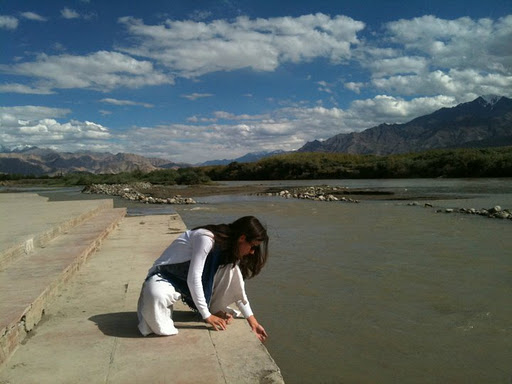
This conversations takes places in sandy mountains. Every now and then I see a stopa. a horse, and of course mountains. Occasionally there are green patches, mostly it is desert. It is Afghanistan to me. Rocks and rocks. The air dries my nose. How can people survive here? It is a true testimony to human ingenuity. He is polite. I hear his thoughts. I do not agree with his developmental view but I am thankful to hear his thoughts. He stops the car. We are now in a complex with Buddhist colorful flags. it is by a river. I walk towards the river. the sun is unforgiven. It is hot as it never is. I kneel down close to the river and touch the water. I feel it refreshed my hand. As I am in silence listening to the humming of the river my new friend suddenly says: ” This water carries too much history. it ends in Pakistan.” “Where does it come from” I aks ” From a sacred lake in Tibet, it is called Man Sabor”.

The Mountain

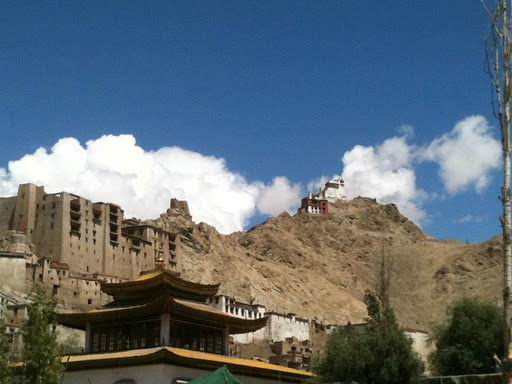
From the small touristic village of Leh you can always see around you
mountains, some are brown, some are spiked with snow. They surround
you in a strange way. They surround you but you do not feel captive,
instead you feel protected. From wherever you are in the village you
can see in the mountains the Gompa, the tStopa and the Palace. They
seat there powerfully making me feel in Tibet. They look like the
constructions I had seen in films or pictures of Llasa.

We were advised not to climb there in the first two days. We should
first acclimatise to the altitude. So during the first day we ventured
through the streets, the shops, and alleys. 2 out of our 3 German
friends decided to sleep. Olly who is 24 decided to follow us. A
Brazilian and a Israeli woman overwhelm anyone, but specially young
German boys. It took me the whole day to find out that Olli had never
flown out of Europe before. He had never left Germany, Austria and
Denmark. I could not even begin to imagine how it was for such a young
and sensitive boy to land from the saxon-scandinavian world in Delhi.
He did not want to waste a single second. He was dazzled, amazed by
all that, all that that even I having been in so many places am
overwhelmed by.

We all felt intermittently sick. Nothing too bad, just the occasional
reminder that we were used to more oxygen. Whenever these reminders
came i drank coffee, water, salt, and in my own invented potion i felt
better. So much better in fact that we decided to climb the mountain
the following day. I am no trekker, I have no experience in any of
this but I wanted to go. I am not very sure why. It was not that I
wanted to reach the Palace, I just went without much thinking about
it. And so the 5 of us: the three German Tobias, Paul and Olli, and
Liron (Israel) and I started our path. First through the city, than
through the alleys, than through the stairs, until we eventually
reached the palace inthe middle of the mountain. We climbed every
stair we looked at every single view. We were not really trying to
arrive anywhere we were just going and seeing. There was no one in a
hurry, no one who needed to arrive anywhere. We took every view, every
step, every breath. amd word with care.

Inside of the old palace, of old walls, and small doors, with almost
anything inside without any signs we naturally made our way to a
temple. I removed my shoes, went in and I sat in front of the Buddha.
I closed my eyes and had a short meditation. It was nothing dramatic
just a sense of emptiness. We climbed every stair till we reached the
roof. From there we saw the village, the mountain and there in the
distance all the way up in the mountain laid the white and red
constructions of the Gompa.

We went down, the Palace and started our walk towards the Gompa like
mountain goats. We went up in zig zag, climbing slowly the sandy,
arid, dried, rocky mountain. I breathed slowly, deeply, it was for me
a walking meditation, one step at the time, not really concerned with
arriving, I just walked. I walked in silence, as the lack of air and
the place naturally make you do so. One step at the time. It was in th
end not a difficult climb. We took our time. The time of within. So
when I reached thr big Buddha I did not even know I would encounter
inside of the temple I sat down and close my eyes. I meditated, I
prayed, I stood in silence. tears shed through my face. they were not
sad. They were not happy. It was just water.

And then we climbed even more and we sat under the nepali/tibetan
colourful flags. The sun was warm, the wind made them fly over us. I
took a few steps towards the edge of the mountain and alone I sat down
looking at it all. All I could say was thank you. I repeated the word
first in my mind, than slowly they started to come out of my mouth.
My vocal chords vibrated thankfulness. Looking at the mountain I could
not do anything but to repeat several times “thank you”. I felt so
much gratitude, and love, and joy. And i wanted to share it with the
world. I wanted to thank the hardship, the difficulties, that which i
did not want that made me have to keep going. I wanted to thank it
all. I thought of all people I love and it overwhelmed me to see how
lucky I am to love so many, to love so much. I felt gratitude for my
travelling companions. For their courage to leave the safety of
Germany, the world they know and suddenly also close their eyes and
meditate. We stood there, and every person we encountered became a
friend. They became someone we shared sometihng special with. We
laid on top of the mountain under the flags looking at the blue sunny
sky and we knew we were forever connected by this. And there I finally
understood that sometimes we need to take time, fight less, struggle
less trust in the path. 7 years ago I became very good friends with
Andrew, an English man who was studying religious studies in Holland.
As the total atheist that I was I condescendingly looked at him and
said “are u a believer?” He hesitated for a second then said ” I
guess I am a believer trapped in the body of an atheist” to what I
responded after short consideration ” I guess I am an atheist trapped
in the body of a believer”. Yesterday as I sat looking at those
mountains. As the air rarefied itself, as I thanked, and thanked and
thanked I finally freed the atheist from my body into the universe, I
realized that I do not want to have a “Ivan” relationship with the
world. In Dostoyevski terms I choose the relationship with the self of
Alyosha.

Leh, Ladakh, Iindia

It looked like a gigantic beach full of enormous sand castles. So dry, what I imagined to be Afganistan. Every now and then I could spot a green clearing in the middle of the majestic mountains. So brown, so arid, so devoid of emotion I thought. Something like a relief after the muddy streets in Delhi, the exaggeration of emotions. Maybe I ll dislike it and go back to Delhi, were Manu, my friend bid me farewell in the middle of the night. Maybe is time for me to hear the call of the Mekong. But as soon as the plane landed, as soon as the chilly air hit my face, as soon as i felt the imponence of the mountains, recognised the familiar tibetan and nepali faces my heart filled with joy and all the pain, all the sickness seemed to also depend on higher levels of oxygen to be able to be felt here.
Within seconds I was found by my new Israeli friend. It took seconds for her to find me, like this randomly, she asked me a question and now we share room, trip, stories, and excitement for it all. Like me she has no plans she needs to be nowhere but within. We walked the gorgeous Tibetan like alleys and rejoiced at every traditionally dressed Tibetan woman we saw, at every colourful Pashmina, at every conversation we had with Nepalis, Tibetans, “Kashmirans”. We visited the Israeli centre, the Muslim Tibetan who sells a bit of it all, we strolled the streets with newly found german friends. As we sat around a table to have coffee and I spoke of my love for the Israelis and the Palestinians I know I rejoiced at thinking that Germans and Israeli share now the same table.

It all takes time is what Leh seems to be gently murmuring to me. Some things are just slow we need have patience but never loose faith. The most magical moment of my first day in this lovely place was to enter the enchanted music shop of this village. A young boy lets us in in the minuscule cubicle where laid dozens of different instruments. I played a guitar, he took a Kalimba, then a flute, then a clarinet, then an instruments I had never seen. he taught me to blow the clarinet I failed miserably at it. He told me he would play for us the most magical instrument that existed. i expected an Indian citar, or an unknown nepali or Tibetan instrument. To my enormous surprise he played the Didgeridoo.

Most instruments were built by his father. As he blew this Indian made Didgeridoo I thought I were in a fairy tale where a beautiful young boy could make music of all that he touched. We were all fascinated. We were enchantedely kept in this little room that contained music and people of the world. “Music is life, without it we are nothing” he explained. I smiled remembering how for the Nambiquara the flutes are religion itself. What connects us with whatever it is that we connect. In this magic place I felt like this…connected to people through time, through culture, through the creation of these instruments. Connected to some kind of mysterious force in the land of Ladakh in the silence of the morning, in the music of the water, in the mixture of these estrange and yet familiar shop. And now I must go and disconnect because here being connected through the internet seems profane, here the connections must be of the archaic type.
Love,
me

Around the World, Delhi

Delhi 15/08/11

I planned to leave Delhi as soon as I arrived. Every single part of my body made itself present within hours. My soul ached of a pain probably as old as the Vedic texts. I wanted to run away, go to Thailand float in the comfort of the Mekong. India did not let me. India is like this it speaks to you, it screams, it pushes and compresses you and it is better for you to listen fast what it is saying. In fact, it is better for you to understand that she will turn you inside out and it is you who must heal your own wounds.
How could I have not remembered it? I had been here before. I had however but a vague memory of the sensorial overdoses. I had but a vague memory of how it is that India crushes you only to later gently hum, softly talk, mesmerise.

I did not plan to stay here in Delhi but I made friends. And with them I ended up doing things that were not in my plans at all.
I did for instance, spend a night in a club. I danced and danced and danced and when I was absolutely exhausted I decided to rest in the bathroom of the place. I stood there in silence looking at the Delhi’s club’s bathroom routine. in fact, it was not so different from anywhere else in the world. There are girls who come in to share secrets, girls who put make up on, they use the bathroom, and there are of course also the ones who come because they feel sick. I stood there in the corner just looking, when suddenly a young girl came in. She looked terribly shaken. She immediately took the first available toilet, and as she went in a friend came after her. she took a while. the friend knocked on the door. she did not answer. The friend stood still.She waited. I waited too. I wondered whether she was ok. She came out looking awful, she did not answer any of the hindi questions posed to her. She sometimes would venture to start speaking but she could not. She would point her own throat. I could feel her words had either dried up, or were to wet to come out.

 I looked at her without pretending not to be looking. And after about 10 minutes of silence I asked her whether she was ok. I knew fully well that was not alcohol wrongdoing that was pain as old as time itself. She still took a long time to say anything. I kept looking at her. Kindly, expressing my support. A few minutes later I repeated my question looking deeply into her eyes ” are you ok?”. Her friend, who turned out to be her sister, remained silent. The girl broke out ” My boyfriend just told me I am not good enough for him, and left with another girl and left me here in this club.” I wanted to hug her. I wanted to magically take her pain away. I smiled and told her” you will be fine. Do not let anyone undermine your self esteem. He screwed up badly. We all do. Forget it. I know you will not believe me now. But it will pass. Time will heal it. Feel whatever it is that you have to feel, but then after let it go.” she looked at me, not very convinced. ” I am not like other grils. i speak too much, I am not beautiful like my sister. He left me because he wants a normal girl.”

I told her all that I could, I told her about my own life, my ow departure. I just wanted her to know that she was quite special, and she would be fine. She smiled and asked me how old I was. “29” I said. “See I am only 18”. I wanted to hug her, I wanted to tell her that pain like this when you are 18 is more painful. It feels like alcohol in a cut. After, with time, the wounds still ache, they throb but it is in a more controllable and familiar way, instead I just smiled, reached her shoulder and held her. She hugged me and broke out in tears. I let her overflow, and in her tears I healed my own wounds. It was a bit like in the legend of Kairos. We were both there in the bathroom of a club supporting each other. Linked by anything but our humanity, our weaknesses and strength.

She dried up her tears, and suddenly said ” I am thankful you were in my path. You already did too much for me, but can I ask you one more thing?” I nodded. “Can you dance with me , I want to feel some joy”. I smiled, and said that I thought there was no better idea than that. We walked out and in the middle of a club in Delhi. In the middle of Shiks, Hindus, Muslims, foreigners I danced with a 18 year old broken hearted girl our pain away. And there I knew in my whole body, that the struggles would not disappear but I was now thankful and able to deal with them. There I remembered that pain is as

Back in London from The Middel East

I landed in London and if the last email was hard to write this one is even harder. It is harder as leaving the M.E I leave somehow defeated. After the last email I decided to go back once again to Palestine. I spent one day more, and crossing the border never felt so pleasurable. Somehow the paranoia that is all over Israel is not there even if there is not a single boy I met who has not been in prison at some point for not much more than simply being a boy and Palestinian. I walked the streets somehow relieved and sad. It felt like since the very positive passionate emotions are not allowed all that is left to feel in Palestine is anger.  As usual they greeted me for coming to Palestine. After there is not that many people who come without being escorted in ridiculous touristic buses. What is it they are afraid of? Oh, yes, there was one person who was killed these day. Forgive me for my cynicism. Palestine does that to you. It hardens your heart. The death of one person is sad. Any person. Watching American’s celebrating B Laden’s death was a particular shocking site. No I do not like Bin Laden but I stand with Martin Luther King on this one “”I mourn the loss of thousands of precious lives, but I will not rejoice in the death of one, not even an enemy. Returning hate for hate multiplies hate, adding deeper darkness to a night already devoid of stars. Darkness cannot drive out darkness: only light can do that. Hate cannot drive out hate: only love can do that”


And so I crossed back to Jerusalem and decided i should meet a cs I had been in contact through email for months. He is a brilliant guy, he is a physicist. He invited me to come to the kibbutz Tsuba where most people he explained me were somehow socialists and communists. He had lived there his whole life. Left twice. Once to go to India, the other to Latin America. he was curious to hear about my experience. genuinely interested. But he explained to me that the most important thing for him was for the state to remain jewish. As a brazilian i always just feel we should just think of ourselves as humans. I  heard him. he heard me. He took me around and explained me things I thought were absurd. “Druzes mistreat the Palestinians because they know them better. Mizrahim ( eastern Jews) also are more racist than Ashkenazim ( european Jews) because they know them better. I proposed that maybe they did so in order to dissociate themselves from the Palestinians, as after all they are arabs too. He disagreed. For him it is as a consequence of having experience with them.


He explained to me he was deluded with peace. “I am thankful every single day that there is no war. but there will be one. and hopefully they attacks us first and then either they exterminate us, or we will annihilate them all. it does not take much. a right wing leader, a militant military leader and you could have that scenario”.  I was speechless. what? but do you want that? can you imagine the suffering? ” i don’t want that but it is going to be that: us or them.” I was then greeted by his ultra zionist father who said things like ” we are different people and we should be proud of the wars we won. as an American i always think… what would Americans say if people started wanting to give back land to indians?” I offered that Columbus day was increasingly being criticised, that canada had created Nunavut a 2 million km square area for the inuit. that Brazil had demarcated several indigenous land reservations all premised on the fact of recognising the harm that has been done to those populations. he dismissed my statements. “here is different.” he was very friendly to me and pitied the fact that he had a class to attend. ” i really like talking to you. i am entirely against that coexistence school you wanted to do your research in. but this conversation is very interesting.” I confess I was more than happy he was leaving, as what do you say to a hardcore racist in his own house, when his racism is disguised in other forms?


I went back to Tel Aviv and then met my long time friend Maya. I told her boyfriend all about my encounters. He was fascinated. He was truly interested. As a meditation teacher, and someone who travelled for 3 years he like me feels we are not that different. he felt sad about me telling him about my ultra zionist encounter. After that I encountered yoni.


Yoni studied with me in Holland. we had not seen each other in 6,5 years. for the past 10 years he lives abroad. I had absolutely no recollection where he stood in the Israeli Palestinian conflict. As soon as I met him I said jokingly ” did you come to celebrate independence day?” to what he surprised me by saying ” I will think of the Al Naqbah”. Al Naqbah, is in Arab the great disaster. While the Israelis celebrate their victory the Palestinians celebrate their loss. I was speechless. That is something I had never heard from a Jewish Israeli. “Jules, I am deeply ashamed of the policies of my country and I feel the only moral thing to do is to leave. to move somewhere else. That is why I have been gone for the past 10 years. I come every 2 years to see my family and then I go.”


Yoni who did his thesis on Spinoza, and now among other things teaches politics surprised me. I asked him what his family felt ” Well, they say they thing is horrible what is happening in israel, but they are good people. you know the drill Israeli leftists… ”


The day after it was time for me to leave. I was told to delete all my pictures from Palestine. To lie. To not say I had friends there. I decided against it. if the price to have my pictures, to stand by having friends is to spend longer hours in the security, maybe risk not being allowed ever back in I ll take it. Yoni advised me ” Fair enough. Just do not volunteer info you do not need to give. I know it is horrible but Israel does that to you.”


So I arrived in the airport and in my little interview i was given the highest security risk. when i was asked where I had been i simply said “everywhere”. When I was asked whether I had friends in Israel I told them the truth. Told their names . They did not explicitly ask me about Palestine so I did not say anything. I had to open my bag and take everything that was inside. Everything was scanned. then i had to answer more questions, then i was invited to go through a metal scan, then to a little cubicle where they asked me to remove shoes, belt etc. then a woman joined me and touched my whole body. I almost felt like asking her whether I should remove all of my clothes. I did not. I just waited. I did not feel angry towards her. In fact, if anything else i pitied her. It must be horrendous to live like this. feeling threatened by everything.


Some minutes before 8 o’clock the loud speakers in the airport warned us that at 8 there would be a minute of silence for the israeli soldiers who had died in conflict. It was memorial day. Once again the siren rang, just like in the memorial day of the holocaust. everybody stood still. So did I. I stood in silence and still. Looking around I felt sorry for all those who lost people. I mourned the death of Palestinians and Israelis. But somehow the saddest thing of all for me is that that siren seemed to rather than teach us about the evils of power and racism, and thinking of ourselves and other as so different to somehow legitimised it. I felt sad for my Israeli friends for not seeing how much they are missing for not crossing those borders. For believing that Arabs can be so different. How could that possibly be? Alex my friend had asked me in the morning “don’t you think the death of the soldiers is sad?” I  explained I thought it was sad any loss of life in any conflict. ” Well, I care more for the Jewish loss of life, you?” He asked me. ” I don’t. I care equally for the loss of lives all over. It is equally sad for me if a unknown brazilian or an argentinian, a british or a Zimbabwean lost their lives in a conflict. I am probably sadder if  I knew the person. I d be probably sadder if you died than any brazilian I don’t know. If Leila who is Moroccan died rather than an unknown brazilian. When we are talking of strangers their death is equally sad for me. Which group they belong to really makes no difference. And if we are talking of ethnic conflicts it is just sad.”


As the siren rang that is what I thought: For as long as we think some lives are more worth than others. Jewish over Palestinians, Americans over Iraqis, rich people in Brazil versus people who live in slums. For as long as it happens we will keep negotiating our thoughts to rationalise what is plain and simple racism.


Back and Forth, The West Bank

This is probably the hardest email I will write. As crossing back the border to Jerusalem and going straight to Tel Aviv, after having spent more than 3 weeks in the West Bank, is nothing short of intense. Not the crossing itself, as it took me no longer than 2.5 hours to make it from Bethlehem to Tel Aviv. It is all in the symbolic, and since we live in the symbolic it is there that the hardest things happen. I crossed on the day that the news of the death of Bin Laden came out and the holocaust memorial-day was happening. Going through the checkpoint as a foreigner was relatively easy. It took a bit of time, but as soon as I held my foreign passport through the window for the young IDF soldier isolated in his cubicle to see I was let go with no questions. Palestinians took much longer. The power of symbols…different papers, different rights. I then walked the already familiar streets of Jerusalem back to Jaffa Street where I took the communal van straight back to Tel Aviv. As I was making my way I admit, in something like an automatic mode, I was called by a friend in Tel Aviv inviting me to come for a yoga class. I was thankful beyond belief.


As soon as I met him he asked me how I was. I explained about my journey in Palestine and he became entirely silent. I asked whether it bothered him that I spoke of people in the West Bank. He said that it did not. He was silent because he could not go there, so he was just learning. He was kind, but I knew it was not entirely true. He felt disturbed that I talked of Palestinians as normal human beings. I did not talk of politics, but simply of my encounters with the people I met. As soon as he could he left me.


It was not the first time it happened. A week ago, before I returned to Jerusalem, I sent a message to a philosophy student I knew from couch surfing. We were supposed to meet. I told him I was in the West Bank, so I thought the most natural thing to do was to ask whether he wanted to read what I had written about it. He did. Later on he wrote to me telling me he thought it was better that we did not meet. Reading my emails, the same ones you all have read, had really disturbed him. I insisted, we met, he was kind, a bit aloof to the extent Israelis are afraid and think of Arabs as different people. He brought with him an Israeli friend who is involved in putting together ex-fighters on both sides to talk with each other. Even this guy, who is so active in promoting a dialogue, was unconvinced that the people I met had told me the things they did. When I talked about my simple encounters with men and women, boys and girls, and told them about our conversations they just could not believe it.


To top it all, back in Tel Aviv I went to meet a friend who had not written to me in ages. He had explicitly commented that he disliked that I was in Nablus on my Facebook status, and made fun of some pictures. But I like him, and I needed to insist on seeing him. He agreed to meet me. As I arrived at his house his first question he asked was what I thought about Bin Laden. I really could not believe it. He felt threatened that I had been in the West Bank. So, in his mind he must have thought something like she must then like terrorists. ‘Why do you like Arabs so much Jules? You really do not understand them. I am going to be very honest. I don’t like them, I hate them’. I heard his thoughts and simply replied ‘you actually do not know them. There is not such a thing as Arabs. There, on the other side, there are people who are not that different from you and me. At the surface maybe. We speak different languages, dress differently, invoke different ideologies, etc.. But scratch the surface and you will find people who have exactly the same searches we do’. He was unconvinced. Was I not harassed? Raped? Did they not want to grab me? I explained over and over again that I had never been treated with so much respect, even when I challenged and asked people about their most cherished beliefs. I explained to him that not all was good in Palestine. It is a fragmented society, with inequality, with some very traditional rules and some very religious people. Yet, treat them with kindness and they will go far in thinking with you, and help you understand them and yourself better. My friend became curious about these things, about the young 22-year-old boy who wanted to learn about Buddhism, about whether they could speak English well, about what things look like in the West Bank. But I felt he was scared. He was scared that I had been there. ‘So you prefer the Palestinians to us, the Jews?’ I hated the question, but as I think we have to deal with these questions I just said what I thought. ‘I like individuals in spite of the group they belong to, for who they are. Both Israeli and Palestinian society is very fragmented, there is no way of talking about Palestinians versus Israelis. It is also different depending on where and who you are with’.


He did not really believe me. He was threatened by my pacifism. I explained: ‘Listen, I realise that the things I believe in are the result of having been born in a culturally mixed place, where ethnicity is not important. I could be killed in Brazil, but not because of who I am. It would be circumstantial, people want money and I had money on me. Or I accidentally got in the wring place at the wrong time. That makes the way I look at things fundamentally different. I know of no one who has been in a war. For me fighting over land or beliefs is very alien. I have had a very easy life in Brazil, so I do realise that that makes me think differently. I have no idea how I would behave in a war, how I would behave if I was forced to be in the army. But given the life I have lived and the things I have seen from travelling and living around the world, I just feel that violence breeds more violence, and never really solves anything’. He looked at me and said: ‘See, you have not experienced a war. That is the problem’, he concluded. I looked at him slightly puzzled and said: ‘Well, I think that that might be the solution, right?’. He was silent. And that is why I hate what this wall does. That is why I hate what this division allows people the believe in. I hate the fear that captures them all. the fear that actually makes them believe that people across the wall are very different. I took my camera and showed him many picture of kids and of boys with me. And once again I was astonished of the power of love. How love is the most subversive force there is. I remembered Gabriel Garcia Marquez’ book ‘Love in the time of cholera’ that was next to me every day I stayed in Beit-Sahour. I remember at the end of the book that love is like cholera, it is contagious, so it must be contained, it can only exist in a parallel world, in isolation. Love threatens people’s notion of power, of control, of boundaries. And I realised with sadness that my love for both the Palestinians and Israelis I met, who were captured in the pictures of my camera, was what threatened them the most. My love makes them have to deal with the other as a human being. And to remain living as they do they simply cannot do it.


The West Bank

I know I have not written in a while, but it happens once all that is unfamiliar starts becoming normal. So as I laid yesterday by the dead sea and suddenly saw 4 young IDF soldiers come parading with their weapons where all there was were tourist enjoying the famous mud, and floating in water I did not even take out my camera to make a picture.


Jericho looks as what I imagine Iraq to be. I sat in the terrace of the restaurant looking at the mountains with no vegetation, the central square, the veiled women, the blue sky while I ate once again Falafel, Arab Salad and  Hummus. I then took a taxi to the dead sea. Abu Omar, my taxi driver spoke fluent English and explained to me all about the sacred places we drove by. There is something of incredibly unfair that I a non religious person have seen some of the most sacred places for Jews, Muslims and Christians. I watched and bow with respect but do not get any touched by it. What always astonishes me is how this places can create so much conflict.


We drove to the Dead Sea and as we reached the Highway we have to put seat belts on. The road in the occupied West Bank is controlled by Israel. So it is the Dead Sea. Palestinians cannot go there. Abu Omar drove me. I had to show my passport to pass through a gate and then another. And there I was again with Israelis and tourists. No Palestinians allowed.


Floating is ok. Spreading the mud in your body is ok too. But being in a fenced area is just not ok at all. Abu Omar gave me a rose. A Palestinian rose he explained. And then we drove back to Jericho. As we were entering the city we were stopped this time by the Palestinian police. And again I had to show my passport. I had to ask why, and Abu Omar explained it was because Israeli government does not allow Israelis to go to Jericho so Palestinian police has to control it.


Most Palestinian I have met dislike the Palestinian police. The Palestinian police is lead by an American. And as many have never ceased to explain they have no power at all. they are just a puppet of Israel and of the West. The only time i heard something pro the police was by a Palestinian who said it was better to have them bc if a Palestinian harms a Jewish person the police can arrest them, before the IDF would create much more harm to many more Palestinians. So they looked at my passport and once again I was wished a good trip by a smiley young boy holding a weapon.


I sat in the central square of Jericho first with about 20 women smoking Narghile, then with about 40 men eating ice cream. They spoke to me in Hebrew. I explained I was not Israeli. I was puzzled they were that friendly to me even thought they though I was Jewish. I took a picture and in return I got an ice cream as a gift.


Fatah and Hamas have supposedly made up. NO one wants to talk about that. Israel condemns it, so does the United States. And the people I have asked here rather not speak about it. Before I made it to Jericho I went back once more to Nablus. This time because I had forgotten my epilepsy pills and Sam is influential enough to be able to get them to me without prescription.


There I met a fascinating Palestinian. He told me about the injustice within Palestine. How rich families pay almost nothing to Palestinian workers. He is a country side man, and lives next to a settlement. “They stole our land, but they are our neighbours for 20 years. we have no problem with them”. He told me he was against injustice. And said in Khalil/Hebron there was too much. ” “When people tell me to boycott settlement products I tell them, lets boycott first Palestinian products of people who exploit Palestinians. The Settlers at least pay fairer wages”. I was astonished. Really? How do people react when you say this, I asked. ” Some agree some don’t. But if you are starving what can you do. you take the wages they give you. but there is too much unfairness within Palestinian society.”


So I write less and less. Maybe it is because all this incoherence becomes more and more familiar. My initial cognitive anthropological questions no longer interest me. As a result of seeing how irreconcilable my initial PhD questions, and the reality here is I decided once and for all to quit my PhD. As I have only one week left in the middle east I take every second with care, and awareness and I really have not idea where and what will I do very soon.


The West Bank is at the same time very similar and a world apart from Latin America. It is very similar in its disorganisation, in the possibility of creating everything anew every day, to find ways to solve problems that do not involve talking to any institution. It is very different in that they cover, they do not touch, they do not laugh as much as we do in Brasil. At least not in the streets.


Tonight I will have my first concert in Palestine. In a little restaurant in Beit Sahour. I will play once again Brazilian music as I did one of these days at the request of a friend. The owner invited me to play a concert. I said I was a bit embarrassed to do so, he insisted. “Don’t worry. Here were are just family.”