Thé à la Menthe


One of my earliest childhood memories is one of a feeding bottle with chamomile tea they used to give me as a child. I still remember how I hated that tepid sweet thing. After thinking about it a lot I realized it could only have been given to me by Cre, my nanny. My mother would have never agreed to give sugar to kids, and my grandmother would have never called an infusion tea. In any case, in my childhood years I became traumatized by camomile tea, and hot sweet drinks.

I rarely drank infusions in Brasil, in NY occasionally, in Amsterdam frequently, and in London I drink infusions all the time. This change occurred mainly because of Olga, my Russian neighbour in Amsterdam, who often invited me to have a cup in her apartment. I liked her brilliant and pessimistic sarcasm far more than the tea itself, but by the end of the year I was hooked.

So when I was told that in Morocco, life circled around a mint tea pot pouring tea from high above I got very excited. Mint infusions were always one of my favourites, so I could not have been more delighted. However, this joy came to an end quite soon; more precisely at the time of my first sip. The famous ‘ thé a la menthe’ tasted nothing like the infusions I was used to. In fact, it did not even taste like the beverage Leila used to prepare when we lived in NY. It is true that she was often unsatisfied. She always complained it didn’t taste like the Moroccan one, but at the time I took that to be a bad thing. So when I finally got to Morocco I was not prepared for my first sip. As I drank I kept imagining the person who prepared it pouring more and more spoons of sugar into it. I was mistaken, however, as would become clear later on. In any case, after this first tea I never drank it again; that is, until our trip to the Sahara.

On our trip, as I have mentioned in earlier topics, I became friends with the driver Abdul. Being the only one fluent in French I had the unfortunate responsibility of all request and questions, but the privilege of all explanations. It is true that many of them seemed to me like mythical views of reality, like when he explained to me that women dressed in black because it was cooler. I thought this was impossible, but did not say anything. In other cases, I simply could not judge it. For instance, I had always imagined that the habit of drinking tea must have come from drinking boiled (=safer) water and from being hard to cool down a drink in the desert. Abdul told me however, that that was wrong, the real reason was that hot tea made people less thirsty. Eventually, after so many hours talking he asked me whether it would be fine to give his nephew a ride. We naturally agreed to this, and it was that ride that led me to my second tea in Morocco.

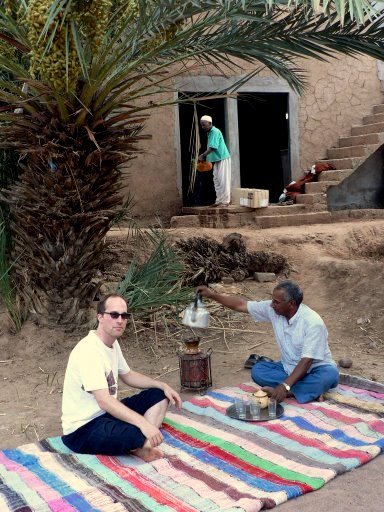
We stopped in the middle of the route, and parked the car on the side of the road. Abdul invited us to come out and follow him. We saw a quite simple house, and some very friendly people. We took some pictures, tried dates from the trees and eventually Abdul came to us and said ‘ you are quite lucky, they will serve you tea.’ With that much luck I couldn’t say that I didn’t want to drink it, and gathered the sweets we had brought with us to contribute somehow and joined them. A carpet was laid on the ground outside, and we sat down observing the ritualistic preparation. First came the boiled water and then some sort of powder (on the box it read ‘gunpowder’…). The water was poured in and out a couple of times before the tea was made. And then it came, a rock of approximately 16cm2 of sugar! We look at it in awe, Abdul crushed it down into the pot, which was about half its size, and poured some water in and served 4 glasses of tea. He still needed to make one more glass so he got some more sugar. And this way the mistery was solved, they weren’t spoons after all, they were sugar meteorites!

About the trip to Morocco


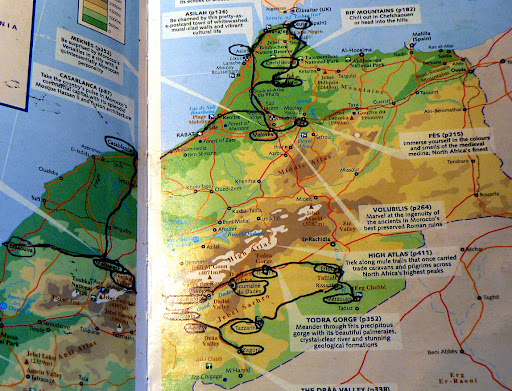
As some of you know, I finally went to Morocco this September. I have written about the meaning of this trip to me in other topics (mainly in my Brazilian blog), but I have never really written about the trip itself. I went to Morocco carrying two return tickets: one for 20 and one for 34 days later. I ended up staying the 34 days and I would have stayed longer, had a small (very small) sense of responsibility (and missing my husband) not started to .

As usual I got prepared the best way I could. I read the guides, romances, history, tips etc. Not so much to be prepared, but more from a desire of starting my trip as soon as the tickets were bought. And as usual every book said a different thing, every person had a different opinion. They were unanimous only in that I should dress modestly, with long sleeves and long pants or skirt, and that I should expect to be approached by everyone.

So the 3 of us (Haiko, Adriana and I) were prepared. We carried few clothes but they were according to the suggestions. We arrived at 9am in Marrakech. It was amazingly hot, there were numerous lines to go through immigration, and it took us a long time to finally get into Morocco. They took our data, and gave us an entrance number in order for the government to know where we were at all times.

When we finally came outside, Mounia , my friend, was waiting for us. I got emotional at seeing her after a few years. And most surprisingly she was dressed exactly as she did in NY: with a sleeveless top.

“But Mounia, we were told that we should avoid even short sleeves?!”
She smiled and said that that was silly, and that everybody dressed as they wished.

We entered her car, and went straight to her apartment. A beautiful and modern place decorated with her beautiful paintings in the centre of the Ville Nouvelle (the new town). Waiting for us was Hafida, Mounia’s childhood nanny, who had prepared a monumental breakfast. Mounia and I spoke French, Hafida and Mounia Moroccan. Hafida veiled to go out, Mounia did not. And right there in the beginning of the trip, even if I did not know it at the time, Moroccan life started to paint itself. A world of strong contrasts, of social and gender inequality unfolded before our own eyes. Inequality plasticized by the difference of languages. A world of mystery and disconcerting beauty always hiding behind heavy doors. A world divided between the religious and the modernizers. We had entered a world of enormous hospitality, amiability, but also of enormous social control. A world of antagonistic forces, kept by a king, who everyone seemed to love. His picture hanging on every public wall.

  • Mounia Dadi
  • is a painter and lives in Marrakech