The Diary of The Unsaid

I should have flown to India. Instead I bought a diary. I called it the Diary of the Unsaid. I now seat in  a recently discovered cafe in Sao Paulo. It is now my favourite place here. I discovered it because of the Diary of The Unsaid.
I seat alone with a crazy idea on my mind, confronted with all its implications.
What is the Idea? It is a modern version of a message inside of the bottle that crossed the world to enlighten someone. The modern version, my modern version, is a Diary. I call it the Diary of the Unsaid. The objective (the initial one at least) is to have a secret message arrive in a secret destination, to a secret receiver. The message is something I had left unsaid. Instead of letting it float I decided to trust the people I connect the most to: travellers!
Would it be possible to have a diary passing hand in hand all the way across the world? I chose for a Diary because I wanted that the travellers who would volunteer to carry it around the world could also be able to write themselves a message they had left unsaid to someone important to them.
and asked in the diary for people to send me an e-mail with the story of how it was that the Diary came to them. They should write their unsaid message on the diary and they could also write their unsaid message to me if they wanted me to post a letter to the person.
And now it is all ready. In about three days I wrote it all. I got lots of friends excited about the idea. And now, I seat again on the newly discovered cafe waiting for the first carrier to arrive. I wait for him knowing fully well it is him. What a great feeling that is!
Life is quite ironic. Once I told my friends about it I had very mixed responses. Ivana who is a psychologist said ” Julieta but do you understand you have only the power to choose the first person? Once it leaves your hand you have to trust others. I know you are a control freak so that is going to be very good for you”.
I barely slept that night thinking about this. It is true, I realized, I have but the power to choose the first person. And then when I had finally come into terms with that I decided it was time for me to find the right person. I knew it had to be a traveler. I am a traveler, I recognise them, but not here in my own town. Here I had no idea where to find them.
So I let destiny take me. I drove my car aimlessly and stopped in a trendy street. I entered a hostel and looked at total strangers realizing it immediately that it could not be them. I felt totally powerless. How could I find the right person?
And then I found this beautiful cafe. “La da Venda” it is called. It means from the store. It is a lovely cafe/old store themed place. I sat and told the story to the lady who worked there. She sympathized with the idea and said that maybe I could find someone here.
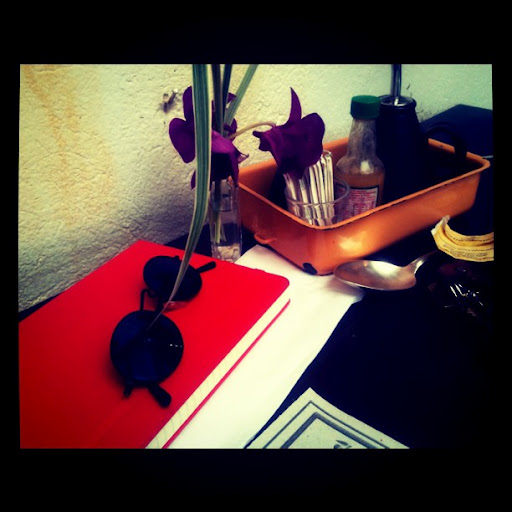
I turned on my Ipad to write and suddenly an Israeli friend of mine came online to tell me I was going about it totally the wrong way. I could not search for the right person. He asked me why did I not go there and deliver the message myself, why did I not say it to the person? And I explained to him what I had realised while writing the Diary. I did not simply want my message to be delivered. I wanted to connect to a sense of serendipity, a sense of fate. I wanted for the message to arrive through the blessings of the people I connect most to: travellers. And so he completed, “then you must wait for the traveler to find you!”
It was a poignant moment to be seating in the most bucolic place ever and to realise the irony. I did not even have the power to choose the first carrier. My power relied on recognizing the carrier for its specialness. Retrospectively, I knew exactly who they could have been in the past. It could have been Michal, Sara, Vesna, Francis, Caue, Fred, Nick. It could have been so many people I encountered. I would have recognized them.
What my friend statement seemed to imply was that not only I could not control things, but that I needed to do what I am the most disastrous at doing: I needed to be patient! 
I drank my last sip of coffee, looked around at the white wall, which is filled with green vases; I looked up at the blue sky, down to the pebbled ground. I looked at all the colours in the little cafe and felt if nothing else the diary had already given me a lot. It had given me a place in Sao Paulo!
I then drove home knowing it would probably take time till I would encounter the right person.
The irony of life never seizes to amaze me….. As I reached home I got a message from Ilan. 
When I lived in Nong Khai I became close friends with a Brazilian couple who were finishing a one year trip around the world. It was somehow rare to find Brazilians in the hidden places I go to. They came and I just wanted them never to stay forever.They had to leave, and were going to meet Ilan in Laos. They told me then that I should meet him since he was such a great guy.
I broke my foot in Thailand and came back to Brazil. One day out of the blue Ilan sent me a message saying that considering we had so many friends in common and that we had lived and had travelled so many similar places he thought we should meet. I replied jokingly that I d become friends with any Brazilian who knew that Laos existed.
And so when he randomly wrote me just as I had stopped searching for the right carrier I knew in my whole body it was him. I asked him if he wanted to be the carrier, and even before I explained anything he said yes!
And then, he had a million ideas. He was excited. He called it “our” diary.  He said it was “A treasure”. He wanted to write a book about. All that dismay feeling I had disappeared. What an illusion power and control are. The greatest gift that this diary has already shown me is that if we let it go a bit we can be witness of the mystery of the universe.
I seat here under a blue sky. I am back at La da Venda. Where else could I pass on my diary? Where else could the diary seize to be mine to be freed to do whatever is intended for?
In the mood of recognizing synchronicity everywhere I received an e-mail from the great jazz pianist Yonathan Avishai. We had spoken of this feeling of connection. We spoke of music. Now as I am about to let my words fly out there, I feel like a musician whose music transforms, and is transformed in the path. I remember again that cry of the of Rajasthan, I remember the klezmer. I remember that nothing is ours, but temporarily in our company. I am about to let go of the Diary of the Unsaid and I feel great joy.
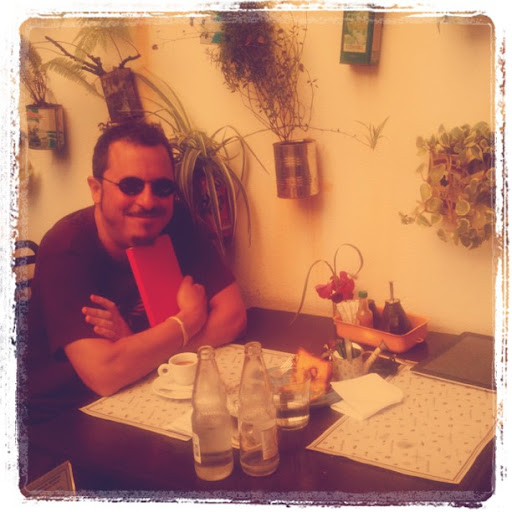
6 hours later. We drank teas and coffees, we travelled through distant lands. We recognized a million synchronicities. The weather changed. And I let the Diary go… I feel a bit of hesitancy, a bit of fear, but yes, I feel great joy.

A Wondering Soul

I have not been writing that much. It always happens when I am quite uncertain. Which is often 🙂 I am about to start a road trip with my brother in Brazil. My brother and I, even though we come from the same family, are incredibly different. He works crazy hours for the financial market, I travel. We have not lived in the same country for almost 15 years. We were always somehow in different places. It only happens for us to spend time together ( lately ) when he changes jobs. Last time he came to Europe, and I felt I was actually meeting him for the first time.

I shamefully confess, I knew little of what my brother thought, and never did I imagine in my wildest dreams he was so intelligent. Capable of always pining down a flaw in an argument in a second even if he had never heard  any of that stuff before. I took him everywhere I thought was interesting. And he tried his hardest to hear the stories of anthropologist, philosophers, scientists, and artist, but as he left me he confessed, though it had been an incredible experience, and though he thought the people he met worked incredibly hard to live what he considered  “ economically difficult lives”, he could not wait to go back to work, and to go back  to his comfortable life. I understood it. It was a nice time, but it had to end.

Now, he has changed jobs again to do something more important in some new important place in his world. And he has one week to travel. In his life, that is a lot. And so we decided on the spur of the moment to go somewhere together on a road trip. Could we even manage to accommodate both of our personalities in a road trip? Who knows, but I am looking incredibly forward to it as I wait for him to appear here in a second having signed up all papers he had to do before we go.

It is a road trip. And that is already me…It is in a fancy car, in Hotels and that is him 🙂

I spent this weekend listening to music. Music that spoke directly to my soul. In Sao Paulo some years ago started something called the “Virada Cultural”. It is 24 hours of music and art, and cultural events all over the city. For twenty-four hours people gather all over the city to do different things. It is an 18 million people place, a violent city, In that one night people go by tube (which works that day 24 hours )to places they usually don’t. Economically underprivileged citizens can afford to go to the expensive theatres they usually cant, rich kids go downtown to spend the night in the middle of all they usually don’t see.

I had never been in Brasil for a Virada Cultural. And I absolutely loved it. Though I confess I ended up joining before the virada ( which is only Saturday to Sunday) on Thursday to take part on a program called “music connections” organised by the Pianist Benjamin Taubkin. The project brought together Israeli and Brazilian musicians. For 5 days I spent time with these people which led me to feel again that I have such a strange connection to music, the middle east, and a wondering soul.

As I sat on the first night in the theatre inside of the cultural Jewish Centre I started my internal travel. It actually started when I entered the building and had to scan my things in a metal detector. It felt like I was in Israel. But back to the Music. I sat. And suddenly came together on stage Brazilian- out -of –this- world percussionists who played from traditional percussion instruments to pans and plates, with Israeli Talmudi brothers (Accordion, Sax and Clarinet) and Brazlian Tuba, Trumpet and trombone players. As I sat there and the Clarinet screamed I could see in my mind the Rajasthani musician singing the Kabelya gipsy cry. The joy and the wondering pain that comes with a wondering soul was there. I traveled in my mind from India all the way to Brazil. I saw Kashmir, Rajasthan, Mc Leod, Israel, Palestine, passing thought the Balkans, Turkey to arrive in northeast Brazil. What is it about music?

The following nights of jam sessions and concerts were stronger and stronger. Seeing the musicians who come from different worlds getting so excited, so moved recognising rhythms and melodies in music that apparently comes from another world was breathtaking. It becomes so evident this humanity that connects us all.

I sat there feeling home. In that essence. In that music. I was so moved that I wondered whether I was a Gipsy, or a Diaspora lost Jewish woman. I felt so at ease again in just being. I felt so thankful for these musicians. I then joined the Virada cultural in an unexpected concert at 6 am. In the centre with people of different social classes, listening to Beatles in the rhythm of Samba!

It ended last night for me in Jazz. I was back to New York for a while. The jazz pianist Yonathan Avishai played with a Joata, a Northeastern Trumpet player from Brazil.  And then in the end back were the Talmudi brothers to end it all up in a celebration of diversity and similarity.

Yonathan told me he was moved. He had not been used to exchanging so much. Usually he just goes for a while to play but spending so many days exchanging had been amazing. I knew all too well what he meant.

Reacquiring my gypsy soul I made peace with myself. It is time to go. I am going on a road trip with my brother, and then I ll follow the cry from Rajasthan, the trumpet from Klezmer. Yes, I guess I have not written before because I was postponing confessing I am going back to the Road. And I am not sure where it will take me.

Brasilia

I am in Brasilia, the capital of Brazil, which was built from nothing in the end of the 50’s and “opened” in the 60’s. I had never been here before. Gabi, my friend who studied with me at the Lse, seats next to me, she is writing a report. People around us study to pass the exams to get a governmental career. It is one that pays well, and is stable. it is one that non public workers usually condemn.

Brasilia is a strange place. Wide open, full of concrete, green, disconnected. It feels to me to reside stereotypically in the Autism spectrum. It is mechanic, functional, and deprived of “theory of mind”. People are not seen walking in streets and to go anywhere it seems to take ages inside of a car in endless roads. There seems to be not that many corners, to change sides I feel we are always taking rounds and crossing under roads. It is like people don’t cross each other, they go round.

I am no specialist in architecture and I am not a visual person so all I feel here is the absence of emotion in the streets. It looks soviet. I wonder what would my dear friend Michele say seeing all of this. I actually wonder whether he has ever been here when in Brasil. When I was in Rome he had the brilliancy of inventing a way to tell me about architecture. He told me (invented) stories of the people behind the buildings he showed me. He realised within minutes I would never be able to focus that much in architecture alone, so he adapted and brought people into it, he brought stories. And in Rome architecture is so full of life that it was probably not a difficult task. Mic what would you say here? I keep wondering…

Most people would conclude from these lines that I am therefore not liking Brasilia. That is actually not really accurate at all! I probably would have not liked had I not known Gabi… but Gabi took me to Beto, and he played the bass, and Beto took me to Oswaldo, and then they took me to a house party. Oh, yes apparently people are bored here with their bars and so they have house parties where everybody knows everybody.

Brasilienses are a new people. They are the children of people who came from everywhere in Brasil to live in a constructed city in the middle of nowhere.

I look around and I see people who study. They want stability. As Gabi puts it “they want no challenges after the exam”. But Gabi is not like that, nor is Felipe, nor is Beto. I guess here in Brasilia inbetweeners and rooted are more seeable than most people in other places. The stability that seems to have been so inorganically built attracts some. It also drives others out. others that come back and no not how to adapt.

And Brasilia is surrounded by a world of esotericism I am yet to discover. So many cults, and groups and villages. It seems truly like polar manifestations. Brasilia feels concrete, these villages sound non material. In the houses of the people I met here I feel warmth. The time, thanks goodness, passes slower than in Sao Paulo.

Jardim Horizonte Azul

Today I am going back to the slum. I have been postponing writing properly about the organization where I spent one week because I want to be the most accurate on the information as possible. As time goes by however, I loose the accuracy of feelings.  But this weekend as I spent the days in a mountainous region around Sao Paulo, with people who rock climb I was given back both the feeling of encountering within, and new possibilities of movements in my foot.


I stood there night and day far from the constructions of the city watching the sun set with even more colours then in the Mekong. What is about the sunset and me? When it starts, and I feel a relief for the day being swallowed by the night I always become static. It is not any sunset that does this to me. It happens only with the ones that take time, the ones where the disappearance of the sun is in fact but the beginning of it. The festival of colours then seems to never stop. It is never just a fast transition between night and day. It is a whole journey that seems to pass through infinity of colours that never repeat.


I sat there watching the night little by little swallow the day. Watching every single star show up for work. The moon smiled gently there in the horizon just a bit above the mountains. And as I looked at the moon I remembered the joy I felt in this institution in the slums of Sao Paulo.


I left you last time in the buses. And so it is that as I walked out from the last bus, I had to walk up a street to find the Associacao Jardim Horizonte Azul. It was not too hard to find it I had to just follow the sounds of happiness. The gate opened into a large green area with little houses built simply but full of colours. Inside, and I could see from outside children laughed and ran and played.


As I went in everyone in my path greeted me. “ Are you a foreigner?”. Or are you here with the school? Probably both, probably none I thought to myself. “I am looking for Joana.” “Oh, you are looking for the teacher? She is always everywhere.”


Joana is my aunt, and what an exceptional woman she is! I always knew that but spending this week with her and her 12th grade class there made me realize it even more strongly. She takes her year 12th of middle upper class students to spend a week volunteering in this association. She is not only a teacher. She is their council, and friend, and idol. It is not because she is perfect. Not at all, it is simply because she has taught them as she has always taught me that we must embrace our vulnerability. Accept the possibilities of our behavior and never compare ourselves to others, neither to feel better, nor worse.


A week in an Association in a very poor area of our city trashes all of our conceptions. It is hard for me who have been working on it for years for those 17 years old full of doubts, and dreams it is mindboggling.


Why should I be talking about them and not the association is the question in my mind. Well, it is because it was through them that I discover the work of the Association. This 17-year-old boys and girls worked everyday from 7 to 4 in a range of activities. We painted houses to make them more colorful for all of us, we worked in the vegetable garden to have real food, organically grown for the children, we worked in the kitchen making breakfast and lunch that would pass any considerations of Jamie Oliver. We helped the workers in the nurseries, and in the classes from babies to 17 year old. We worked on crafting and of course through all this work we met the community and each other.


Every night my aunt made the class seat in the room we all slept to tell their day. It was a written journal. It was moving beyond belief to hear these sheltered kids tell of the tiredness, joy, and difficulties during the day. It was wonderful to be able to share with them what happened and together discover parts of the place we could not have seen on our own.


I spent lots of time in the kitchen. Anyone who knows me well knows how truly remarkable that is. I don’t really cook. I like kitchen tales though. And Silvana the lady who lives there in the community and works in this kitchen for years feeds not only people’s body but also their souls. She was patient to have us there I d imagine probably making it all slower. She always smiled saying we were helping. And as we cooked, and cut and talked the children from the Association would stop in front of us on the open kitchen window to talk to the ladies and men who worked there. From little children to 17 year old they all came after having left their school.


These are the lucky ones, who have gotten a place in the Associaiton. It takes about 2 years for them to be able to get in. Not enough place, nor money for everything. They never want to leave there. It is incredible. I feel like it does not matter how much I write I will not be able to convey the importance of this work. When these 17 years old are there learning music, planting, playing, wood work they are not in the streets falling prey to drugs. When these children come it might be the first time they ever have fruit in their lives. When their mothers start to participate in the project they learn how to keep breastfeeding longer, how to raise their children in a healthier way.


This became clear to me when I visited the UBS ( Basic Unit of Health) in the area. This organization is so respected that the government of Sao Paulo put them in charge of taking care of 14 UBS. I went for a visit and by chance arrived on a day where mothers with babies of the slums, and neighborhood around where there for a talk. I was quite moved to see how clean and spotless was the place. There was even a garden built with money of the workers to make the place nicer. I sat in the meeting and saw the lady of the Institution I was coming from invite these mothers to join them in the Institute for a weekly conversation on motherhood.


“All of us have something to learn”


She put it nicely.


In the group were two ladies who had been part of the program (which for lack of money is now closed) “Dear Mom”. The program took 40 pregnant women and taught them about being mothers. It paid them about 150 dollars a month in order to keep them from working for 6 months so they could stay home and breastfeed, and take care of their babies. In this meeting there were two ladies who had been part of the group before. They immediately said they would come for the weekly meetings, and praised how much that project had made the development of their children better.


Later on, I sat with the nurse watching the procedure with babies of the community. Apparently, mothers should bring their babies every month to check if all is ok. I watched lots of mother come in. The nurse always asked them what they were feeding the babies, and about their general development. I could see empirically how the program “Dear Mom” worked. All other mothers except from the ones who had taken part on the program had babies that were less developed. The mothers who had been to the program not only were more articulated, but fed their children fruits, and vegetables, had breastfed them for a longer time, and did not use walkers, nor baby bottles, nor pacifiers. They also had adopted Steiner philosophy for toys, preferring wood and invented ones, to plastic ones bought in a store.


I was moved beyond belief. So much of my own (hidden) prejudices being trashed there. The idea that nothing works in Brasil, the idea that poor people don’t care, don’t know, the idea that little interventions in a sea of disparity does not make a difference. There I watched people from the community working hard as hell in maintaining something they could see (just as I could) made their lives better.


How many times did I hear from the workers that if the money was to finish they would have to work somewhere else but would come to volunteer there. It is not an aseptic place. It is full of emotions. Sometimes 17-year-old stop in front of the kitchen to tell something awful they did in the school. The ladies in the kitchen give advice. Sometimes 7 years old stop in front of the main office. The coordinator asks “ Do you need something”. The child says no. “Oh. I know what it is. Do you want a hug? I want a hug!” And so defying all laws in the developing world these workers hug and children and adults feel happier and continue their day.


That is what it is. This association is a place that not only brings food, medical care, and activities for these communities. But it actually turns them into a community where people realize how important they are for each other’s lives.  It is a place of tolerance to diversity, of craving for knowledge, of the possibility of art and holistic approach to living. But above all, it is a place that teaches what my aunt has taught her students and me.   We must embrace our vulnerability. Accept the possibilities of our behavior and never compare us to others, neither to feel better, nor worse. Only in the limits of our development can we truly encounter others. We have to be honest about that. In doing so we transpose our own limitations. This would become even more clearer later on the night of poetry, and on the farewell day where 12th graders from upper class Sao Paulo where put to exchange openly with the 15-17 year old kids from the area their perceptions of each other. There all of our limitations and prejudices would be spoken out loud. I felt like in an encounter of Israeli and Palestinian. I was somehow shocked to notice how deluded we are in Brasil to ignore the fact that this is just as much an apartheid state. But I guess I will have to write about this later.

Carnival and the Ephemeral Identity

It is incredibly hard to decide what to write about from Rio. The days have been blue, the sun has never left the sky, and carnival has been carnival. I have reencountered friends I met when studying in Brasil 12 years ago, in NY 11 years ago, in England a few years ago, and even travellers I crossed Kashmir with last year. I have made a great new friend. A gorgeous Iraqi English woman. Of the strange things that happen to me. In one day I am partying with a broken foot in the street carnival with a Bahraini girl, and of the other I meet an Iraqi in Brazil.


There is something that makes me feel at ease with these gorgeous and complex women of the Orient. They have identities that are so complex. I myself feel a little bit divided in this mosaic of identities. So I lay in Bikini in Ipanema, admiring the gorgeous people around but hoping for Sara to arrive since I know she will understand this multiplicity I have inside.


We will inevitably talk about the world. About emotions. About our experiences in Israel and Palestine. We will laugh and be intrigued by it all. Like foreigners who have crossed too many borders we will feel no belonging to a specific identity, while at the same time feeling a bit of them all. We will feel just like human beings, we will find familiar and strange things here together. Oh yes, it is true, I forgot, but this my country, I should somehow be an expert on it. I am not. In fact, I am not at all.


I walk around the Carnival in the street with my broken foot. The street is packed. There is music, there is joy. I have no phone. I search the purple hat of yet another friend. People are surprised I am alone. Boys and men offer kisses, marriage proposals, unforgettable nights, smiles, and when I explain I have just come back from another world that I do not want to waste their time of Carnival to my surprise they offer help.


The thing is that Carnival is a time, an ephemeral possibility of it all. It is a time in Brasil where people party in spite of it all. And in Brasil partying is incredibly related to sexuality. The Bahraini girl is shocked and marvelled by some gorgeous Carioca ( native of Rio) who just out of the blue kisses her. I am Brazilian and I am shocked too. So I explain as I walk around to these beautiful guys that they should not waste their breath on me, I am here on a mission, I am searching for a friend.


To my surprise my apparent lack of desire to engage sexually, but still engage humanly puzzles these boys. They then want to know where I come from, who am I, about Buddhism, and the East, do I need help? It is almost like once I just talk plain normally they feel they must take care of me in a non sexual way. It is funny. I have many conversations which are not typical at all. It somehow feels like anywhere else in the world.


There is one part of me that loves this joy, this easiness of it all. People look at my broken foot and congratulate me on not letting it stop me from partying. I love the fact that everybody talks to everybody. Another part of me feels incredibly lonely. I have yet another conversation with yet another stranger and he tells me of a poetry book called ” distracted we will win”. I who always feel we can either in life use things to distract ourselves from ourselves, or encounter ourselves and the others feel very puzzled.


I just can’t, and do not know how to do it. I love the joy. But if I am distracted I am not fully present I therefore cannot feel it. The stranger then explains to me that he sees “distraction” as a way of stopping the mind. A way of just being in the body. I am completely puzzled. That sounds Buddhist to me. Stop the mind, being present. But how can he call this being distracted? I walk a bit more till some other stranger seats next to me.


I am tired I seat on the stairs. I need a rest and I decide to just look at the parade in front of me. This new stranger has melancholic eyes. She offers me a smile, candy, and many words.


I seat observing this human manifestation. I feel happy. I feel puzzled. I feel intrigued by how much Brazilians touch each other. Sara is Iraqi and having spent one carnival night  in rio while the rest in Bahia feels this carnival is quite moderate. Almost European.


As she says that I laugh. I remember meeting in Rome my Italian friend who lives in Palestine and who in Rome was now shocked at the clothes of Italian girls.


This multiplicity of identities is woven in such an intricate way that I need as much touch as a Brazilian when I am in Europe, I need to feel it viscerally like they feel in the middle east when I am in South East Asia, and I need to be present in a Buddhist way in the Middle East. In Brasil now, I feel I need space like they have in Thailand. I suddenly realise that the fabric of a traveller’s identity is not only complex but it is circumstantial. I am suddenly in Brasil and I feel home with a Middle Eastern. But certainly in the Middle East I would be listening to samba.

Kitchen Tales in Brasil

In Brazil it is said that nothing starts before Carnival. It actually means that when millions of people go down to the coastline of Brazil to celebrate New Year’s eve dressed in white and jumping waves (it is summer in Brazil)  in a celebration of Brazilian syncretism that mixes African and European traditions we do not really celebrate the new year. We celebrate this interim period we know will last until the year really starts after Carnival. Everything between the 1st of January and Ash Wednesday is not really that serious. Well, one could argue nothing is ever that serious in Brazil. In some corners the preparation for carnival starts as soon as carnival is over.

It has been 11 years I have not been in Brazil for carnival. And had I not broken a foot I would not be here this year either. But I am and in a broken foot I decided to behave in a Carnival way. I decided to live my fantasies for a brief period when all is possible. I decided to go back to Rio, which is known by the Carioca ( people born in Rio), as the cidade maravilhosa ( the wonderful city).
Rio is without a question beautiful to the point of taking your breath away. Every single time I go to Rio I am flabergasted. I do understand every single time why it is that Cariocas have a tougher time living abroad then we Paulistas ( people who come from Sao Paulo) do. In all inequality that Brasil is, Rio’s beaches are democratic spaces, the bars where the traditional Samba is played is a democratic place where young and old, rich and poor gather to sing and play music. Yes I love Rio. It is usually there, in this little bars, with owners who tell the clients to shut up to hear the music that I feel more Brazilian. Usually I feel adrift wherever it is that I am.
Oh, the contradictions of me and Brasil. I live in a huge house. There are people here who work on making my life, and my family’s lives easier. Much easier. We don’t cook, nor wash, nor clean. Yet it is not that these work is made invisbly. No, as I wrote in my last e-mail, Claudia, one of the ladies who works here, even without knowing me as I arrived to say Hello flung her arms wide open around me and hugged me. Ever since that day whatever it is I am doing she shows up to tell me about her day, and nights, and life.
She, like million other northeastern Brazilians, came to the south east region to  search for a better life. People in the south usually make fun of them. They laugh of their accents. An accent that is even more melodic than the portuguese foreigners already feel is music. She told me her story. In pieces. Every piece amounts to one more tragedy which in her mouth comes out in laughter
Claudia is 34. She got pregnant as a teenager. Her mother had 8 children. She lost one to drugs. Claudia with a baby in her arms left her house after a fight and found a job as a maid. In the northeast, in some house where she had to work doing it all, she considered the boss a mother. The boss indeed helped her a lot while exploiting her at the same time. How can it be that these relationships are so mixed in Brasil? She speaks of her with love. Eventually she went back to her mother’s house. And her life ever since has been like that. Looking for jobs, leaving her children behind, and bringing them close whenever she was more stable.
Yes. she got pregnant again. She entered a relationship with a man she did not love to have her daughter close. He was nice at first, then he beat her. And then she beat him back. And he used her. And she left. To find temporary solace in the arms of other men. No she never lost her smile. Everyday when I hear a little more she has both tears in her eyes and a smile in her face. Every day she works incredibly hard, every night she goes out. Oh the contradictions of Brasil…
Nininha, a gorgeous northeastern girl, also works here. She is really beautiful. She also has a child who now cannot go to school because there is no place in the public school of the neighbourhood. Private school is unthinkable for those who do all the jobs that people in my social class do not. As I am here writing she shows up to ask me whether  I have seen a cd with the pictures of her daughter. Apparently my aunt had borrowed it. I had not. But I had seen the whole album of pictures of Claudia’s family and so had my cousin, my aunt, my grandmother.
They love my grandmother who is according to them the best boss they had ever had. They would never leave her even if she wanted them to go. They even bought her a gift the other day. My grandmother who is 87 and still goes to the gym, and drives, travels, and goes to museums told them “she needed nothing and that  they should not waste the money they had worked so hard for with her”. But they wanted to. Hearing them tell me that story I remembered my own wedding when Terezinha, who is my age, and works for my parents for almost two decades gave me a huge amount of money compared to her salary as a gift for my wedding. I told her I could not possibly take it. She insisted it was her way of helping me to start a new life. With my eyes full of tears, I took it, and then told my mom to give it back as complimentary bonus after. Oh, the contradictions of Brazil.
I am going to Rio this weekend. Searching in these brief illusions of carnival solace for my contradicted body and soul. Claudia is happy beyond belief. It is not so much because of Carnival. It is because now she is stable enough to bring her children from the north to live with her here.
“I have never abandoned my children. They know. When I organise myself I go get them.”
That is a bit of Brasil. A world of inequality where in one place people are shot because of it, and in others people share laughter, stories, and warmth in spite of it.
Let’s see what happens when the year finally begins. Happy Carnival.

Chico Buarque

“Nao existe pecado do lado debaixo do equador”. Literally means that sins do not exist below the equator. This lyrics are part of one of Chico Buarque’s song. The singer and composer Chico Buarque is the nephew Brazilian Portuguese dictionary author, and the son of one of Brasil´s most important historian. Chico, as he is known, has composed love songs, carnival songs, passionate songs, political songs, stories and songs about so many other topics.  He has giving voice to men and women of so many different brazilian worlds. There are many many worlds within Brasil. He is considered by many our greatest composer. I include myself in this list that considers him as such.

I usually say that as soon as I land in Brasil I feel 3 things in the air : the violence, the sensuality and the joy. This time in a broken foot I did not stop to observe anything. Now I feel it all around me again. I just came back from a concert/play of Chico Buarque´s songs. It was a presentation on love. And in Brazil love is passionate. There are fights, and jealousy, and betrayals and forginviness, and passion, and fights and forgiveness and passion and figths and forgiveness and passion….

I looked around me and I saw women and men who sat around touched viscerally by those songs. They all knew them. They had all loved in that way. They had all once loved  “slowly but desperately” because there was no time,  they had all made ” samba and love” ,  they had all “mixed their legs through the nights not knowing which ones to use when they had to depart”. They all knew these lyrics.  So their eyes carried tears. It came from inside, from within, from the guts.
On stage a woman and a man enacted a couple ( did they enacted or were they really the thing ?) that went through an almodovarian vicious cycle of passion.  They loved and cried, fought and laughed. They sang, danced, recited poetry from all over the world…. the painted with neruda the night. In my poor translation it goes.

I only want 5 things
The first is love without an end
The second is to see autumn
The third is the grave winter
Fourthly comes the summer
The fith thing are your eyes
I dont want to sleep without your eyes
I dont want to be without you looking at me
I give up on spring so that you keep looking at me
neruda

I looked around and I could feel all of this violence, and passion, and joy in the air. It suddenly striked me what a world apart I was from spiritual chaotic India, Buddhist reserved and warm Thailand. Oddly enough Chico reminded me of different moments in Asia. It reminded of me floating in the Gaia listening to two older musicians play Dylan. I never liked Dylan but that night I learned to like. Mark, my friend from my PhD who came to visit me was there seating next to me. We were observing the small details of the night.

Mark is American but like me he left his country too long ago to actually feel connected to the culture. That night he connected to something. He connected to the music that came from his home country. Tonight I connected to mine. I remembered being in a vipassana meditation retreat and learning that passion was as much of a negativity as anger. Through meditaiton we were practicing to erradicate this. I remember thinking to myself that a cure to passion would not sell that well in Brasil.

I sat throught the night not as moved as everybody around. I heard the music. The craving for passion. The feelings floating around me and thought I was somehow less brazilian in that I was not sure that that was such a great way to go about love. But then came the last song where Chico used the tenses of verbs to create and atemporal notion of love. A love that is not bounded by time. And then he talked about the “time of gentleness” that comes after the chaotic time. And then somehow the music walked within me in places that other songs do not reach. I shed a tear. I somehow knew in my body that my soul was finally arriving here.

The Arrival in Brasil

It is 30 degrees here in Sao paulo. I arrive and go straight to the hospital after more than 30 hours travelling. Emergency room. There is something comic about it. The man who calls out the patients does not manage to get anyone to come in. After calling out 5 people n a roll who seemed to have disappeared he exclaims

” i guess i should go call the patients in Deola”.

I stop to wonder for a second what is Deola and then I remember it is the bakery next door. i am amused. ” That is Brasil”, I think , “even the patients don’t take their sickness that seriously.”

All is so wonderfully informal. The way the fellow Brazilian/Lebanese who also needed a wheel chair in the airport starts to chat with me while we wait for our luggage. As soon as I mentioned I had been to Israel and Palestine he exhales with admiration.” Have you been to Nablus? What a nice place.” He then teaches me how to be able to go from Israel to Jordan into Lebanon by ” losing” my passport there.” Easier this way. ” Then he gets my email so that I can get tips on where to buy Humus, and Tahina, and Zaatar and anything Middle Eastern I might need here in Sao Paulo.

I had been enchanted by the cordiality of Udom, my Thai wheel chair carrier, then surprised by the intense energy of my Dohan porter, and had been relived to be welcomed home by Paulo the Brazilian one. He wanted to know what had happened to me, where was I, told me stories and then when he had cut all paths to make my way shorter, because my flight had landed earlier he told me not to worry he would stay with me till my parents would arrive.

It was not necessary as I could see my parents smiling and carrying me a flower as soon as I went out. When my father asked Paulo, the porter, whether he could take me all the way outside so that he could drive to pick me up, he offered to take me all the way to the parking lot so that I would not have to wait any longer. ” she has already travelled too much”.

It is a culture of exceptions, or “circumtiality” that creates many problems but also this feeling of easiness, of particularity, and happiness.

I am happy but slightly off place, mixing words in English, wanting to “way” people.

I had been travelling more than 30 hours but I somehow don’t mind at all going straight to hospital. The doctor looks at the X-ray I brought with me. He sees no reason for needing an operation.

” if you foot is as it is here you should be fine just with imobilisation. “

I feel a sudden rush of adrenaline inside my stomach. i remember every fall I had since I casted my foot. Every walk, and climbing stairs, and attempts to dance, and step, and hop, and climb. Could it possibly be that I managed to dislocate a simple fracture because of my inability to stay still?

I have to do a new X-ray. It is Brazil which means everybody asks you what happen to you and they all tell you what had happened to them. I want to kill the man who keeps telling me about operating my foot. He speaks with the confidence of a surgeon. He is just a patient thank god.

When I am brought back to the doctor have he exclaims ” the good news is that this is a simple injury and whoever told you have to operate is crazy.” I am relieved and terrified at the same time.

“What are the bed news?”

” There are no bad news.”

I am relieved beyond belief. I want o hug him and the whole world.

” In two months you should be ok do do whatever you want”.

I go back to my grandmothers home and I meet Claudia the new lady who works there. I had spoken to her many times before. I walk towards her to introduce myself. Before I even finish the sentence she walks towards me, flings her arms around me and gives me a hug.

I am slightly surprised. I am surprised that I am surprised? The truth is that I realise so many things seem strange to me. I am so affectionate by most standards in the world, I am so informal. But that what made me feel a little bit Brazilian abroad now seem like diluted here. And what is odd is all the rest that I picked up living abroad.

I am not very sure what will I do in Brasil. It has only been one day. It might even be that it is odder than going to Burma. Surely more strange than going back to India. Maybe that is it. Maybe there is truly never going back anywhere. Those are figures of our imagination. We are usually simply just going. Going “home” might just mean you go to a place where the social rules apply to you more, where the people expect you to know them. And some you do, but some have been trashed so long ago that they are just as odd as the ones that belong to the foreign villages.

There is just “going” I guess. I try to remember the beginning of India. one step at the time. Now this is a literal and figuratively thing. I tried to remember that it takes a while for the soul to arrive. I guess mine still is watching the sunset in the Mekong. Getting ready to float in the Gaia. One step at the time and I know it will also arrive here.