Unknown's avatar

About julietafalavina

Eu escrevo da minha vida, e agora sobre a minha recuperação da saúde .

A Wondering Soul

I have not been writing that much. It always happens when I am quite uncertain. Which is often 🙂 I am about to start a road trip with my brother in Brazil. My brother and I, even though we come from the same family, are incredibly different. He works crazy hours for the financial market, I travel. We have not lived in the same country for almost 15 years. We were always somehow in different places. It only happens for us to spend time together ( lately ) when he changes jobs. Last time he came to Europe, and I felt I was actually meeting him for the first time.

I shamefully confess, I knew little of what my brother thought, and never did I imagine in my wildest dreams he was so intelligent. Capable of always pining down a flaw in an argument in a second even if he had never heard  any of that stuff before. I took him everywhere I thought was interesting. And he tried his hardest to hear the stories of anthropologist, philosophers, scientists, and artist, but as he left me he confessed, though it had been an incredible experience, and though he thought the people he met worked incredibly hard to live what he considered  “ economically difficult lives”, he could not wait to go back to work, and to go back  to his comfortable life. I understood it. It was a nice time, but it had to end.

Now, he has changed jobs again to do something more important in some new important place in his world. And he has one week to travel. In his life, that is a lot. And so we decided on the spur of the moment to go somewhere together on a road trip. Could we even manage to accommodate both of our personalities in a road trip? Who knows, but I am looking incredibly forward to it as I wait for him to appear here in a second having signed up all papers he had to do before we go.

It is a road trip. And that is already me…It is in a fancy car, in Hotels and that is him 🙂

I spent this weekend listening to music. Music that spoke directly to my soul. In Sao Paulo some years ago started something called the “Virada Cultural”. It is 24 hours of music and art, and cultural events all over the city. For twenty-four hours people gather all over the city to do different things. It is an 18 million people place, a violent city, In that one night people go by tube (which works that day 24 hours )to places they usually don’t. Economically underprivileged citizens can afford to go to the expensive theatres they usually cant, rich kids go downtown to spend the night in the middle of all they usually don’t see.

I had never been in Brasil for a Virada Cultural. And I absolutely loved it. Though I confess I ended up joining before the virada ( which is only Saturday to Sunday) on Thursday to take part on a program called “music connections” organised by the Pianist Benjamin Taubkin. The project brought together Israeli and Brazilian musicians. For 5 days I spent time with these people which led me to feel again that I have such a strange connection to music, the middle east, and a wondering soul.

As I sat on the first night in the theatre inside of the cultural Jewish Centre I started my internal travel. It actually started when I entered the building and had to scan my things in a metal detector. It felt like I was in Israel. But back to the Music. I sat. And suddenly came together on stage Brazilian- out -of –this- world percussionists who played from traditional percussion instruments to pans and plates, with Israeli Talmudi brothers (Accordion, Sax and Clarinet) and Brazlian Tuba, Trumpet and trombone players. As I sat there and the Clarinet screamed I could see in my mind the Rajasthani musician singing the Kabelya gipsy cry. The joy and the wondering pain that comes with a wondering soul was there. I traveled in my mind from India all the way to Brazil. I saw Kashmir, Rajasthan, Mc Leod, Israel, Palestine, passing thought the Balkans, Turkey to arrive in northeast Brazil. What is it about music?

The following nights of jam sessions and concerts were stronger and stronger. Seeing the musicians who come from different worlds getting so excited, so moved recognising rhythms and melodies in music that apparently comes from another world was breathtaking. It becomes so evident this humanity that connects us all.

I sat there feeling home. In that essence. In that music. I was so moved that I wondered whether I was a Gipsy, or a Diaspora lost Jewish woman. I felt so at ease again in just being. I felt so thankful for these musicians. I then joined the Virada cultural in an unexpected concert at 6 am. In the centre with people of different social classes, listening to Beatles in the rhythm of Samba!

It ended last night for me in Jazz. I was back to New York for a while. The jazz pianist Yonathan Avishai played with a Joata, a Northeastern Trumpet player from Brazil.  And then in the end back were the Talmudi brothers to end it all up in a celebration of diversity and similarity.

Yonathan told me he was moved. He had not been used to exchanging so much. Usually he just goes for a while to play but spending so many days exchanging had been amazing. I knew all too well what he meant.

Reacquiring my gypsy soul I made peace with myself. It is time to go. I am going on a road trip with my brother, and then I ll follow the cry from Rajasthan, the trumpet from Klezmer. Yes, I guess I have not written before because I was postponing confessing I am going back to the Road. And I am not sure where it will take me.

Back in Nablus

I am back to Nablus. And when you travel any place you go back to feels a bit like home. Every Tuesday the Turkish bath is destined for women and so I decided to come back for that. I of course also came because I like Nablus and the people I met here. The day I spent in the Hamman, or Turkish bath, was interesting. I was able to talk, or at least attempt to communicate with  many Palestinian women. The Turkish bath becomes a huge party. Women smoke narghile, dance, drink teas and coffees, have beauty masks put on,  massages, lay down  in the hot stones, seat in the steam rooms, and of course talk. Although my experience in the Hamman was really interesting, as I just come back from watching Real Madrid beat Barcelona I feel I should talk about that.


I watched the game with Yahya, Ehab ( sam’s brothers) and Jaafar. It was with Jaafar and Yahya that I drove to Bethlehem and saw the wall. Today for the first time we talked of the Intifada. I dont know how it happened as Yahya does not usually talk that much and definitely not about politics. The thing is that life here is political so not talking about is not really an option. I think I asked him whether he remembered the second Intifada. I knew he would as he was 15 at the time. But my question just demonstrated my naivety. Learning about the Intifada from afar is just so different. Yahya told me that of course he did remember there was no way not to.


“I remember we were waiting for 2 weeks and we knew they would come any day. so we bought food. we were told not to leave the house but for the essential. every night i put Mahmoud ( his younger brother) to bed and told him stories so that he would not be scared. but the thing was that I was scared as hell. But just the first three days then you get used to it.” He showed me videos and spoke casually of being shot at with rubber bullets  while rescuing people. I asked if he thought that that would be a third Intifada. he said no ” nothing can be worse anymore”. I asked what was worse. ” i lost 6 of my closest friends he said. that is the saddest. the rest you get used to” He showed me videos of the roads I now know being invaded by thanks, and houses demolished. He showed me human shields. And then said ” you know. i was next to a soldier and he shot at a kid purposely to miss. I asked him why he missed it. and he said he could not shoot a kid. he had kids of his own. he did not want to be there but had to. not all soldiers are bad. but you must understand that many of them do horrible things.”


I again had tears in my eyes. he spoke with calmness and that probably is what breaks me. he told me of being in jail. he told me of having his house invaded. of rescuing children. then we went to watch real madrid. Jaffar and i were supporting barcelona while Yahya and Ehab supported R Madrid.  We smoked Narghile and he asked me to ask Jaafar how he felt about the Intifada. ” It is sad” he said quietly. He told me about having a soldier in his house, being tide, having eyes covered while special unit soldiers used his window to shoot. then he told me about his father going to another house they owned and not returning. mother sent jaafar to go after father,  so when he got there he was kept. mother wondering why they were not back sent daughter… and eventually whole family was in the other house with the soldiers. they told me laughing. “they were in a secret mission but did not think that having my whole family missing would be suspicious. so they let them all go, but kept me as a way to make sure my family would not tell anyone”. they laughed. Ehab, 18 seeing my pain said ” jules, we know they have to do it, they also have not choice, they have to do what they are told.” that broke me a bit more. how could these guys be that gentle ? My eyes filled with tears once more. ” Jules, don’t cry, if we don’t laugh about it what do we do? that is how our life is. i wish i could travel like you. i wish i could have a job. but now it is like this we never know what could happen. please don’t cry. we are ok.”


I walked away to cry in the bathroom on my own, in silence. When I was able to I went back to watch the game. I apologised for crying. ” Please, Don’t apologise. You are the most compassionate person i have ever met. Meeting you has changed me a lot you know? You have open my mind” said Yahya. The kindness these boys who have been shot at, arrested, and who have thrown stones at jeeps treat me, the extent to which they are willing to go to rethink their beliefs, and ideas because of my questions bewilder me. There is a mix of maturity and matter of factness they take life which coexists with a naiveté and search for love. I have not encountered nothing of what I heard about Palestinians from my Israeli friends or from the media here.


I have been asking questions to all of those I encounter. I ask women and men of abuse, of veils, of children, of war, intifada, sex, west, friendship, family, humanity and they are far from being these incapable of critical thought islamophobics all over want us to believe they are. They are indeed religious and try to understand the world through the Koran but they would never refuse to think about a question not as a Muslim, not as a Palestinian but as an individual human being. It could be that I have been really lucky only to encounter the people who are really kind, human, and open to me. Or maybe it could be that kindness and respect allows for even those with the most different of beliefs to stop and think if it is ever truly ok to hurt someone. So far I have yet not encounter a single one that thinks, or says it is.


” Our life is like this now. we must not stop laughing right?” I agreed. And watched Cristiano Ronaldo score for R Madrid. The city went mad. Like anywhere else in the world football invokes all these emotions and feelings. Like anywhere else it brings joy to some, sadness to others, but most importantly it definitely distracts all from the harshness of the real world.


Brasilia

I am in Brasilia, the capital of Brazil, which was built from nothing in the end of the 50’s and “opened” in the 60’s. I had never been here before. Gabi, my friend who studied with me at the Lse, seats next to me, she is writing a report. People around us study to pass the exams to get a governmental career. It is one that pays well, and is stable. it is one that non public workers usually condemn.

Brasilia is a strange place. Wide open, full of concrete, green, disconnected. It feels to me to reside stereotypically in the Autism spectrum. It is mechanic, functional, and deprived of “theory of mind”. People are not seen walking in streets and to go anywhere it seems to take ages inside of a car in endless roads. There seems to be not that many corners, to change sides I feel we are always taking rounds and crossing under roads. It is like people don’t cross each other, they go round.

I am no specialist in architecture and I am not a visual person so all I feel here is the absence of emotion in the streets. It looks soviet. I wonder what would my dear friend Michele say seeing all of this. I actually wonder whether he has ever been here when in Brasil. When I was in Rome he had the brilliancy of inventing a way to tell me about architecture. He told me (invented) stories of the people behind the buildings he showed me. He realised within minutes I would never be able to focus that much in architecture alone, so he adapted and brought people into it, he brought stories. And in Rome architecture is so full of life that it was probably not a difficult task. Mic what would you say here? I keep wondering…

Most people would conclude from these lines that I am therefore not liking Brasilia. That is actually not really accurate at all! I probably would have not liked had I not known Gabi… but Gabi took me to Beto, and he played the bass, and Beto took me to Oswaldo, and then they took me to a house party. Oh, yes apparently people are bored here with their bars and so they have house parties where everybody knows everybody.

Brasilienses are a new people. They are the children of people who came from everywhere in Brasil to live in a constructed city in the middle of nowhere.

I look around and I see people who study. They want stability. As Gabi puts it “they want no challenges after the exam”. But Gabi is not like that, nor is Felipe, nor is Beto. I guess here in Brasilia inbetweeners and rooted are more seeable than most people in other places. The stability that seems to have been so inorganically built attracts some. It also drives others out. others that come back and no not how to adapt.

And Brasilia is surrounded by a world of esotericism I am yet to discover. So many cults, and groups and villages. It seems truly like polar manifestations. Brasilia feels concrete, these villages sound non material. In the houses of the people I met here I feel warmth. The time, thanks goodness, passes slower than in Sao Paulo.

Jardim Horizonte Azul

Today I am going back to the slum. I have been postponing writing properly about the organization where I spent one week because I want to be the most accurate on the information as possible. As time goes by however, I loose the accuracy of feelings.  But this weekend as I spent the days in a mountainous region around Sao Paulo, with people who rock climb I was given back both the feeling of encountering within, and new possibilities of movements in my foot.


I stood there night and day far from the constructions of the city watching the sun set with even more colours then in the Mekong. What is about the sunset and me? When it starts, and I feel a relief for the day being swallowed by the night I always become static. It is not any sunset that does this to me. It happens only with the ones that take time, the ones where the disappearance of the sun is in fact but the beginning of it. The festival of colours then seems to never stop. It is never just a fast transition between night and day. It is a whole journey that seems to pass through infinity of colours that never repeat.


I sat there watching the night little by little swallow the day. Watching every single star show up for work. The moon smiled gently there in the horizon just a bit above the mountains. And as I looked at the moon I remembered the joy I felt in this institution in the slums of Sao Paulo.


I left you last time in the buses. And so it is that as I walked out from the last bus, I had to walk up a street to find the Associacao Jardim Horizonte Azul. It was not too hard to find it I had to just follow the sounds of happiness. The gate opened into a large green area with little houses built simply but full of colours. Inside, and I could see from outside children laughed and ran and played.


As I went in everyone in my path greeted me. “ Are you a foreigner?”. Or are you here with the school? Probably both, probably none I thought to myself. “I am looking for Joana.” “Oh, you are looking for the teacher? She is always everywhere.”


Joana is my aunt, and what an exceptional woman she is! I always knew that but spending this week with her and her 12th grade class there made me realize it even more strongly. She takes her year 12th of middle upper class students to spend a week volunteering in this association. She is not only a teacher. She is their council, and friend, and idol. It is not because she is perfect. Not at all, it is simply because she has taught them as she has always taught me that we must embrace our vulnerability. Accept the possibilities of our behavior and never compare ourselves to others, neither to feel better, nor worse.


A week in an Association in a very poor area of our city trashes all of our conceptions. It is hard for me who have been working on it for years for those 17 years old full of doubts, and dreams it is mindboggling.


Why should I be talking about them and not the association is the question in my mind. Well, it is because it was through them that I discover the work of the Association. This 17-year-old boys and girls worked everyday from 7 to 4 in a range of activities. We painted houses to make them more colorful for all of us, we worked in the vegetable garden to have real food, organically grown for the children, we worked in the kitchen making breakfast and lunch that would pass any considerations of Jamie Oliver. We helped the workers in the nurseries, and in the classes from babies to 17 year old. We worked on crafting and of course through all this work we met the community and each other.


Every night my aunt made the class seat in the room we all slept to tell their day. It was a written journal. It was moving beyond belief to hear these sheltered kids tell of the tiredness, joy, and difficulties during the day. It was wonderful to be able to share with them what happened and together discover parts of the place we could not have seen on our own.


I spent lots of time in the kitchen. Anyone who knows me well knows how truly remarkable that is. I don’t really cook. I like kitchen tales though. And Silvana the lady who lives there in the community and works in this kitchen for years feeds not only people’s body but also their souls. She was patient to have us there I d imagine probably making it all slower. She always smiled saying we were helping. And as we cooked, and cut and talked the children from the Association would stop in front of us on the open kitchen window to talk to the ladies and men who worked there. From little children to 17 year old they all came after having left their school.


These are the lucky ones, who have gotten a place in the Associaiton. It takes about 2 years for them to be able to get in. Not enough place, nor money for everything. They never want to leave there. It is incredible. I feel like it does not matter how much I write I will not be able to convey the importance of this work. When these 17 years old are there learning music, planting, playing, wood work they are not in the streets falling prey to drugs. When these children come it might be the first time they ever have fruit in their lives. When their mothers start to participate in the project they learn how to keep breastfeeding longer, how to raise their children in a healthier way.


This became clear to me when I visited the UBS ( Basic Unit of Health) in the area. This organization is so respected that the government of Sao Paulo put them in charge of taking care of 14 UBS. I went for a visit and by chance arrived on a day where mothers with babies of the slums, and neighborhood around where there for a talk. I was quite moved to see how clean and spotless was the place. There was even a garden built with money of the workers to make the place nicer. I sat in the meeting and saw the lady of the Institution I was coming from invite these mothers to join them in the Institute for a weekly conversation on motherhood.


“All of us have something to learn”


She put it nicely.


In the group were two ladies who had been part of the program (which for lack of money is now closed) “Dear Mom”. The program took 40 pregnant women and taught them about being mothers. It paid them about 150 dollars a month in order to keep them from working for 6 months so they could stay home and breastfeed, and take care of their babies. In this meeting there were two ladies who had been part of the group before. They immediately said they would come for the weekly meetings, and praised how much that project had made the development of their children better.


Later on, I sat with the nurse watching the procedure with babies of the community. Apparently, mothers should bring their babies every month to check if all is ok. I watched lots of mother come in. The nurse always asked them what they were feeding the babies, and about their general development. I could see empirically how the program “Dear Mom” worked. All other mothers except from the ones who had taken part on the program had babies that were less developed. The mothers who had been to the program not only were more articulated, but fed their children fruits, and vegetables, had breastfed them for a longer time, and did not use walkers, nor baby bottles, nor pacifiers. They also had adopted Steiner philosophy for toys, preferring wood and invented ones, to plastic ones bought in a store.


I was moved beyond belief. So much of my own (hidden) prejudices being trashed there. The idea that nothing works in Brasil, the idea that poor people don’t care, don’t know, the idea that little interventions in a sea of disparity does not make a difference. There I watched people from the community working hard as hell in maintaining something they could see (just as I could) made their lives better.


How many times did I hear from the workers that if the money was to finish they would have to work somewhere else but would come to volunteer there. It is not an aseptic place. It is full of emotions. Sometimes 17-year-old stop in front of the kitchen to tell something awful they did in the school. The ladies in the kitchen give advice. Sometimes 7 years old stop in front of the main office. The coordinator asks “ Do you need something”. The child says no. “Oh. I know what it is. Do you want a hug? I want a hug!” And so defying all laws in the developing world these workers hug and children and adults feel happier and continue their day.


That is what it is. This association is a place that not only brings food, medical care, and activities for these communities. But it actually turns them into a community where people realize how important they are for each other’s lives.  It is a place of tolerance to diversity, of craving for knowledge, of the possibility of art and holistic approach to living. But above all, it is a place that teaches what my aunt has taught her students and me.   We must embrace our vulnerability. Accept the possibilities of our behavior and never compare us to others, neither to feel better, nor worse. Only in the limits of our development can we truly encounter others. We have to be honest about that. In doing so we transpose our own limitations. This would become even more clearer later on the night of poetry, and on the farewell day where 12th graders from upper class Sao Paulo where put to exchange openly with the 15-17 year old kids from the area their perceptions of each other. There all of our limitations and prejudices would be spoken out loud. I felt like in an encounter of Israeli and Palestinian. I was somehow shocked to notice how deluded we are in Brasil to ignore the fact that this is just as much an apartheid state. But I guess I will have to write about this later.

The Slums, and the border of within

People were always intrigued that I was never afraid of crossing borders to arrive in places that most people do not go to. It is true that when I crossed the wall to stay in the houses of strangers in Palestine I was slightly scared, or that when I visited Bolivia on my own I was at first apprehensive, or that when I decided to celebrate Ramadan in Kashmir (against all advices) I had a small hesitation. But never did I actually believe it was difficult to get to those places. I took all forms of transportation to arrive in the last village in Nubra Valley and climbed a rocky mountain, which was a few km from Pakistan without thinking it was far. I always ignored these voices of hesitation because I wanted to meet the other. As I have often put it: I wanted to hear those who have no voice.


So when my aunt, who teaches in a Waldorf school, invited me to spend one week volunteering in an association in one of Sao Paulo’s slums I was quite intrigued to realised I thought it was so difficult to get there. I did not really research the association I just asked her where it was. And my first thought was that it was too hard to get there, too far, too dangerous. I did not voice the thought, out of shame, but the truth is that my first impulse was of ‘impossibility”.  It is just out of the question to go there, I thought. This thought brought me immediately the question: How could it be that I who cross all kinds of borders. I who fly for days, and take several times buses for dozen of hours, and ricksaws, and tuk tuks, and boats, and shikaras in countries I often know no one nor speak the language found it sooo hard to take 3 buses to get to a slum in my own city of Sao Paulo?


It is because going to the slum in Sao Paulo involves crossing the borders of within. And those are way harder to cross. The return to my own country allows me to finally hear all of those who have no voice next to me.


It is also not without reason that I was apprehensive. As I talked to my Israeli friend who was talking on the Gaza situation I decided to research the statistics of homicides in the area of the association I was going to go to. In one of the neighbourhoods I was passing by only in one year (a bad one) 1777 people were killed. We are talking of one neighbourhood that houses 300 thousand people!


But so it is that puzzled by my own prejudices I decided to put my back on my back, retrieve my adventurer soul, a bit left aside since I arrived here, to cross all the borders of my own prejudices.


I took the first bus seeing things that were at first familiar. I drove it till the last point by that time not recognizing anything else anymore. On this bus alone it took me 1,5 hours. As I took this bus I kept thinking of the thousand (or maybe millions) of workers who take this journey (that only one part took me over one hour) every single day.  The second bus in another hour was going to take me to Jardim Angela the neighbourhood, which was considered in 2001 by Unesco as one of the most violent places in the world. It was truly like being in a different country for me. I knew nothing around and when I finally took the third bus with my backpack on my back intrigued to see how green this area was I was asked whether I was a foreigner.


I was puzzled. Has the time I have spent abroad changed me so much? And pondering about it I remembered that when I visited the neighbourhood where many illegal African immigrants live in Tel Aviv (which is so feared and avoided by my Israeli friends) people often started conversations immediately in English. I am usually taken for being Israeli in Israel and all over the world, but in that neighbourhood they never thought I was. It puzzled me then, like it puzzled me here. But I came to realise that that assumption had to do more with my attitude then with my looks. The truth is that the only volunteers, or people who were not from this poor neighbourhoods that went there were foreigners. This conclusion brought me another insight. Maybe it is because for all of us it is easier to help where we “know” of the less the context. It is probably easier to be empirical where our societies have not tainted us by prejudice of so called “factual information.


People looking like me in the slum are foreigners. They, probably like me, are not capable to cross the borders of within in their own countries so they take buses and planes and do it somewhere else. And quite honestly it does not matter to me where we help and encounter the other. It is the fact that we do that matters. It is in going to those places that we might start to learn to challenge our own prejudices which are always there does not matter what we do or where we come from.


And so it is that I arrived. I arrived in the Jardim Horizonte Azul. I arrived in an association that did far more than my wildest dreams. An association created by a German woman in the end of the 70’s. The work of this lady has transformed the lives of babies, children, adults, and the physical structure of three very poor areas in Sao Paulo. I in crossing the borders of within have been able to finally see what I always knew from the world. It does not matter where we are, we are always so alike.


It was an intense week. And I want to write properly about it. I want to write about the different experiences I had. But I will do it in parts. So first I will start here. Where it started for me. It started on the simple but incredibly hard first step. It commenced on the internal one, on the decision to go where you learned never to go to, nor to see.


On the way there, on the first bus, I stood next to an old lady. She had a perfect posture that was not destroyed by the years, nor the hard work I could see marked by the lines in her face. I hesitated on whether to tell her about it or not. She did not look particularly happy, nor did she look sad… It was just a resignation of someone who takes probably many buses to go to work everyday. I thought she looked so beautiful, in her flawless posture, in her austere presence. And I wanted to tell her about it.


So I did. She was touched. And decided to tell me her life. She told me she was 78. And then she told she came from the slums from a very poor family and that she had been the first black woman in one of Sao Paulo’s prestigious Universities. She had studied pedagogy. She had worked very hard in being the best student there. She told me she had studied to prove the world, and herself that the colour  of a person skin does not matter. I heard her quite moved.  And pondered about our country that prides itself of having no racism. I heard the woman in a mixture of admiration and sadness. I admired her austerity and strength but was sad that somehow she had needed to fight so hard against racism. I also felt uncomfortable that she searched in me some sort of validation. Then I realised I also searched in her, and in our conversation a validation. I expected in our brief encounter to erase the centuries of separations between classes, which in Brasil is highly correlated with colour. I was also searching for some kind of redemption.


I had no idea on that bus how much I would understand that better on the days to follow. How much I would understand how the capital culture, as Bourdieu puts, it is used to reinforce social distinctions. I never imagined how much of our relationships would be coloured by these distinctions. I never knew on that moment how much of my prejudices I believed not to have would be massacred listening to the poetry night in the slums. So I can’t let you know in one go. It takes time to discover the association, their work, the people, the art, the boundaries, the social and physical structure of the poor suburbs of Sao Paulo.


On that bus I carried my backpack as a foreigner. Because yes, that is what I am. A stranger. A stranger who is always searching for connection. We all are. On that bus I started to cross the frontiers of within. And I invite you all to do it. To help, to see those we have heard are so different than us. If you still can’t do it next door go far away. But go because we cannot afford to just stay still watching TV and reconfirming our untested judgments. I invite you to learn more about this world I have discovered this week. A world that was always there, next to me, a world which inhabitants work on our houses in the centre, our bars and restaurants, beauty parlours, stores, buses, subways, constructions, supermarkets etc. I invite you to learn about what happens to their children when they take every single day this journey, I thought it was impossible, to come here and work on this side.

Carnival and the Ephemeral Identity

It is incredibly hard to decide what to write about from Rio. The days have been blue, the sun has never left the sky, and carnival has been carnival. I have reencountered friends I met when studying in Brasil 12 years ago, in NY 11 years ago, in England a few years ago, and even travellers I crossed Kashmir with last year. I have made a great new friend. A gorgeous Iraqi English woman. Of the strange things that happen to me. In one day I am partying with a broken foot in the street carnival with a Bahraini girl, and of the other I meet an Iraqi in Brazil.


There is something that makes me feel at ease with these gorgeous and complex women of the Orient. They have identities that are so complex. I myself feel a little bit divided in this mosaic of identities. So I lay in Bikini in Ipanema, admiring the gorgeous people around but hoping for Sara to arrive since I know she will understand this multiplicity I have inside.


We will inevitably talk about the world. About emotions. About our experiences in Israel and Palestine. We will laugh and be intrigued by it all. Like foreigners who have crossed too many borders we will feel no belonging to a specific identity, while at the same time feeling a bit of them all. We will feel just like human beings, we will find familiar and strange things here together. Oh yes, it is true, I forgot, but this my country, I should somehow be an expert on it. I am not. In fact, I am not at all.


I walk around the Carnival in the street with my broken foot. The street is packed. There is music, there is joy. I have no phone. I search the purple hat of yet another friend. People are surprised I am alone. Boys and men offer kisses, marriage proposals, unforgettable nights, smiles, and when I explain I have just come back from another world that I do not want to waste their time of Carnival to my surprise they offer help.


The thing is that Carnival is a time, an ephemeral possibility of it all. It is a time in Brasil where people party in spite of it all. And in Brasil partying is incredibly related to sexuality. The Bahraini girl is shocked and marvelled by some gorgeous Carioca ( native of Rio) who just out of the blue kisses her. I am Brazilian and I am shocked too. So I explain as I walk around to these beautiful guys that they should not waste their breath on me, I am here on a mission, I am searching for a friend.


To my surprise my apparent lack of desire to engage sexually, but still engage humanly puzzles these boys. They then want to know where I come from, who am I, about Buddhism, and the East, do I need help? It is almost like once I just talk plain normally they feel they must take care of me in a non sexual way. It is funny. I have many conversations which are not typical at all. It somehow feels like anywhere else in the world.


There is one part of me that loves this joy, this easiness of it all. People look at my broken foot and congratulate me on not letting it stop me from partying. I love the fact that everybody talks to everybody. Another part of me feels incredibly lonely. I have yet another conversation with yet another stranger and he tells me of a poetry book called ” distracted we will win”. I who always feel we can either in life use things to distract ourselves from ourselves, or encounter ourselves and the others feel very puzzled.


I just can’t, and do not know how to do it. I love the joy. But if I am distracted I am not fully present I therefore cannot feel it. The stranger then explains to me that he sees “distraction” as a way of stopping the mind. A way of just being in the body. I am completely puzzled. That sounds Buddhist to me. Stop the mind, being present. But how can he call this being distracted? I walk a bit more till some other stranger seats next to me.


I am tired I seat on the stairs. I need a rest and I decide to just look at the parade in front of me. This new stranger has melancholic eyes. She offers me a smile, candy, and many words.


I seat observing this human manifestation. I feel happy. I feel puzzled. I feel intrigued by how much Brazilians touch each other. Sara is Iraqi and having spent one carnival night  in rio while the rest in Bahia feels this carnival is quite moderate. Almost European.


As she says that I laugh. I remember meeting in Rome my Italian friend who lives in Palestine and who in Rome was now shocked at the clothes of Italian girls.


This multiplicity of identities is woven in such an intricate way that I need as much touch as a Brazilian when I am in Europe, I need to feel it viscerally like they feel in the middle east when I am in South East Asia, and I need to be present in a Buddhist way in the Middle East. In Brasil now, I feel I need space like they have in Thailand. I suddenly realise that the fabric of a traveller’s identity is not only complex but it is circumstantial. I am suddenly in Brasil and I feel home with a Middle Eastern. But certainly in the Middle East I would be listening to samba.

Kitchen Tales in Brasil

In Brazil it is said that nothing starts before Carnival. It actually means that when millions of people go down to the coastline of Brazil to celebrate New Year’s eve dressed in white and jumping waves (it is summer in Brazil)  in a celebration of Brazilian syncretism that mixes African and European traditions we do not really celebrate the new year. We celebrate this interim period we know will last until the year really starts after Carnival. Everything between the 1st of January and Ash Wednesday is not really that serious. Well, one could argue nothing is ever that serious in Brazil. In some corners the preparation for carnival starts as soon as carnival is over.

It has been 11 years I have not been in Brazil for carnival. And had I not broken a foot I would not be here this year either. But I am and in a broken foot I decided to behave in a Carnival way. I decided to live my fantasies for a brief period when all is possible. I decided to go back to Rio, which is known by the Carioca ( people born in Rio), as the cidade maravilhosa ( the wonderful city).
Rio is without a question beautiful to the point of taking your breath away. Every single time I go to Rio I am flabergasted. I do understand every single time why it is that Cariocas have a tougher time living abroad then we Paulistas ( people who come from Sao Paulo) do. In all inequality that Brasil is, Rio’s beaches are democratic spaces, the bars where the traditional Samba is played is a democratic place where young and old, rich and poor gather to sing and play music. Yes I love Rio. It is usually there, in this little bars, with owners who tell the clients to shut up to hear the music that I feel more Brazilian. Usually I feel adrift wherever it is that I am.
Oh, the contradictions of me and Brasil. I live in a huge house. There are people here who work on making my life, and my family’s lives easier. Much easier. We don’t cook, nor wash, nor clean. Yet it is not that these work is made invisbly. No, as I wrote in my last e-mail, Claudia, one of the ladies who works here, even without knowing me as I arrived to say Hello flung her arms wide open around me and hugged me. Ever since that day whatever it is I am doing she shows up to tell me about her day, and nights, and life.
She, like million other northeastern Brazilians, came to the south east region to  search for a better life. People in the south usually make fun of them. They laugh of their accents. An accent that is even more melodic than the portuguese foreigners already feel is music. She told me her story. In pieces. Every piece amounts to one more tragedy which in her mouth comes out in laughter
Claudia is 34. She got pregnant as a teenager. Her mother had 8 children. She lost one to drugs. Claudia with a baby in her arms left her house after a fight and found a job as a maid. In the northeast, in some house where she had to work doing it all, she considered the boss a mother. The boss indeed helped her a lot while exploiting her at the same time. How can it be that these relationships are so mixed in Brasil? She speaks of her with love. Eventually she went back to her mother’s house. And her life ever since has been like that. Looking for jobs, leaving her children behind, and bringing them close whenever she was more stable.
Yes. she got pregnant again. She entered a relationship with a man she did not love to have her daughter close. He was nice at first, then he beat her. And then she beat him back. And he used her. And she left. To find temporary solace in the arms of other men. No she never lost her smile. Everyday when I hear a little more she has both tears in her eyes and a smile in her face. Every day she works incredibly hard, every night she goes out. Oh the contradictions of Brasil…
Nininha, a gorgeous northeastern girl, also works here. She is really beautiful. She also has a child who now cannot go to school because there is no place in the public school of the neighbourhood. Private school is unthinkable for those who do all the jobs that people in my social class do not. As I am here writing she shows up to ask me whether  I have seen a cd with the pictures of her daughter. Apparently my aunt had borrowed it. I had not. But I had seen the whole album of pictures of Claudia’s family and so had my cousin, my aunt, my grandmother.
They love my grandmother who is according to them the best boss they had ever had. They would never leave her even if she wanted them to go. They even bought her a gift the other day. My grandmother who is 87 and still goes to the gym, and drives, travels, and goes to museums told them “she needed nothing and that  they should not waste the money they had worked so hard for with her”. But they wanted to. Hearing them tell me that story I remembered my own wedding when Terezinha, who is my age, and works for my parents for almost two decades gave me a huge amount of money compared to her salary as a gift for my wedding. I told her I could not possibly take it. She insisted it was her way of helping me to start a new life. With my eyes full of tears, I took it, and then told my mom to give it back as complimentary bonus after. Oh, the contradictions of Brazil.
I am going to Rio this weekend. Searching in these brief illusions of carnival solace for my contradicted body and soul. Claudia is happy beyond belief. It is not so much because of Carnival. It is because now she is stable enough to bring her children from the north to live with her here.
“I have never abandoned my children. They know. When I organise myself I go get them.”
That is a bit of Brasil. A world of inequality where in one place people are shot because of it, and in others people share laughter, stories, and warmth in spite of it.
Let’s see what happens when the year finally begins. Happy Carnival.

Chico Buarque

“Nao existe pecado do lado debaixo do equador”. Literally means that sins do not exist below the equator. This lyrics are part of one of Chico Buarque’s song. The singer and composer Chico Buarque is the nephew Brazilian Portuguese dictionary author, and the son of one of Brasil´s most important historian. Chico, as he is known, has composed love songs, carnival songs, passionate songs, political songs, stories and songs about so many other topics.  He has giving voice to men and women of so many different brazilian worlds. There are many many worlds within Brasil. He is considered by many our greatest composer. I include myself in this list that considers him as such.

I usually say that as soon as I land in Brasil I feel 3 things in the air : the violence, the sensuality and the joy. This time in a broken foot I did not stop to observe anything. Now I feel it all around me again. I just came back from a concert/play of Chico Buarque´s songs. It was a presentation on love. And in Brazil love is passionate. There are fights, and jealousy, and betrayals and forginviness, and passion, and fights and forgiveness and passion and figths and forgiveness and passion….

I looked around me and I saw women and men who sat around touched viscerally by those songs. They all knew them. They had all loved in that way. They had all once loved  “slowly but desperately” because there was no time,  they had all made ” samba and love” ,  they had all “mixed their legs through the nights not knowing which ones to use when they had to depart”. They all knew these lyrics.  So their eyes carried tears. It came from inside, from within, from the guts.
On stage a woman and a man enacted a couple ( did they enacted or were they really the thing ?) that went through an almodovarian vicious cycle of passion.  They loved and cried, fought and laughed. They sang, danced, recited poetry from all over the world…. the painted with neruda the night. In my poor translation it goes.

I only want 5 things
The first is love without an end
The second is to see autumn
The third is the grave winter
Fourthly comes the summer
The fith thing are your eyes
I dont want to sleep without your eyes
I dont want to be without you looking at me
I give up on spring so that you keep looking at me
neruda

I looked around and I could feel all of this violence, and passion, and joy in the air. It suddenly striked me what a world apart I was from spiritual chaotic India, Buddhist reserved and warm Thailand. Oddly enough Chico reminded me of different moments in Asia. It reminded of me floating in the Gaia listening to two older musicians play Dylan. I never liked Dylan but that night I learned to like. Mark, my friend from my PhD who came to visit me was there seating next to me. We were observing the small details of the night.

Mark is American but like me he left his country too long ago to actually feel connected to the culture. That night he connected to something. He connected to the music that came from his home country. Tonight I connected to mine. I remembered being in a vipassana meditation retreat and learning that passion was as much of a negativity as anger. Through meditaiton we were practicing to erradicate this. I remember thinking to myself that a cure to passion would not sell that well in Brasil.

I sat throught the night not as moved as everybody around. I heard the music. The craving for passion. The feelings floating around me and thought I was somehow less brazilian in that I was not sure that that was such a great way to go about love. But then came the last song where Chico used the tenses of verbs to create and atemporal notion of love. A love that is not bounded by time. And then he talked about the “time of gentleness” that comes after the chaotic time. And then somehow the music walked within me in places that other songs do not reach. I shed a tear. I somehow knew in my body that my soul was finally arriving here.

The Arrival in Brasil

It is 30 degrees here in Sao paulo. I arrive and go straight to the hospital after more than 30 hours travelling. Emergency room. There is something comic about it. The man who calls out the patients does not manage to get anyone to come in. After calling out 5 people n a roll who seemed to have disappeared he exclaims

” i guess i should go call the patients in Deola”.

I stop to wonder for a second what is Deola and then I remember it is the bakery next door. i am amused. ” That is Brasil”, I think , “even the patients don’t take their sickness that seriously.”

All is so wonderfully informal. The way the fellow Brazilian/Lebanese who also needed a wheel chair in the airport starts to chat with me while we wait for our luggage. As soon as I mentioned I had been to Israel and Palestine he exhales with admiration.” Have you been to Nablus? What a nice place.” He then teaches me how to be able to go from Israel to Jordan into Lebanon by ” losing” my passport there.” Easier this way. ” Then he gets my email so that I can get tips on where to buy Humus, and Tahina, and Zaatar and anything Middle Eastern I might need here in Sao Paulo.

I had been enchanted by the cordiality of Udom, my Thai wheel chair carrier, then surprised by the intense energy of my Dohan porter, and had been relived to be welcomed home by Paulo the Brazilian one. He wanted to know what had happened to me, where was I, told me stories and then when he had cut all paths to make my way shorter, because my flight had landed earlier he told me not to worry he would stay with me till my parents would arrive.

It was not necessary as I could see my parents smiling and carrying me a flower as soon as I went out. When my father asked Paulo, the porter, whether he could take me all the way outside so that he could drive to pick me up, he offered to take me all the way to the parking lot so that I would not have to wait any longer. ” she has already travelled too much”.

It is a culture of exceptions, or “circumtiality” that creates many problems but also this feeling of easiness, of particularity, and happiness.

I am happy but slightly off place, mixing words in English, wanting to “way” people.

I had been travelling more than 30 hours but I somehow don’t mind at all going straight to hospital. The doctor looks at the X-ray I brought with me. He sees no reason for needing an operation.

” if you foot is as it is here you should be fine just with imobilisation. “

I feel a sudden rush of adrenaline inside my stomach. i remember every fall I had since I casted my foot. Every walk, and climbing stairs, and attempts to dance, and step, and hop, and climb. Could it possibly be that I managed to dislocate a simple fracture because of my inability to stay still?

I have to do a new X-ray. It is Brazil which means everybody asks you what happen to you and they all tell you what had happened to them. I want to kill the man who keeps telling me about operating my foot. He speaks with the confidence of a surgeon. He is just a patient thank god.

When I am brought back to the doctor have he exclaims ” the good news is that this is a simple injury and whoever told you have to operate is crazy.” I am relieved and terrified at the same time.

“What are the bed news?”

” There are no bad news.”

I am relieved beyond belief. I want o hug him and the whole world.

” In two months you should be ok do do whatever you want”.

I go back to my grandmothers home and I meet Claudia the new lady who works there. I had spoken to her many times before. I walk towards her to introduce myself. Before I even finish the sentence she walks towards me, flings her arms around me and gives me a hug.

I am slightly surprised. I am surprised that I am surprised? The truth is that I realise so many things seem strange to me. I am so affectionate by most standards in the world, I am so informal. But that what made me feel a little bit Brazilian abroad now seem like diluted here. And what is odd is all the rest that I picked up living abroad.

I am not very sure what will I do in Brasil. It has only been one day. It might even be that it is odder than going to Burma. Surely more strange than going back to India. Maybe that is it. Maybe there is truly never going back anywhere. Those are figures of our imagination. We are usually simply just going. Going “home” might just mean you go to a place where the social rules apply to you more, where the people expect you to know them. And some you do, but some have been trashed so long ago that they are just as odd as the ones that belong to the foreign villages.

There is just “going” I guess. I try to remember the beginning of India. one step at the time. Now this is a literal and figuratively thing. I tried to remember that it takes a while for the soul to arrive. I guess mine still is watching the sunset in the Mekong. Getting ready to float in the Gaia. One step at the time and I know it will also arrive here.

Departure

I write this from inside the plane. I am almost in Doha. Two of my 3 flights are almost done. I slept the entire time in both of them. They are usually narcotic to me. Buses, trains, planes any means of transport. This time it was not so much the effect of the plane but probably the accumulated emotion caused not only by my leg, the fever but especially by saying goodbye to my little place in front of the Mekong. I surely will miss the jack trees, the palm trees, the communal tables, the Mekong, the tropical Muesli, the Pad Thai and the sunsets. But what overwhelms me is not and probably will never be a place, for me it is always about the people.

As I hopped around in my crutches being followed by the whole of Mut Mee staff and some guests who became friends a cascade of tears streamed down my face. I feel so much love for this people. I have so much to be thankful for.

Ian who had spent 11 hours with me in Hospital and had come every day since to see me brought me a set of gifts. A package for the trip, three amulets and bracelets for me to give people.

” You are a giver my dear.”

What better gift could be given to me? They are beautiful simple bracelets I could put in the arms of those I love. The generosity of such a gift is indescribable. And so it was that a day before my departure I put a bracelet around the arm of every single friend I made. Every time I did I explained the origin of the gift and I “wayed” in the Buddhist Thai style.

Doing it to my friends from the Kitchen was the most moving as every single way was followed by a clumsy hug where I tried to not fall nor drop my crutches. every single one was followed by kisses and tears.

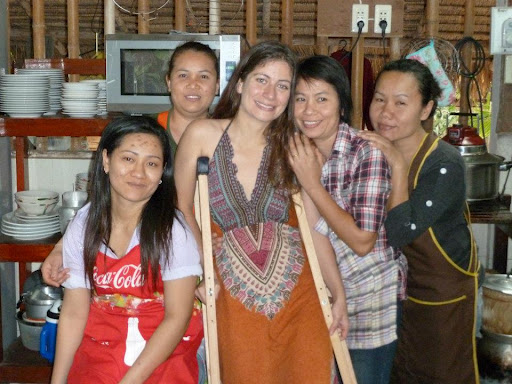
And then this morning the ladies who work in the Kitchen presented me with a T-shirt of Nong Khai. These wonderful women who work in the Kitchen Tia, Joy, Noy, Wii, Pook, kung, Man, Yong and Gaew do not make much money, they do not have spare money and yet they tipped in to get me a gift. The t-shirt was covered in messages in a foreign language to them so that I could understand. The amount of thought that went into this moved me beyond belief. While I was left in my room reading the shirt I sobbed. On the top it read “Memories are a treasure of the mind”. As I read this message I knew that that had been written by the always smiling Yong (who had once offered to rescue me from the rapist). I have never seen Yong not dressed in white, I had never seen her without a smile and not spreading joy around. Yong seems to be quite spiritual and very connected to Buddhism. Yong’s message was the most philosophical the others were pure emotion.

Then I got from Pook a handmade bag. A bag made of Mut Mee (which is a type of fabric). These bags are meticulously made selling one would be the equivalent of approximately one quarter of Pook’s monthly salary. She gave me one as a gift. A bag made by someone who worked with me at Mut Mee made of Mut Mee!!! More tears.

Wii as I was about to go showed up with a bag full of Guava which she knew was my favourite fruit.

My very dear friend Michal hearing about my accident hoped on a bus for 18 hours to come and meet me. I love Michal for her eternal willingness to question her own knowledge and assumptions. i love her for being the kind of person who pays attentions to the details. We had met in India in Mc Leod, we drove together in that bus that had an accident where a man died. We have had a million Palestinian Israeli talks. We travelled together after that accident until I left ( against her advice) India. She has taught me more Hebrew and about Israeli music then all of all my other friends together. We have laughed about every surreal situation to the point of exhaustion. Now on hearing about my accident she hoped on several buses for several hours to be able to see me… To be able to help me pack, shower, laugh and of course find whose fault it was that I broke my foot 🙂 I still think it is hers since if she had been more persuading I would just never have left India 🙂

As I was about to go I suddenly lost it. i started to sob uncontrollably. San, toothless homeless, also showed up to say goodbye. Julian filmed the whole parade. A handicapped hoping about being followed by all this loving people. i hugged and hugged and kissed people. As we made our way out and I saw all of my friends there, I saw Tia ( who is always so reserved) waiting in front of the Pavilion for me. Behind her was the Mekong. Next to me Nick carried my bags. As I enter the van I see my last last glimpse of the sunsets I have gotten used to admire everyday. It somehow seems so insignificant that my eyes go back to all these people who are there.

People who have not travelled for a while don’t imagine how profound can be the links you developed on the road. As I stood there I felt enormous love and gratitude. I felt part of it. Part of that little village where even the ex homeless guy bakes me a gift and shows up to say goodbye.

That place is mine not because I was born there, not because I married someone who had to be there. that place was mine because it is where people know me for what I am. They know me with all of my tears, insecurities, flaws. That place became mine because I connected to the people.

Nick takes me to the airport and flies with me to Bangkok. I don’t know how I would have done without him. Once I reach Qatar Airways, he waits for me to be checked in and for a wheel chair to take me to yet another flight. He hugs me and when I thank him he tells me to not be silly he would not have offered to come if he did not mean it. ” It was a nice road trip! if I had not come many other people would have. Tomorrow I ll be back to Mut Mee.”

In my last email I wrote I was certain I would meet other strangers who would help. I was right. As I am introduced to Udom, the man who is in charge of driving my Wheel chair he smiles and says:

” Do not worry Madam I will take care of you until you are inside of the airplane.”

I put my hands in a sincere “way” and say a fragile, exhausted ” Kopum ka” (Thank you).

He does as promised, he cruises the messiness and rush hour of the airport making sure nothing and no one inadvertently hits my foot. He wonders if I need to go to the bathroom, or drink, or have a coffee. And when he finally puts me on the plane he wishes me a good trip, a speedy recovery and a fast return to Thailand.

I have by now managed to get myself together. And I put my hands confidently in front of my chess and in that Kopum ka I thank the whole of Thailand. I thank every person I have met in Asia.

I have been living my life in the illusion of being open. I used to feel covered but always open to letting people go in. Yet I was always afraid of being hurt. Always afraid of being abandoned. So when they would penetrate me within I would freak out.

Leaving a PhD, a marriage, a life and crossing borders aimlessly crushed me so many times in so many ways. Weirdly enough when all broke down I found out that it is just better to be fragile all the time. In Portuguese we say ” a flor da pele” which literally means in the flower of skin. But I visualise it as being in a sense without skin, being raw without protections. It is a softer way of being. It is a scary way of being. You undress yourself of all the clothes, all the fears, and vulnerabilities you have accumulated through life. And then you stand there naked with all of the wounds, and marks, and broken parts. Then you just are. It is just so good to just be.

As I put my hands in way and thank Udom he is for me the embodiment of all of this transformation that has started to take place on me.

Udom is for me Asia and I thank it.

Kopum KA 🙂