About Emotion and Criticism

We According to her, it did not matter how different the classes she chose for the semester were, at some point they always met at a point that united them all. I never knew if things were really all connected, or as Joao Carlos, an arts and communication professor, always said it was because of our repertoire that we are able to connect and appreciate things more or less. I later on married to a neuroscientist, and started to think of Joao Carlos’ repertoire as bases for neurological networks that connect the way they can according to the information we hold. There are days that my atheism and scepticism is strong and the neurological and evolutionary explanations are more than enough to explain those connections. Other days, however, I use these neuro-networks to connect Jung´s notion of synchronicity, with the mystic´s idea of connectivity, with the wanderings (that I have no way of judging) of quantum physicists. In the end, I still do not know the reason for those meeting points, but I could never deny that Joss was right, they always happen.

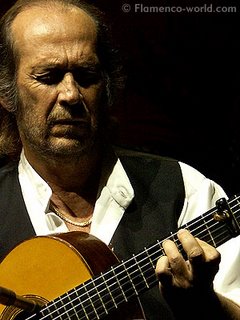
This point happened to me one of these days as I attended a concert by Paco de Lucia here in London. In fact, it happened afterwards, when I said goodbye to the friends I watched the concert with and carefully considered our conversation.

In the beginning of the concert, the guitar strings vacillated, teetered and some notes did not come out. I paid attention, a lot of attention to those faults. I paid attention in the emotion the man next to me felt to see his idol. I paid attention to the group of Spaniards who kept screaming ‘Maestro’ during the concert, to the people who filmed, those who took pictures, those who whistled… Enfin, I paid attention to everything but that moment. In the second part of the concert, I stopped looking around, and I finally felt the music. And as usual I was overcome by emotion.

On my way out, I ran into my friends. One, like me, had paid enormous attention to the mistakes. The other, a flamenco player himself and huge Paco de Lucia fan, did notice those notes as well, but to him it meant little. Paco had been great, his timing always perfect, his hand unexplainably fast. The emotion he had felt came from being in front of this man, who is the greatest flamenco guitarist alive.

And only when I came home I could finally understand that moment: the dichotomy between emotion and criticism. I realized that every time I let myself be taken by the emotion of being in front of someone or something I admire, I insist on minimizing my critical sense. I guess out of fear perhaps of finding a fault and not being able to admire it any longer. On the other hand, when I let my criticism go unchecked, I inevitably miss the moment. The problem I realize does not lie in criticism itself, or in the emotion, but in the idea that something must be perfect as a whole all the time. My friend was right, who cares if some notes did not come out? Paco is fenomenal!

Thé à la Menthe


One of my earliest childhood memories is one of a feeding bottle with chamomile tea they used to give me as a child. I still remember how I hated that tepid sweet thing. After thinking about it a lot I realized it could only have been given to me by Cre, my nanny. My mother would have never agreed to give sugar to kids, and my grandmother would have never called an infusion tea. In any case, in my childhood years I became traumatized by camomile tea, and hot sweet drinks.

I rarely drank infusions in Brasil, in NY occasionally, in Amsterdam frequently, and in London I drink infusions all the time. This change occurred mainly because of Olga, my Russian neighbour in Amsterdam, who often invited me to have a cup in her apartment. I liked her brilliant and pessimistic sarcasm far more than the tea itself, but by the end of the year I was hooked.

So when I was told that in Morocco, life circled around a mint tea pot pouring tea from high above I got very excited. Mint infusions were always one of my favourites, so I could not have been more delighted. However, this joy came to an end quite soon; more precisely at the time of my first sip. The famous ‘ thé a la menthe’ tasted nothing like the infusions I was used to. In fact, it did not even taste like the beverage Leila used to prepare when we lived in NY. It is true that she was often unsatisfied. She always complained it didn’t taste like the Moroccan one, but at the time I took that to be a bad thing. So when I finally got to Morocco I was not prepared for my first sip. As I drank I kept imagining the person who prepared it pouring more and more spoons of sugar into it. I was mistaken, however, as would become clear later on. In any case, after this first tea I never drank it again; that is, until our trip to the Sahara.

On our trip, as I have mentioned in earlier topics, I became friends with the driver Abdul. Being the only one fluent in French I had the unfortunate responsibility of all request and questions, but the privilege of all explanations. It is true that many of them seemed to me like mythical views of reality, like when he explained to me that women dressed in black because it was cooler. I thought this was impossible, but did not say anything. In other cases, I simply could not judge it. For instance, I had always imagined that the habit of drinking tea must have come from drinking boiled (=safer) water and from being hard to cool down a drink in the desert. Abdul told me however, that that was wrong, the real reason was that hot tea made people less thirsty. Eventually, after so many hours talking he asked me whether it would be fine to give his nephew a ride. We naturally agreed to this, and it was that ride that led me to my second tea in Morocco.

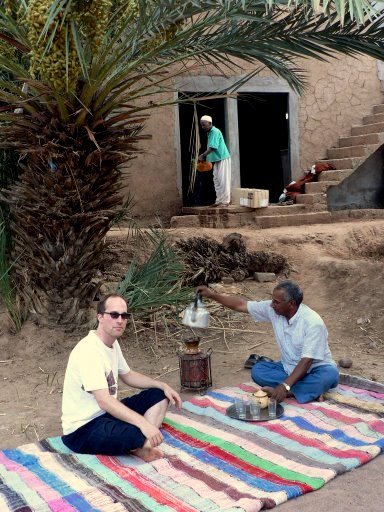
We stopped in the middle of the route, and parked the car on the side of the road. Abdul invited us to come out and follow him. We saw a quite simple house, and some very friendly people. We took some pictures, tried dates from the trees and eventually Abdul came to us and said ‘ you are quite lucky, they will serve you tea.’ With that much luck I couldn’t say that I didn’t want to drink it, and gathered the sweets we had brought with us to contribute somehow and joined them. A carpet was laid on the ground outside, and we sat down observing the ritualistic preparation. First came the boiled water and then some sort of powder (on the box it read ‘gunpowder’…). The water was poured in and out a couple of times before the tea was made. And then it came, a rock of approximately 16cm2 of sugar! We look at it in awe, Abdul crushed it down into the pot, which was about half its size, and poured some water in and served 4 glasses of tea. He still needed to make one more glass so he got some more sugar. And this way the mistery was solved, they weren’t spoons after all, they were sugar meteorites!